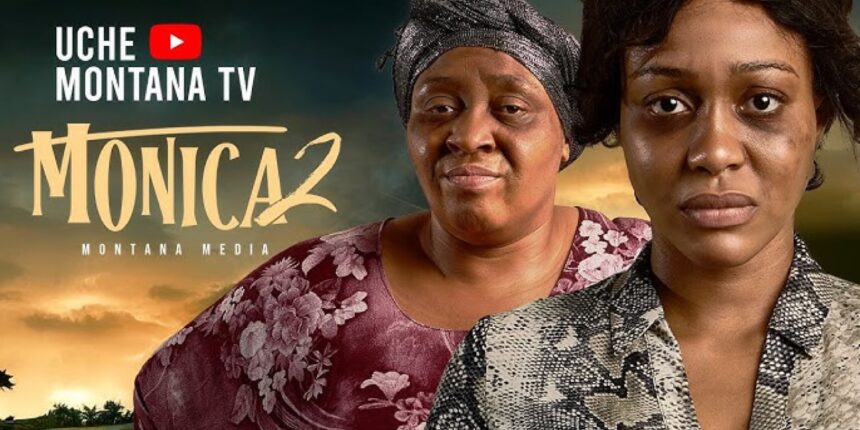
Uche Montana’s movie Monica 2 is not just trending, it is striking a nerve for its relatability.
Across social media, clips from the Nollywood drama have sparked strong reactions, with many Nigerians saying the story feels uncomfortably familiar. The core of the film is a reality many understand but rarely see clearly on screen: the pressure to carry family expectations, often at a personal cost.
In Monica 1 and 2, Uche Montana tells a story that goes beyond drama. It reflects a lived experience where success comes with responsibility, and saying “no” is not always an option.
That is what makes the film hit differently. For many viewers, it is not just entertainment. It is recognition.
What Is Monica 1 & 2 About?
Released on May 2, 2026, Monica 2 quickly moved from a sequel to a viral moment in Nollywood’s growing YouTube space.
The film follows the success of Monica, which pulled over 17 million views and built a loyal audience. The sequel wasted no time matching that momentum. It crossed over 6 million views within 24 hours and surpassed 10 million views in just 48 hours, making it one of the fastest-growing Nollywood releases on YouTube.
At its core, the story centres on Monica, the firstborn daughter who has spent most of her life holding her family together financially, emotionally, and physically.
For the first stretch of the film, Monica’s sacrifices almost look noble. She wakes up early to help her mother hawk pap before her siblings are even out of bed. She bathes and dresses them, takes them to school, goes to a tailoring shop to learn, picks her siblings from school, helps with assignments, and still finds a way to provide for everyone. At some point, she even pauses her own education so her younger siblings can go to school. And she does it all without complaint. No anger. No resistance. Just quietly enduring while smiling.
It almost feels admirable at first, watching the “perfect daughter” do what she is supposed to do.
But slowly, that image begins to crack, giving way to how a biological mother will treat her first born daughter simply because she was treated the same way.
Black Tax & The Reality Behind It
At the centre of the movie is what many people call “black tax”.
It is the expectation that once you start earning, you also become responsible for others including your parents, siblings and sometimes extended family. It often starts small, but over time, it becomes a constant obligation.
In Monica 2, that idea is not just explained, it is lived. Monica is not just helping. She is carrying everything. And the difficult part is that it is not framed as abuse at first. It is presented as duty. As responsibility. As what a “good daughter” should do.
But as the story unfolds, you begin to see the weight of it. The giving never stops. The expectations never reduce. And appreciation is basically non-existent.
Why It’s Hitting Too Close For Comfort
As the film progresses, the questions start to build. Why is the mother so harsh?
Why deny Monica a university education while her younger siblings get that chance?
Why stop her from marrying a man who genuinely wanted to support her?
Why allow that same man to later marry her younger sister and then accuse Monica of jealousy?
At some point, it stops feeling like sacrifice and starts feeling like exploitation. There are moments it almost feels like Monica is not even treated as a biological child. The level of harshness makes it seem like she is an outsider in her own home.
Even more frustrating is the role of the father. He sees what is happening. He knows it is wrong. He tries to speak but ultimately allows his wife’s decisions to stand, watching his daughter carry a burden that slowly breaks her.
And just when you think Monica might finally be free, the betrayal deepens. Her siblings who benefited the most from her sacrifices begin to treat her the same way their mother did. They run to her when they need help, knowing she will not say no, but show little respect once they get what they want.
That cycle is what makes the film hard to watch. Because it is familiar.
A Shift In How Nigerians See Family Responsibility
Part of the strong reaction to Monica 2 is that it reflects a shift already happening.
For a long time, family support came with no clear limits. You gave what you had, and you kept giving. Questioning that pattern was seen as disrespect. But that is starting to change.
More young Nigerians are beginning to talk about boundaries. About burnout. About the need to build a life that is not entirely defined by family demands. In that sense, Monica’s story feels like a mirror and a warning.
Because while many viewers wanted her to push back earlier, to choose herself, the film does not rush to give her that moment. And maybe that is the point. Not everyone gets to break free in time.
Why Monica 2 Is Trending
The film’s rise is not just about numbers. It is about reaction. Within hours of its release, scenes from Monica 2 began circulating across TikTok, X, and Instagram. Viewers began reacting, sharing, and arguing.
A lot of the conversation is driven by how real the story feels. Many watchers have described it as “hard to watch,” not because it is confusing, but because it mirrors situations they recognise too well.
The timing also plays a role. Conversations around financial pressure, family responsibility, and personal boundaries are already active among young Nigerians. Monica 2 stepped into that space and quickly became part of it.
Then there is the platform. By releasing directly on YouTube, Uche Montana reached a wide audience instantly. People could watch, react, and share in real time and that speed helped push the film into viral territory.
Conclusion
In the end, Monica 2 is not trending because it is dramatic. It is trending because it feels real and reflects a version of life many Nigerians know sometimes too well.
The pressure to provide.
The expectation to endure.
The guilt that comes with choosing yourself.
That is why it is uncomfortable.
And that is why people cannot look away.