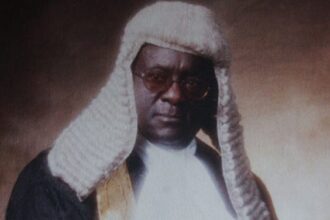
On this day, May 23 in 2013, 2013, Nigerian novelist, poet, professor and critic, Chinua Achebe was buried at his hometown, Ogidi in Idemili North Local Government Area after he died on March 21, 2013.
Findings revealed that Achebe’s childhood was influenced by both Igbo traditional culture and postcolonial Christianity. He excelled in school and attended what is now the University of Ibadan, where he became fiercely critical of how Western literature depicted Africa.
Moving to Lagos after graduation, he worked for the Nigerian Broadcasting Service (NBS) and garnered international attention for his 1958 novel Things Fall Apart.
In less than 10 years he would publish four further novels through the publisher Heinemann, with whom he began the Heinemann African Writers Series and galvanized the careers of African writers, such as Ngũgĩ wa Thiong’o and Flora Nwapa.
Achebe sought to escape the colonial perspective that framed African literature at the time, and drew from the traditions of the Igbo people, Christian influences, and the clash of Western and African values to create a uniquely African voice.
He wrote in and defended the use of English, describing it as a means to reach a broad audience, particularly readers of colonial nations.
In 1975 he gave a controversial lecture, “An Image of Africa: Racism in Conrad’s Heart of Darkness”, which was a landmark in postcolonial discourse.
Published in The Massachusetts Review, it featured criticism of Albert Schweitzer and Joseph Conrad, whom Achebe described as “a thoroughgoing racist.”
When the region of Biafra broke away from Nigeria in 1967, Achebe supported Biafran independence and acted as ambassador for the people of the movement. The subsequent Nigerian Civil War ravaged the populace, and he appealed to the people of Europe and the Americas for aid.
When the Nigerian government retook the region in 1970, he involved himself in political parties but soon became disillusioned by his frustration over the continuous corruption and elitism he witnessed.
He lived in the United States for several years in the 1970s, and returned to the US in 1990 after a car crash left him partially paralyzed. He stayed in the US in a nineteen-year tenure at Bard College as a professor of languages and literature.
Winning the 2007 Man Booker International Prize, from 2009 until his death he was Professor of African Studies at Brown University. Achebe’s work has been extensively analyzed and a vast body of scholarly work discussing it has arisen.
In addition to his seminal novels, Achebe’s oeuvre includes numerous short stories, poetry, essays and children’s books. His style relies heavily on the Igbo oral tradition, and combines straightforward narration with representations of folk stories, proverbs, and oratory.
Among the many themes his works cover are culture and colonialism, masculinity and femininity, politics, and history. His legacy is celebrated annually at the Chinua Achebe Literary Festival.