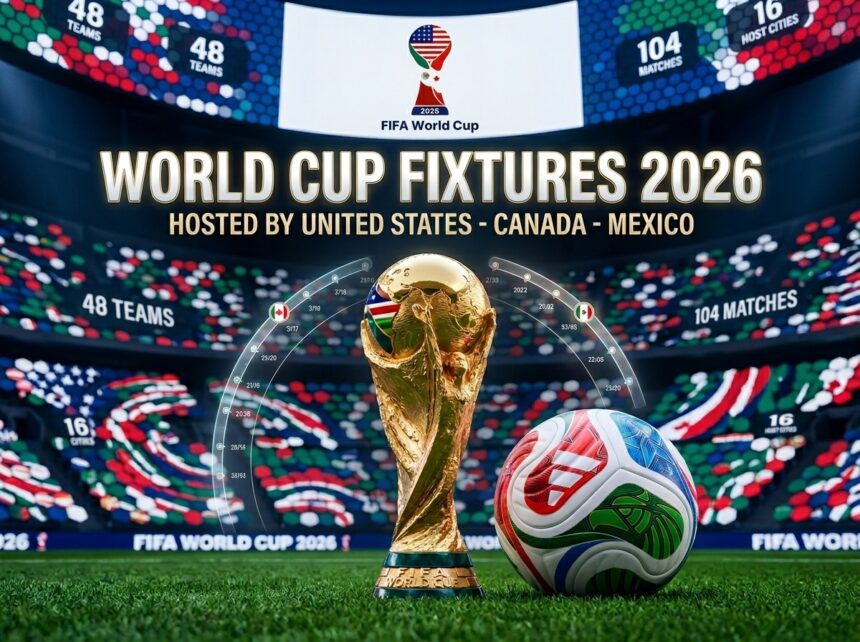
The wait is nearly over. World Cup fixtures 2026 are confirmed, kick-off times are locked in, and 48 nations are about to descend on North America for the biggest football tournament ever staged. From June 11 to July 19, the action runs almost non-stop, 104 matches across 16 cities, three countries, and a whole new format most fans haven’t fully wrapped their heads around yet.
If you’re trying to work out when your team plays, which group games matter most, or simply want to know when the final kicks off, this is the complete guide.
The Basics: When and Where
The 2026 FIFA World Cup runs from Thursday 11 June to Sunday 19 July 2026. That’s 39 days of football across the United States, Canada, and Mexico, the first time three countries have ever co-hosted the men’s tournament.
The majority of games, 78 out of 104, take place in the US across 11 host cities: Atlanta, Boston, Dallas, Houston, Kansas City, Los Angeles, Miami, New York/New Jersey, Philadelphia, Seattle, and the San Francisco Bay Area. Mexico hosts 13 matches across Mexico City, Guadalajara, and Monterrey. Canada gets 13 fixtures split between Toronto and Vancouver.
The opening match: Mexico vs South Africa at Mexico City Stadium, Thursday 11 June.
The final: MetLife Stadium, New York/New Jersey, Sunday 19 July.
The New Format, Explained
This tournament looks different from anything that came before it. Instead of 32 teams in eight groups of four, there are now 12 groups of four, Groups A through L. Every team plays three group-stage games. The top two from each group advance automatically. That gives you 24 teams. Eight more come from the best third-placed finishers, bringing the total to 32.
Those 32 go into the Round of 32, which starts on 28 June, a stage that didn’t exist at any previous World Cup. After that, it’s the familiar knockout format: Round of 16, quarter-finals, semi-finals, third-place play-off, and the final.
One other structural change worth knowing: FIFA has deliberately kept the top-seeded teams on opposite sides of the draw. Spain (ranked No.1 in the tournament seedings) and Argentina (No.2, and defending champions) cannot meet before the final if both win their groups. Same goes for France and England. Whether or not that produces the final everyone wants is another matter, but it’s a deliberate decision worth understanding before you start tracking the bracket.
Group Stage: Key Fixtures and Dates
The group stage runs from 11 June through 27 June. Below are the match-ups generating the most attention.
Group A — Mexico, South Africa, Czechia, Korea Republic
Mexico open the whole tournament against South Africa on June 11 at home. The final group round includes Czechia vs Mexico and South Africa vs Korea Republic.
Group B — Switzerland, Canada, Bosnia and Herzegovina, Qatar
Canada, as hosts, play all three group games on home soil — opening against Bosnia and Herzegovina on 12 June at BMO Field in Toronto before moving to Vancouver.
Group C — Brazil, Morocco, and others
Brazil’s opening fixture on 13 June is against Morocco at MetLife Stadium in New Jersey at 6pm ET, one of the tournament’s most anticipated first-round matchups.
Group D — USA, Paraguay, Australia, Türkiye
The hosts open on 12 June at SoFi Stadium in Inglewood, California against Paraguay. It’s the Americans’ first home World Cup match in 32 years.
Group H — Spain, Cape Verde, Saudi Arabia, Uruguay
European champions Spain play their first two fixtures in Atlanta before heading to Guadalajara to face Uruguay, a game that looks like the group decider on paper.
Group I — France, Senegal, Norway, and others
France play all three group games in the northeast US. Their opener against Senegal at MetLife Stadium on 16 June at 6pm ET is one of the most-watched matches of the group stage worldwide.
Group J — Argentina, Algeria, Austria, Jordan
Holders Argentina begin their title defence on 16 June against Algeria in Kansas City. Algeria are the only African side to have beaten Argentina at a World Cup, in 1982, so the storyline practically writes itself.
Group K — Colombia, Portugal, and others
A Colombia vs Portugal group stage fixture is the kind of thing that would have been a knockout game in previous tournaments. Under the new format, it’s a group game.
Group L — England, Croatia, Ghana, Panama
England, managed by Thomas Tuchel, open against Croatia, a rematch of the 2018 semi-final, at AT&T Stadium in Arlington on 18 June at 3pm local time. The roof stays closed. June in Dallas without shade is not the place to be. England then face Ghana in Boston on 23 June before finishing the group against Panama at MetLife Stadium on 27 June.
Knockout Stage: Dates at a Glance
Once the group stage wraps on 27 June, the bracket takes over.
| Round | Dates |
|---|---|
| Round of 32 | 28 June – 3 July |
| Round of 16 | 4 July – 7 July |
| Quarter-finals | 9 July – 10 July |
| Semi-finals | 14–15 July |
| Third-place play-off | 19 July |
| Final | 19 July |
The semi-finals are scheduled for Dallas and Atlanta. The third-place match and the final are both on 19 July, the third-place game in the afternoon, the final in the evening at MetLife.
Teams that win their group could play up to eight matches to lift the trophy. Under the old 32-team format, it was seven. One more game to win it all, that’s the trade-off for a bigger field.
Nations Playing at the World Cup for the First Time
One of the most interesting threads running through the 2026 draw is the number of genuine first-timers. Uzbekistan and Jordan will both appear at a World Cup for the first time. Cape Verde and Curaçao are also making their debuts. Curaçao, a Caribbean island nation with a population of around 150,000, will become the smallest country by population ever to compete at the tournament.
Iraq returns to the World Cup for the first time since 1986. That’s a 40-year gap.
Teams to Watch and Tournament Favourites
Spain go in as European champions and tournament top seeds. Their squad, built around a core of young, technically excellent players who dominated Euro 2024, is widely considered the most complete in the field right now.
Argentina, as defending champions, carry the weight of expectation. Lionel Messi has been named in the initial squad, though there are ongoing questions about his fitness after an injury scare earlier in 2026. If he plays, he plays. If he doesn’t, it changes everything.
Brazil haven’t won the World Cup since 2002, but this squad has depth, and their fixture schedule is kind of early on. France, Germany, Portugal, England, and the Netherlands all carry genuine knockout-round quality.
The dark horses worth following: Morocco, who reached the semi-finals in Qatar and now have a full tournament cycle of experience behind them. Colombia, who qualified with considerable ease and have a dangerous attacking lineup. And the US, playing at home with a squad that has more top-flight European experience than any previous American generation.
How to Watch the World Cup 2026
In the United States, all 104 games are on Fox (70 matches) and FS1 (34 matches), with every game available in 4K through the Fox One app.
In the UK, coverage spans the BBC and ITV. Sky Sports also has a full schedule breakdown with kick-off times listed in British Summer Time (BST).
For fans in other territories, check your local broadcaster, FIFA has sold rights across most major markets globally.
Final Thoughts
The 2026 World Cup is built differently from any tournament that came before it. The scale is larger, the schedule is longer, and the new Round of 32 means there’s less margin for error from day one. A team that loses their opening group game isn’t necessarily out, but they can’t afford much of a stumble from there.
For fans planning to follow the tournament closely, whether from the stands or from home, the key dates are 11 June (opening day), 27 June (last group stage games), 28 June (knockouts begin), and 19 July (the final). Everything in between is football, and there’s a lot of it.
104 games. 48 nations. 39 days. Enjoy it.