The political atmosphere around Abuja on 26 May, 2026 carried an unusual tension that quickly spilled into public discussion as reports linked to a heated confrontation involving veteran Nollywood actor turned political aspirant Emeka Ike began circulating across social platforms. What started as routine post primary election conversations within party structures soon shifted into a situation that drew attention toward electoral processes, party conduct, and the role of institutions responsible for oversight. The setting was already sensitive due to ongoing internal party adjustments ahead of the 2027 election cycle, which made every development around candidate selection highly scrutinized by observers following political realignments in the Federal Capital Territory.
The sequence of events that followed did not unfold in isolation, as it was tied directly to the aftermath of a House of Representatives primary election conducted under the Nigeria Democratic Congress, a political structure that had been managing internal contests across different constituencies. The Abuja Municipal Area Council AMAC and Bwari political corridor became the focal point of this specific dispute, as aspirants awaited final clarity on who would emerge as the party flag bearer for the legislative seat. Within this atmosphere of expectation, disagreement over procedure and outcome gradually escalated into a confrontation that later moved beyond party walls.
Primary election tension inside party structure
The primary election conducted around 25 May 2026 was designed to produce a consensus candidate for the House of Representatives seat covering the Abuja Municipal Area Council AMAC and surrounding districts. Delegates were reportedly assembled under party supervision, with accreditation processes taking place before voting commenced. Observers of the exercise noted that internal competition had already been intense, as multiple aspirants had spent weeks engaging party stakeholders, mobilizing support, and attempting to secure delegate confidence.
According to accounts circulating from participants within the process, concerns began to surface during accreditation stages when questions were raised about voter lists, eligibility documentation, and the inclusion of certain delegates. It was at this early point that disagreements reportedly started forming between different camps, although voting still proceeded under supervision of party officials. The Nigeria Democratic Congress maintained administrative responsibility for conducting the exercise, while the Independent National Electoral Commission Independent National Electoral Commission was present in a monitoring capacity as required by electoral guidelines for political party primaries.
As the voting concluded later that same day, preliminary results were announced internally, declaring a winner who was expected to represent the party in the general election. It was at this stage that objections intensified from one of the leading aspirants, as concerns over fairness, transparency, and procedural compliance were raised. The objections did not remain confined to internal party dialogue, as they soon expanded into public expressions of dissatisfaction.
Rising disagreement after declaration of results
By 26 May 2026, the aftermath of the primary had already created visible divisions among stakeholders involved in the contest. The declaration of results became the central point of contention, with allegations focusing on how delegates were verified and how votes were counted. It was during this period that Emeka Ike reportedly challenged the outcome, insisting that certain procedural elements did not align with what transpired during voting.
Supporters accompanying him during this period were also seen engaging in heated exchanges around documentation and accreditation records, particularly questioning how voter eligibility was established. Attention quickly shifted toward administrative records, including Continuous Voter Registration CVR documentation that was referenced during discussions at later points of the confrontation. These records became a point of focus as parties attempted to reconcile discrepancies between expectations and announced outcomes.
The situation escalated beyond verbal exchanges within party structures, as the dispute moved toward regulatory oversight channels. This transition marked a significant turning point, as the matter began involving electoral authorities beyond the party environment where the primary had taken place.
Movement toward electoral commission office
Later on 26 May 2026, the dispute reportedly extended to the premises of the Independent National Electoral Commission office in Abuja, where aggrieved aspirants and supporters sought clarification regarding the conduct of the primary election. The visit was framed around demands for explanation concerning accreditation records, delegate lists, and the transparency of the electoral process used by the Nigeria Democratic Congress.
At the INEC facility, discussions reportedly centered on procedural documentation and the extent to which electoral guidelines were followed during the primary. Officials present were engaged in attempts to clarify the boundaries of INEC oversight in internal party elections, explaining the distinction between monitoring roles and direct administration of party primaries. This exchange formed part of the broader tension as participants sought answers regarding the legitimacy of the process that produced the declared candidate.
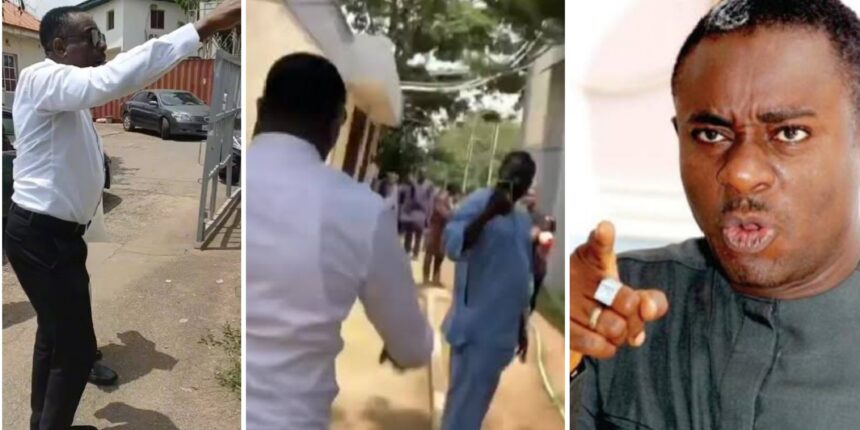
Footage circulating online showed moments of intense dialogue, with emphasis placed on how records were maintained and how decisions were validated. The environment was described as emotionally charged, driven by disagreement over interpretation of electoral procedures. Despite the tension, the engagement remained within the framework of administrative discussion, focusing on documents and process explanations rather than physical confrontation.
What the circulating videos captured
Videos that emerged shortly after the INEC office engagement became central to public interpretation of the incident. These clips showed Emeka Ike speaking in a firm and emotional tone while addressing concerns related to the primary election. Supporters were seen gathered around, while officials attempted to provide explanations regarding voter registration processes and accreditation frameworks.
The footage also captured repeated references to electoral documentation, with emphasis placed on verifying how delegate lists were compiled and how accreditation was confirmed before voting. Officials were observed responding with procedural clarifications, explaining how monitoring functions operate within political party primaries and where institutional authority begins and ends.
What was not clearly established in the footage was any definitive visual proof of manipulation or confirmed irregularity. Instead, the videos primarily documented disagreement, explanation, and attempts at clarification between parties involved. This distinction became important in shaping how the incident was later interpreted, as the recorded material showed interaction rather than resolution.
Institutional position during the dispute
As of now, there is no formal statement from the Independent National Electoral Commission addressing the specific allegations raised during the confrontation at its Abuja office. The absence of an official detailed response meant that much of the narrative continued to circulate through social media posts, online commentary, and secondary reporting from digital platforms.
INEC’s general role in such situations typically involves monitoring party primaries rather than directly managing internal party disputes. This structural limitation became relevant during the discussions at the Abuja office, where officials reiterated the scope of their oversight responsibilities. The distinction between monitoring compliance and adjudicating disputes within party structures formed a key part of the explanation provided during the engagement.
The Nigeria Democratic Congress also maintained internal communication channels regarding the matter, although no unified public resolution had been widely reported at the time of circulation. This created a situation where multiple versions of the event continued to exist simultaneously across different platforms.
Possible legal pathway after dispute
By 27 May 2026, reports began to emerge suggesting that some aggrieved aspirants within the party structure were considering legal options to challenge the outcome of the primary election. These reports indicated that internal resolution mechanisms were still being explored, but the possibility of court action remained open if consensus could not be reached.
No major court ruling or officially confirmed legal filing had been established as the dominant resolution at that point. Instead, the matter remained within a preparatory stage where stakeholders were weighing procedural and legal pathways. The absence of formal litigation meant that the dispute continued to exist primarily within administrative and political discussion spaces rather than judicial determination.
This stage added another layer to the unfolding situation, as attention shifted from immediate confrontation to potential institutional review processes that could extend the timeline of resolution significantly.
Public reaction shaped by visibility of a public figure
The involvement of Emeka Ike added a distinct dimension to the incident, as his long standing presence in the Nigerian entertainment industry meant that his political engagement attracted widespread attention. The visibility of his participation in the primary election dispute amplified public interest, particularly because it combined entertainment industry recognition with active political contestation.
The circulation of footage showing him addressing electoral officials contributed to broader conversations around internal party democracy, transparency in candidate selection, and the credibility of primary election systems. These discussions extended beyond the immediate dispute, becoming part of wider public discourse on how political parties manage internal competition.
The situation also highlighted the increasing intersection between public figures and political participation, where personal reputation and political engagement converge in highly visible environments. This intersection intensified attention on the Abuja incident, making it a focal point of online debate.
Broader implications within political environment
The events surrounding the Abuja confrontation reflected ongoing sensitivity within party structures regarding candidate selection processes ahead of the 2027 election cycle. The House of Representatives contest in the AMAC Bwari corridor represented one of several competitive internal races where aspirants sought party endorsement under closely watched conditions.
Within this environment, procedural clarity, delegate verification, and transparency mechanisms remain central to maintaining internal confidence among participants. The dispute that emerged around the Nigeria Democratic Congress primary highlighted how disagreements over these elements can quickly escalate when expectations diverge from declared outcomes.
While the specific allegations raised during the confrontation remain unverified publicly, the incident itself demonstrated the importance of documentation, communication, and structured dispute resolution within party systems. The visibility of the disagreement ensured that it became part of wider political conversation across media and public platforms.
Closing sequence of unfolding events
In days leading to June 2026 , the situation had settled into a state of ongoing discussion without definitive resolution publicly announced. The primary election outcome remained contested within certain circles, while electoral authorities maintained their procedural stance regarding oversight boundaries. The presence of competing narratives ensured that the incident continued to circulate widely, fueled by video evidence of confrontation and discussion rather than conclusive adjudication.
What remains clear from available accounts is that the confrontation at the INEC office became a defining moment in the aftermath of the Nigeria Democratic Congress primary election in Abuja. It placed the conduct of internal party elections under renewed attention and highlighted the intensity that often surrounds candidate selection processes in competitive political environments.
The story continues to develop as stakeholders explore internal and external resolution pathways, while public attention remains fixed on how the dispute will ultimately be addressed within both party and institutional frameworks.