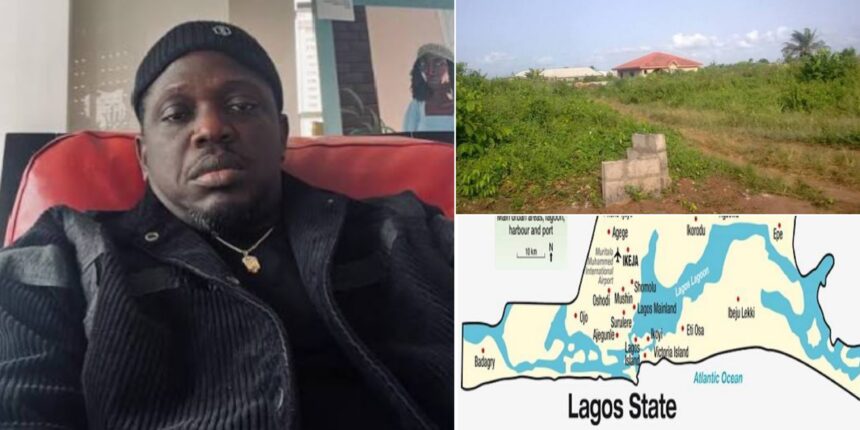
Lagos is a city where conversations about land, identity, migration, and money rarely stay quiet for long, especially when they intersect with celebrity influence and social media interpretation. A single online exchange can quickly move from entertainment spaces into heated public debate, drawing in history, law, emotion, and long standing urban narratives that many people already carry in their minds. That is exactly the environment in which the recent Illbliss controversy emerged, where a discussion about contribution and presence in Lagos real estate was interpreted in sharply different ways depending on who was reading it and from which perspective.
At the center of the unfolding reaction is a question that refuses to settle easily, not because the facts are unclear, but because the subject itself sits at the intersection of ownership perception, economic visibility, and historical memory. When conversations about land ownership in Lagos begin, they rarely remain technical for long, as they quickly expand into identity discussions that touch millions of people who live, work, invest, and build their lives in the city. The Illbliss remarks added another layer to an already sensitive topic, pulling attention back to who owns what, who controls value, and how contributions across different communities are understood in a rapidly expanding megacity.
What follows is a structured breakdown of the controversy, the statements that triggered reactions, and the deeper factual framework that defines land ownership in Lagos beyond emotion or online interpretation.
Illbliss Backlash Overview
What triggered the reaction
Illbliss recently sparked widespread online debate after defending Igbo contributions to Lagos economy and real estate development. During an exchange on X, screenshots circulating online showed the rapper making comments that many interpreted as suggesting that Igbos own Lagos lands and lease properties back within the city. The interpretation of those comments immediately spread across social media platforms, generating backlash and renewed ethnic tension discussions in online spaces.

The reaction was intensified by the tone and framing of responses attributed to him, especially as users began quoting and resharing parts of the conversation out of context or without the full exchange. Reports also indicate that he later issued an apology following the backlash, although the damage in public interpretation had already expanded beyond the original discussion.
The original statement that sparked attention
The controversy began after Illbliss responded to discussions about Lagos economic development, particularly focusing on commerce and real estate participation across ethnic groups. His statement read:
“The Igbos have contributed immensely to the Lagos economy! Commerce wise! If you have a problem with it, hug a frigging transformer!!! We have made massive investments in real estate too!! Other tribes have contributed too. Why is it always a problem when it’s the Igbos? Why?”
This message was received in mixed ways. Some readers interpreted it as a defense of economic inclusion and contribution, while others focused on the phrasing and context, believing it implied ownership dominance over Lagos property markets. The divide in interpretation became the foundation of the backlash.
The viral escalation
The situation escalated further when another message, reportedly deleted, circulated online and was attributed to Illbliss. That message read:
“We own your lands fool. We bought everywhere and renting it back to you. Thank you Lagos for the opportunity. You will pay rent forever in this city, bloody scavenger.”
This version intensified public reaction significantly, especially among users who viewed it as an ethnic provocation. Yoruba commentators and others expressed concern about the implications of such framing, while others questioned whether the quote was authentic or taken out of context.
The combination of verified statement, alleged deleted content, and social media resharing created a layered controversy that quickly moved beyond music and celebrity commentary into broader societal debate.
Prior context around tribalism discussion
The controversy also resurfaced an earlier conversation where Illbliss spoke against tribalism during an appearance on the Outside The Box podcast. In that discussion, he emphasized that Igbos have contributed significantly to Lagos through trade and commerce, while also questioning narratives that encourage exclusion of non indigenes from states where they live and work.
This earlier position added complexity to the reaction, as observers tried to reconcile his anti tribalism message with the interpretation of his recent online statements.
The Bigger Question Behind the Debate
Who really owns land in Lagos
The question of land ownership in Lagos cannot be answered through ethnicity alone, nor through online interpretations of economic participation. It requires understanding three distinct layers, which are historical context, legal structure, and economic participation. Each layer provides a different perspective that helps explain why the debate remains emotionally charged even when legal clarity exists.
Historical Layer of Lagos Land
Indigenous foundation of the city
Long before modern Nigeria existed, the area now known as Lagos was inhabited primarily by Awori Yoruba communities alongside other related groups. Historical records and oral traditions consistently reference early settlements and landholding structures that were deeply rooted in indigenous governance systems.
Prominent traditional families associated with landholding in the early formation of Lagos include Aromire, Oniru, Oloto, Ojora, and Onikoyi. These families were part of the early socio political structure that defined land access, inheritance, and community organization within the region.
From this historical perspective, Lagos is widely recognized as an indigenous Yoruba homeland, shaped over centuries before colonial administration and modern governance structures were introduced.
Legal Layer of Land Ownership
Land Use Act framework
Under the Land Use Act of 1978, all land within each Nigerian state is vested in the state governor, who holds it in trust for the people. This legal framework fundamentally changed the structure of land ownership across the country, including Lagos.
Individuals and institutions do not own land in absolute terms under customary or ethnic control. Instead, ownership is established through legally recognized instruments such as Certificates of Occupancy, Rights of Occupancy, and Deeds of Assignment.
This means land ownership in Lagos is defined by documentation and legal title rather than ethnicity or ancestral identity.
What this means in practical terms
There is no legal category that recognizes land ownership by ethnic groups within Lagos State. Statements such as Igbo land in Lagos or Yoruba ownership of all Lagos land do not exist within the legal framework of Nigerian property law.
Instead, ownership is individual, corporate, or institutional, and it is regulated by state authority under federal law.
Economic Layer of Lagos Property
Lagos as a commercial magnet
Lagos functions as Nigeria’s commercial center, attracting migration, investment, and business activity from across the country and beyond. As a result, property ownership is widely distributed among different ethnic groups and foreign investors.
Groups including Igbo, Yoruba, Hausa, Edo, Urhobo, Itsekiri, and international investors all participate in property ownership across residential, commercial, and industrial sectors.
This economic reality reflects Lagos as a convergence point rather than an exclusive territory controlled by one group.
Contribution patterns across groups
Igbo entrepreneurs are widely recognized for strong participation in trade, retail distribution, import networks, and real estate investment within Lagos. Yoruba entrepreneurs also maintain significant presence across real estate development, construction, and institutional property ownership.
These overlapping contributions reflect economic participation rather than territorial ownership.
Do Igbos Own Most of Lagos?
Evidence based assessment
There is no verified census, registry, or statistical data that supports the claim that any single ethnic group owns the majority of land in Lagos. Property ownership records are not structured around ethnicity, making such measurement difficult and often misleading.
Similarly, no evidence suggests that Yoruba individuals collectively own all land in Lagos either. The distribution of property is fragmented, private, and market driven.
The idea of majority ownership by one group is therefore not supported by available factual data.
Why the Debate Becomes Sensitive
Emotional and historical layers
The sensitivity around Lagos land discussions often stems from deeper issues such as migration history, economic competition, and political narratives. Lagos is one of the most diverse cities in Africa, hosting millions of residents from different parts of Nigeria.
Because of this diversity, statements that appear to assign ownership or dominance to one group over others often trigger strong reactions, regardless of intent.
Role of public interpretation
In digital spaces, short statements are often removed from context, reshared, and reinterpreted through existing social biases. This dynamic contributed significantly to how the Illbliss comments were received and debated across platforms.
What Experts Generally Agree On
Historical agreement
Lagos is historically rooted in Yoruba indigenous settlements and cultural structures.
Legal agreement
Land ownership is determined by formal title and statutory recognition under Nigerian law.
Economic agreement
Multiple ethnic groups actively participate in property ownership and development within Lagos.
Factual conclusion
No ethnic group holds exclusive ownership of Lagos State land as a whole.
Bottom Line
The controversy surrounding Illbliss reflects how quickly conversations about identity and economics can escalate in a diverse city like Lagos. While his comments were interpreted in different ways, the broader factual framework remains consistent across historical, legal, and economic perspectives.
The claim that Igbos or any other group exclusively owns Lagos land is not supported by legal records or verifiable data. Lagos remains a complex, multi layered city where land ownership is defined by law and documentation, while economic participation is shared across many communities that contribute to its continuous growth.