Most drivers in Nigeria do not lose their licence all at once. It happens bit by bit: a checkpoint here, a fine there, a few ignored penalty points that quietly stack up on a record they never knew was being kept. Then one day, the FRSC tells them their right to drive has been suspended, and they are genuinely stunned, not because the law did something unexpected, but because they never took it seriously enough to know what it said.
Nigeria recorded 10,446 road crashes in 2025, up 9.2 percent from the previous year, with 5,289 people killed. Those numbers came from the Federal Road Safety Corps itself, disclosed by Corps Marshal Shehu Mohammed at a press conference in February 2026. The agency has made no secret of what is driving that figure: dangerous driver behaviour, speeding, drunk driving, phone use behind the wheel, and an attitude toward traffic law that treats fines as a minor inconvenience rather than a signal that something more serious is coming.
What changed in 2025 is that the FRSC activated its Penalty Point System in earnest, meaning violations now do more than generate fines. They accumulate against a driver’s licence in a way that can lead directly to suspension or full withdrawal. Understanding which offences carry that risk is no longer optional for anyone who drives on Nigerian roads.
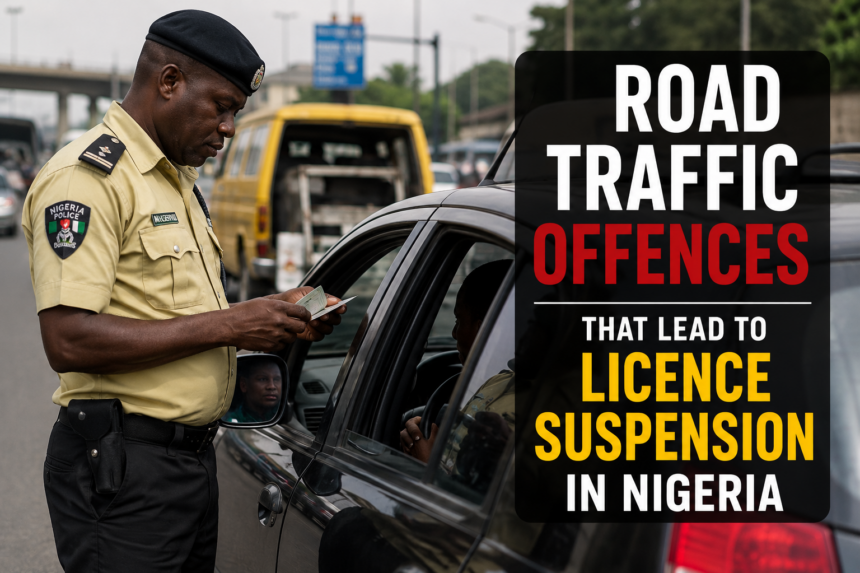
Road Traffic Offences That Lead to Licence Suspension in Nigeria

The road traffic offences that lead to licence suspension in Nigeria are not always the dramatic ones. Some are as routine as driving with an expired licence or being stopped with a phone in your hand. What matters under the current system is not just the severity of a single offence but how quickly the points from multiple violations push a driver past the threshold that triggers action on their licence.
How the Penalty Point System Works and Why It Now Has Teeth
The legal foundation was always there. Section 10(4) of the FRSC (Establishment) Act, 2007, read alongside Regulation 220 of the National Road Traffic Regulations (NRTR), 2012, gave the Corps the authority to assign penalty points to drivers on top of fines. For years, the provision existed largely on paper. In 2025, Corps Marshal Shehu Mohammed directed its activation as a live enforcement tool.
Under the system, every traffic offence now carries two consequences: a monetary fine and a point value recorded against the driver’s licence. Those points accumulate. A driver who hits 10 to 14 points receives a formal warning, a notification that their conduct on the road has been flagged and that they need to correct it. Between 15 and 20 points, the licence is suspended. At 21 points, it is withdrawn entirely, meaning the driver no longer has a legal right to operate a vehicle on Nigerian roads.
The Nigeria Highway Code, which draws on Section 10(5)(c) of the FRSC Act, adds another layer to this. It specifies that 21 cumulative points lead to an endorsement of the licence. After five such endorsements, the licence stands suspended. Confiscation can last between three and six months, while revocation can be permanent. These are not theoretical outcomes. With the penalty point system now active, every fine-paying encounter with an FRSC officer leaves a record.
What makes this system particularly consequential is how quickly points can accumulate in a single encounter. A driver stopped for driving without a valid licence already faces 10 points in one interaction. Add a phone violation and a speed limit breach on the same trip, and that driver is past the warning threshold before they even know the system exists. The FRSC’s own example illustrates the point: running a red light, exceeding the speed limit, and using a phone in one trip can put a driver past 11 points immediately.
Dangerous Driving: The Offence That Can End Your Licence in One Stop
Dangerous driving carries the highest point value of the common offences that most motorists are likely to face. The fine is 50,000 naira and the penalty is 10 points, assigned in a single stop. Repeat instances of dangerous driving are specifically flagged by the FRSC as grounds for licence suspension and prosecution, meaning the fine is not the ceiling of what can happen.
Under the NRTR, dangerous driving covers a broad range of conduct. Improper overtaking, which is one of the most common causes of head-on collisions on Nigerian highways, falls squarely within it. So does sudden lane changes without signalling, driving in a manner likely to endanger other road users, and what the regulations refer to as reckless driving. The distinction between dangerous and reckless is not always clear in practice, but FRSC officers have wide discretion in applying the charge.
What gets overlooked is that dangerous driving does not require an accident to have occurred. A driver who overtakes on a bend, jumps a median, or forces another vehicle off the road can be booked for dangerous driving regardless of whether anything was damaged or anyone was hurt. The offence is about the conduct, not just the outcome. That is a meaningful legal distinction, because it means prosecution does not wait for a body count.
Speeding, which the FRSC identified as the single greatest cause of crashes on Nigerian roads in December 2025 at 41 percent of incidents, is treated as a separate offence but frequently coexists with a dangerous driving charge on the same notice sheet. The speed limits are 50 km/h in urban areas, 100 km/h on expressways for private cars, 90 km/h for commercial vehicles, and 60 km/h for tankers and trailers. School zones and residential areas carry a 30 km/h limit. A speed violation alone draws a 5,000 naira fine and 5 points. Combined with dangerous driving in the same stop, a driver is already looking at 15 points, which is the suspension threshold.
Driving Without a Licence: The Violation That Costs More Than the Fine
Driving without a valid licence, which includes both having no licence at all and driving with one that has expired, carries a 10,000 naira fine and 10 penalty points. Those 10 points represent two-thirds of the way to licence suspension in a single offence. A repeat offence within the same licence cycle, meaning before the points have cleared, is sufficient to trigger suspension on its own.
The fine was revised as part of the Federal Government’s 2026 schedule of traffic offences and penalties, which lists fines ranging from 2,000 naira at the low end to 200,000 naira for fleet operation violations. The licence violation sits mid-range in terms of the monetary penalty, but its point value is among the highest of any single charge a typical driver will encounter.
There is a parallel issue for learner drivers. A person driving without a learner’s permit, or a learner who drives without a licensed driver accompanying them, faces the same category of violation. Many Nigerians who have been driving for years have never formally obtained or renewed their licences, relying on the fact that enforcement at checkpoints has historically been inconsistent. The penalty point system changes the calculus because it means that even a single documented encounter now sits on a driver’s record, not just in someone’s fine book that gets filed and forgotten.
The Joint Tax Board and FRSC revised the fee structure for driver’s licence issuance in June 2025, covering all new applications, renewals, and re-issues. Driving with an expired document after that revision carries the same violation status as driving with no document at all.
Drunk Driving, Drugs, and the Limit Nigerian Officers Rarely Measure
Nigeria’s legal blood alcohol concentration limit is 0.05 percent, set under the NRTR 2012. Driving under the influence of alcohol or drugs attracts a 5,000 naira fine, 5 penalty points, and possible imprisonment under the regulations. Repeat offenders are specifically cited as being at risk of licence suspension.
The practical problem with DUI enforcement in Nigeria is documented and well known within the safety sector. A study on law enforcement agents published in the Traffic Injury Prevention journal found that only 5 percent of officers surveyed, mostly from the FRSC, were aware of how to use breathalysers or objectively assess blood alcohol concentration. The majority of enforcement happens through subjective assessment: officers observing erratic driving, slurred speech, or the smell of alcohol. That means the formal charge of DUI, with its accompanying penalty points, is less frequently applied than the underlying conduct would warrant.
What this means in practice is that a driver who has genuinely been drinking may be stopped, found impaired by observation, and either let go with a warning, asked to pay an informal settlement, or formally booked under a different charge such as dangerous driving, which carries twice the point value. The system, as designed, should capture this conduct. The gap is in consistent field application of the specific DUI charge and its consequences.
Drug influence, covered alongside alcohol in the same regulatory provision, is even harder to enforce without field testing equipment. The formal penalty is identical to the alcohol charge, but the practical enforcement rate is lower. This does not diminish the legal exposure. If a driver is formally charged under DUI with five points, those points count the same as any other entry against the licence. What differs is how frequently that formal charge actually gets applied versus how frequently the conduct occurs on Nigerian roads.
Speeding and the Violations That Stack Points Quickly
Speed limit violations carry a fine of 5,000 naira and 5 penalty points. In construction zones, the same violation applies with higher risk given the presence of workers and altered road conditions. The FRSC uses mobile speed detectors during patrols on major routes, and digital ticketing has made enforcement more consistent on federal highways than it was five years ago.
What matters practically is how speed violations interact with other charges. A driver stopped for speeding who is also found driving without a current licence has already accumulated 15 points in that single stop. That is the suspension threshold. A driver with a prior undocumented speeding charge on their record who then picks up a dangerous driving charge and a phone violation in a separate encounter goes from zero to 19 points, sitting within one violation of full withdrawal.
Construction area speed limits are a separate charge code in the FRSC’s offence schedule, meaning a driver exceeding the limit in a construction zone is not cited under the general speed limit violation but under a provision that carries its own fine and points. That distinction matters because it means the points from two different speed-related violations in two different locations can accumulate independently, not collapse into a single charge.
Phone Use, Seat Belts, and the Smaller Violations People Underestimate
Using a mobile phone while driving, whether for calls, texting, or browsing, carries a 4,000 naira fine and 4 penalty points. Hands-free devices are permitted, but only for voice calls. Texting on a hands-free setup is not a defence. The specific charge is a light and sign violation in FRSC’s coding, but it appears consistently on enforcement records and has received increased attention as digital ticketing has made it easier to document.
Seat belt violations attract a 3,000 naira fine. Child restraint violations, meaning failing to properly restrain a child in the vehicle, carry the same fine but 6 penalty points, which is significantly higher than the adult seat belt charge. This reflects the FRSC’s stated priority of child safety on the roads. Child sitting position violations, which cover children travelling in front seats when they should not be, also carry 3,000 naira with its own points. Both are classified separately, so a single stop involving both can add more points to a record than most drivers expect from what looks like a seat belt check.
Failure to place caution signs after a breakdown costs 3,000 naira. Road obstruction, which covers parking on highways or blocking traffic flow, also carries a 3,000 naira fine. These lower-fine violations are often treated as minor, but at 3 to 4 points each, they contribute to a cumulative record. A driver who has picked up a speeding violation, a phone charge, and a seat belt violation across separate encounters is sitting at 13 points, one clear checkpoint stop from a formal warning and not far from suspension.
Failure to report a road crash in which you were involved or witnessed carries a 20,000 naira fine. That is one of the steeper monetary penalties outside of dangerous driving and fleet violations, and it comes with corresponding points. The FRSC treats crash reporting as a separate and significant obligation, partly because non-reporting delays emergency response and partly because it obstructs investigations into what caused the crash.
What Happens After Your Licence Is Suspended or Revoked
A suspension means the licence is temporarily withdrawn. During that period, the driver has no legal authority to operate any vehicle on Nigerian roads. The Nigeria Highway Code states that confiscation following endorsements can run between three and six months. A driver who continues to drive during a suspension period is in the same position as someone driving with no licence at all, which re-exposes them to the 10-point, 10,000 naira charge and restarts the accumulation cycle.
Revocation is the permanent end of a driver’s licence. It carries no fixed reinstatement timeline because it is designed as a final consequence for drivers who have repeatedly demonstrated that they are a danger on the road. Under the Highway Code, revocation can be for life. Reinstatement after revocation requires engaging with the FRSC at the state command level and is not guaranteed.
The penalty point records also travel internationally. The FRSC noted in its announcement of the penalty point system that the accumulated record will be forwarded to foreign countries when Nigerian drivers apply for driving rights abroad. This has direct implications for Nigerians who drive professionally in the diaspora or who intend to relocate and transfer their driving credentials. A Nigerian driver’s licence history is no longer just a domestic record.
Fines are paid through the Federal Government Revenue Account, which can be accessed through any commercial bank or through Remita online. To pay via Remita, the process is to select Pay FG Agency, choose FRSC under MDAs, and then select Offences. After payment, the teller or printout must be taken to the FRSC office where the booking was made. In April 2026, the Federal High Court in Abuja barred the police and FRSC from issuing on-the-spot insurance fines without a court order, so that specific practice was restrained, but all other fines remain enforceable through the existing payment process.
The Gap Between the Law and What Actually Happens on Nigerian Roads
The penalty point system is a meaningful development in how Nigeria manages driver accountability. The problem is that its effectiveness depends entirely on consistent enforcement, and the Nigerian road safety environment has chronic gaps in that area. Corruption at checkpoints, informal settlements, and the sheer volume of vehicles moving daily through under-resourced enforcement corridors mean that a significant proportion of violations never reach the formal booking stage where points get recorded.
FRSC arrests dropped from 29,220 in 2023 to 21,580 in 2024, even as total crash numbers and deaths rose. That decline in formal arrests alongside rising fatalities is not a sign that driving improved. It reflects the persistent gap between the number of violations committed on Nigerian roads and the number that actually result in a formal record. For the penalty point system to work as intended, violations need to be documented, not settled informally.
State enforcement is a further variable. The FRSC’s jurisdiction is federal highways. LASTMA handles traffic within Lagos, the Vehicle Inspection Office operates across states, and police traffic units manage their own beats. These agencies do not all operate on the same penalty point framework. A driver stopped by LASTMA for a traffic violation in Lagos may not have that violation recorded against their FRSC licence record in the same way a federal highway booking would be. The system has jurisdictional seams that sophisticated violators can navigate.
What the FRSC has built with the penalty point activation is a structure that, if consistently applied, would make driving record accountability far more real than it has ever been in Nigeria. The roadblocks are not legal; the framework is legally sound. They are operational: equipment gaps, training deficits among enforcement officers, and an entrenched culture of informal resolution that both officers and drivers have relied on for decades. The trajectory, given the FRSC’s increasingly digital enforcement approach and the political will expressed in the 2026 fine schedule, is toward tighter documentation. Drivers who have been cavalier about fines and checkpoints are operating on borrowed time.
Protect Your Licence Before the Points Do It For You
The 2026 fine schedule and the active penalty point system together represent the most consequential shift in Nigerian driver accountability in recent years. For drivers who have treated FRSC checkpoints as a minor tax on the commute, the shift in what those encounters now mean for their licence record is significant. A single stop involving dangerous driving or driving without a valid licence can place someone within touching distance of suspension without any prior history.
The offences most likely to cause rapid point accumulation are the ones that often feel routine in practice: an expired licence not yet renewed, a phone call taken without a hands-free device, overtaking on a road where it was clearly unsafe. These are not acts that most drivers think of as career-ending in driving terms. Under the current system, the combination of two or three of them documented across separate encounters can produce that outcome.
The more useful way to read the penalty point threshold is backwards. A driver with 14 points is in warning territory. They need only one more substantive violation to move into suspension. That is not a comfortable margin on roads where dangerous driving is the number one cause of crashes and where 5,289 people died in 2025 alone. The law is finally built to reflect that danger. Whether enforcement closes the gap between what the law says and what happens at checkpoints is the real test for Nigerian road safety going forward.