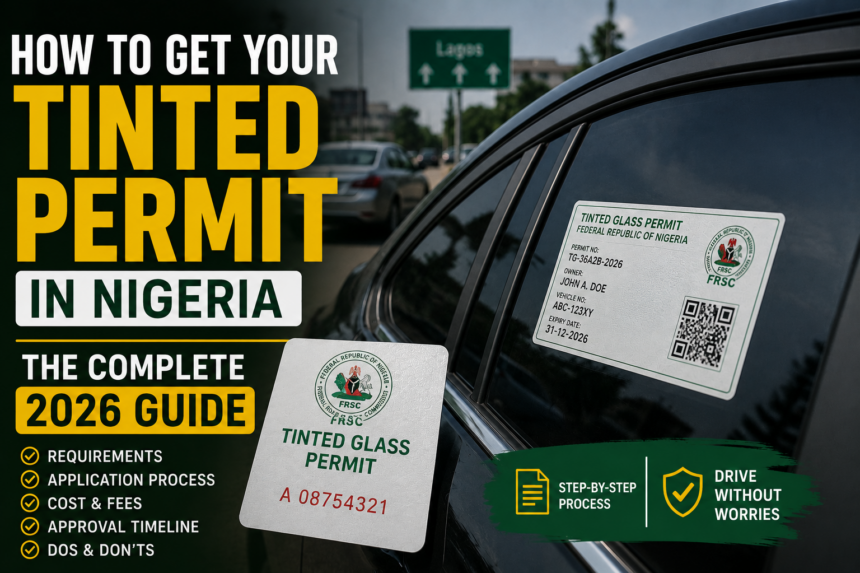
A police officer flags you down, peers through the windscreen, and the next words out of his mouth are about your tinted windows. For many Nigerian car owners, that interaction has been a source of stress, confusion, and in too many cases, money extracted on the spot under the threat of vehicle impoundment. The irony is that a proper legal process now exists to address exactly this situation, and most of the people being harassed at checkpoints do not know enough about it to protect themselves.
In April 2025, former Inspector-General of Police Kayode Adeolu Egbetokun relaunched the tinted glass permit policy and moved the entire application process online through the Police Specialized Services Automation Project, commonly known as POSSAP. The stated logic was straightforward: standardize the permit process, create a verifiable digital database, and remove the room for arbitrary enforcement at checkpoints. Whether that logic has played out the way the police intended is a separate conversation. What is clear is that if your vehicle has tinted windows in Nigeria right now, this permit system is the official path to legal compliance.
One thing worth clarifying before anything else: the tinted permit in Nigeria has nothing to do with the Vehicle Inspection Office (VIO). VIO handles driver’s licence biometrics and road-worthiness checks under the Federal Road Safety Corps. The tinted glass permit falls entirely under the Nigeria Police Force. That distinction matters because searching for a VIO route to this permit will send you in circles. The only recognised channel is the NPF’s own portal.
How to Get Your Tinted Permit in Nigeria
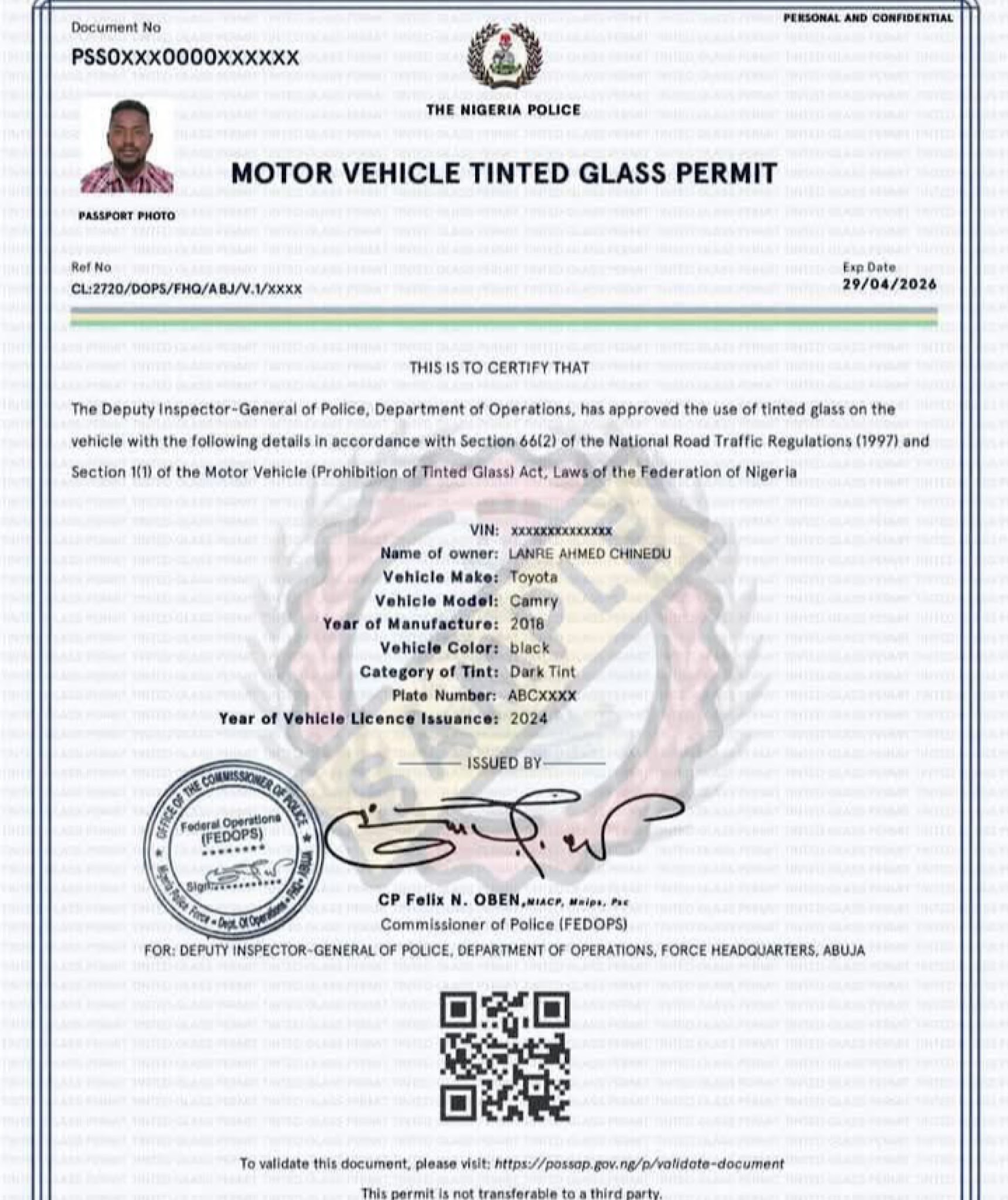
Getting a tinted permit in Nigeria is now a fully digital process managed by the Nigeria Police Force through www.possap.gov.ng. This guide covers the legal basis for the permit, who qualifies, the exact application steps, what it costs, and the current legal dispute that has kept formal enforcement suspended since early January 2026. Understanding all of this is the difference between driving with confidence and being caught off guard at a roadblock.
Why the Police Say Tinted Windows Need a Permit
The argument the police make is a visibility one. During a stop-and-search, officers need to be able to see inside a vehicle to assess whether occupants are armed or pose a threat. Heavily tinted windows prevent that. The NPF has consistently cited rising cases of armed robbery, kidnapping, and other violent crimes where suspects travelled in vehicles with tinted glass, using the reduced visibility to avoid identification at security checkpoints.
In the statement announcing the resumption of enforcement in December 2025, the Force Public Relations Officer, CSP Benjamin Hundeyin, described what the police were seeing: a pattern of criminal groups using vehicles with unauthorised tinted glass to conceal identities and carry out offences ranging from armed robbery to kidnapping. The police used this security rationale to justify pushing ahead with enforcement even while legal challenges were pending in court.
The counterargument, made loudly by the Nigerian Bar Association and civil rights groups, is that the same checkpoints that are supposedly protecting Nigerians from tinted-window criminals have historically been sites of extortion. The concern is not theoretical. Nigerians who drive to the office daily know what it looks like when an officer spots a Range Rover with factory tint and waves it through after a brief pleasantry, then turns around and makes a middle-class Honda Accord owner’s afternoon miserable over the same windows. That selective enforcement has coloured public reception of the policy from the start.
None of that changes the basic fact: if your car has tinted windows, Nigerian law requires you to have documentation for them. Whether enforcement is active at any given moment or not, the law has not been repealed. Driving without a permit leaves you exposed whenever enforcement resumes.
The Law Behind the Permit and What It Actually Covers
The legal foundation for Nigeria’s tinted glass permit is the Motor Vehicles (Prohibition of Tinted Glass) Act, originally enacted as Decree No. 6 of 1991 during the military era. The Act makes it an offence to tint, shade, or heavily colour any glass installed on a motor vehicle in a way that obscures or renders invisible the persons or objects inside, except with the approval of the designated authority and for such good cause as that authority may establish.
Section 66(2) of the National Road Traffic Regulation of 1997 adds an additional layer, specifying conditions under which exemptions can be granted. Together, these two pieces of legislation are what the NPF cites when issuing and enforcing tinted permits. Only applicants who meet the requirements under both instruments are supposed to receive the permit.
This is precisely where a major legal dispute has developed. The NBA argues that the 1991 Act is a military-era law that predates the 1999 Constitution and does not align with democratic governance standards. The association also argues that the National Assembly lacks the competence to have enacted the law in its current form, and that the NPF has no statutory authority to impose fees on citizens through permit enforcement. These are not minor quibbles. They are fundamental constitutional questions that are currently before the Federal High Court in Abuja in Suit No. FHC/ABJ/CS/1821/2025, filed on September 2, 2025, by the NBA through its Section on Public Interest and Development Law.
The court proceedings have not yet produced a final ruling. Until they do, the law as it currently stands on paper still requires a permit for vehicles with tinted windows. The legal challenge does not suspend the law, it challenges its validity. Those are two different things, and many motorists have conflated them into a belief that tinted windows are now freely permissible. They are not.
Who Can Actually Qualify for the Permit
This is a question that has caused real frustration among Nigerian car owners, particularly those who bought imported vehicles that arrived from the port with factory-fitted tinted glass. The vehicle was cleared through customs. Duties were paid. Nothing about the transaction felt illegal. Yet the moment the car hits Nigerian roads, the tint becomes a compliance issue. The NPF’s position is that regardless of origin, factory or aftermarket, if the tint significantly reduces visibility into the vehicle, a permit is required.
In practice, there are two recognised grounds for obtaining a tinted permit. The first is medical. If a vehicle owner has a documented health condition that makes them unusually sensitive to sunlight, such as lupus, photosensitivity disorders, or albinism, a permit can be applied for on medical grounds. The application must include a medical report obtained specifically from a government hospital. Private clinic reports are not accepted. The report must be presented in its original form at the biometric capture stage for verification.
The second ground is security. Individuals who face documented personal security risks, high-profile figures with verifiable threat assessments, and corporate fleets with legitimate security operations fall into this category. This is not a provision most ordinary car owners can invoke. It exists largely for executive protection arrangements and similar professional security contexts.
The honest assessment is that the qualification criteria, as originally written, were never designed for the mass of Nigerian motorists who simply drove off a lot in a factory-tinted Toyota Camry or Sienna. That reality is one of the things the NBA is challenging in court, and it explains why the public response to the policy has been so hostile. The permit regime was originally conceived as a narrow exception, not a mass compliance exercise for ordinary car owners.
How to Apply for Your Tinted Permit on POSSAP: Step by Step
The application lives entirely on the POSSAP portal at www.possap.gov.ng. There is no offline version. No paper form at a police station. No agent whose office you can visit to hand in documents. If anyone tells you otherwise, they are either misinformed or running a scam. The official process from start to finish goes like this:
Go to www.possap.gov.ng and create an account. For individuals, you register using your National Identification Number (NIN), Bank Verification Number (BVN), or Tax Identification Number (TIN). Corporate applicants use their TIN. Fill in your personal details accurately, create a password, and verify your email address using the confirmation code that will be sent to your inbox.
Once logged in, navigate to the services menu and select Tinted Glass Permit. The portal will prompt you to verify your Vehicle Identification Number (VIN), which attracts a separate verification fee of N2,850. After the VIN check passes, you return to the main application page and begin entering your vehicle details: plate number, make, model, colour, engine number, and chassis number. These must match your official vehicle registration documents exactly. Any mismatch will flag your application.
The documents you need to upload are: your vehicle licence data page, proof of vehicle ownership, and a clear photo of your vehicle. Every file must be below 2MB in size. If you are applying on medical grounds, upload the government hospital medical report alongside these documents. Keep original copies of everything. You will need to present them at the biometric capture stage.
After uploading, review every detail before submitting. Once satisfied, proceed to payment and pay the application fee of N14,200 using any available debit card on the portal, MasterCard, Visa, or Verve. The portal also accepts payment at bank branches and via mobile banking or POS against the invoice it generates. After payment, the portal will either redirect you to a facial verification page or send a link to your email for the same process. Complete the facial verification as prompted.
The final step is scheduling your visit to the State Intelligence Bureau (SIB) within your state’s police command for biometric capture. This is where your fingerprints and photograph are taken. The NPF has made it possible for applicants who face difficulty completing the process online to also handle this stage at the Force Headquarters in Abuja. After biometric capture, your application enters the review queue. The NPF states that processing takes between one and five working days, provided all submitted details are accurate. If approved, the permit is issued digitally through the portal. Download it, save it on your phone, and print a copy for your vehicle.
What the Tinted Permit Actually Costs
There are two official fees in this process. The VIN verification step costs N2,850. The main application fee is N14,200. That puts the total official cost at N17,050. Both payments go through the portal and are reportedly remitted to the Treasury Single Account of the federal government, not directly to the police force. The NPF, through its spokesperson, has denied that the policy is designed to generate revenue for the force. Critics, including the NBA, have questioned this framing given the mandatory annual renewal structure.
Because the permit is valid for one year and must be renewed annually, a car owner with tinted windows is looking at this cost every twelve months. In an economy where fuel subsidy removal since 2023 has pushed up costs across the board and where electricity tariffs have risen sharply, that is not an insignificant number. Some vehicle owners on Nairaland and other Nigerian forums have made the calculation that it is cheaper to strip the tint from their windows entirely than to pay for the permit and deal with the renewal requirement year after year.
Be wary of anyone offering to obtain the permit for you for a fee lower than the official amount, or quoting charges in addition to the two listed above as required by the portal. The NPF has warned that the only legitimate process is through POSSAP, and that anyone claiming to fast-track approval outside the portal is not operating within the system. Given how notorious roadside extortion has become as a problem, the risk of handing money to an intermediary is very real.
Biometric Capture and Vehicle Inspection: What to Expect
After submitting your application on POSSAP, a physical visit is still required for biometric capture. The State Intelligence Bureau in your state police command is the designated location. In most states, this means travelling to the state capital. One of the common complaints raised by applicants, including a report published by Daily Trust in August 2025, is that the SIB is only available in state capitals, forcing people from rural and semi-urban areas to make long trips. The POSSAP platform also experienced technical glitches that prevented some applicants from downloading their permits even after completing all steps. These are real friction points that the NPF has not fully resolved.
At the SIB, your fingerprints and photograph are captured and tied to your NIN in the database. For medical applicants, this is also the point where original documents are physically verified before capture is allowed. Bring everything you uploaded during the online application in its original form. Do not assume that the uploaded scans are enough at this stage. Officers doing the verification are checking originals.
Once the permit is issued, it carries a QR code that police officers can scan during a roadblock to verify its authenticity instantly using your plate number or VIN. This is the feature the NPF has promoted as the system’s core advantage over the old paper-based permit regime, which was routinely faked. Whether the QR scanning infrastructure is consistently available to officers across the country is another matter, but in theory, a valid digital permit stored on your phone should end a checkpoint conversation quickly.
The Court Battle That Has Enforcement on Hold
Understanding where enforcement currently stands requires following a sequence of events that began in mid-2025 and extended into the new year. When the NPF launched the tinted permit policy in April 2025, it set an initial enforcement deadline of June 1, 2025. That was pushed to August 12, then to October 2. Each extension came after public backlash and reports of officers at checkpoints harassing motorists even before the official deadlines passed.
On September 2, 2025, the NBA’s Section on Public Interest and Development Law filed Suit No. FHC/ABJ/CS/1821/2025 at the Federal High Court in Abuja, directly challenging the constitutionality of the policy. A separate suit, filed in the Federal High Court in Warri by lawyer John Aikpokpo-Martins, resulted in an October 3, 2025 court order directing all parties to maintain the status quo pending the determination of an interlocutory application. The police suspended enforcement again.
On December 12, 2025, the police counsel informed the Abuja court of an agreement to keep enforcement suspended pending court outcomes. Two days later, on December 15, 2025, the NPF issued a statement through CSP Hundeyin announcing that enforcement would resume from January 2, 2026. The NBA, through its president Mazi Afam Osigwe, SAN, immediately condemned this as executive recklessness and called it a grave affront to the authority of the courts. The association warned it would initiate contempt proceedings against the IGP.
On December 17, 2025, the High Court of Delta State issued an ex parte injunction in Suit No. HOR/FHR/M/31/2025, restraining the IGP and the NPF from implementing the policy nationwide. The court barred police from harassing, arresting, detaining, or extorting motorists under the policy. Three days before the January 2 enforcement date, the police issued a statement confirming that they had been served with the court order and were placing enforcement on hold. The case was adjourned to January 20, 2026 for further proceedings.
Where that case stands at the time of publication is not yet resolved. The court proceedings are ongoing. The NPF has filed preliminary objections and applied for the interim order to be vacated. The NBA has committed to seeing the matter through. Motorists are sitting in the middle of this dispute, which means enforcement on the ground is inconsistent. Some officers stop tinted vehicles; others do not. The absence of a uniform enforcement directive creates exactly the kind of environment where roadside extortion thrives.
What Nigerian Car Owners Should Do Right Now
The court orders have not repealed the tinted glass law. They have temporarily restrained enforcement. Once the litigation concludes, if the court upholds the policy, enforcement will resume and anyone without a permit will be non-compliant. Banking on the case going in the NBA’s favour and never getting the permit is a gamble that puts you at the mercy of whatever enforcement environment exists the day you are stopped.
If your vehicle windows are light enough that visibility into the cabin is not significantly impaired, you are in a better position. The regulation targets tint that obscures or renders invisible the occupants inside. Mild factory tint on rear windows may not trigger enforcement, especially if front windows are clear. But if your vehicle has the kind of deep tint where an officer cannot see your face from outside, the risk is real regardless of whether the car came that way from the manufacturer.
For those who decide to apply, the process is available now on POSSAP regardless of the enforcement freeze. The portal is open. Applications are being received and processed. Getting the permit before enforcement resumes means you are not scrambling when a new deadline drops and the portal gets overwhelmed with last-minute applications, which is exactly what happened before each of the 2025 deadlines.
For those who have already been stopped at a checkpoint without a permit and paid money outside the official channel, that payment is not a substitute for the POSSAP permit. It has no legal standing. If you are stopped again, the prior informal payment will not protect you. Only the digital permit from the portal constitutes documented compliance.
The NBA has also made it clear that any motorist who is harassed, arrested, or has their vehicle impounded over the tinted permit policy while the court order restraining enforcement is still in place has legal recourse. The association directed its branches and Human Rights Committee to provide legal support to affected citizens. Save that information. In a country where most people settle roadside disputes with cash because they do not know their rights, knowing that free legal representation is available through the NBA is genuinely useful.
The Permit Exists. The Dispute Is Real. Know Where You Stand.
Nigeria’s tinted permit controversy is not going to be resolved by ignoring it. The law exists. The policy exists. The digital permit system exists. The legal challenge exists. All four of these things are simultaneously true, and the outcome of the pending court cases will determine which of them ultimately shapes the road ahead for Nigerian motorists.
What is working against ordinary Nigerians in this situation is not just the policy itself but the broader enforcement culture around it. The checkpoints that are supposed to implement this regulation are the same checkpoints where extortion has been documented for decades. The POSSAP portal that is supposed to eliminate corruption from the process has had glitches that leave applicants stranded after paying. These problems do not cancel the need to be documented. They are reasons to document correctly through the official channel, not to stay undocumented and hope for the best.
For Nigerian car owners navigating this right now, the practical position is this: if your windows are deeply tinted, apply through POSSAP and get documented. Keep the digital permit accessible on your phone. Know that an officer stopping you for tinted glass while the court order is in force has no legal authority to arrest or detain you. And if the NBA’s case succeeds and the policy is struck down entirely, the permit you obtained will simply expire without needing renewal. You will not have lost anything except the application fee. That is a reasonable price to drive without anxiety.