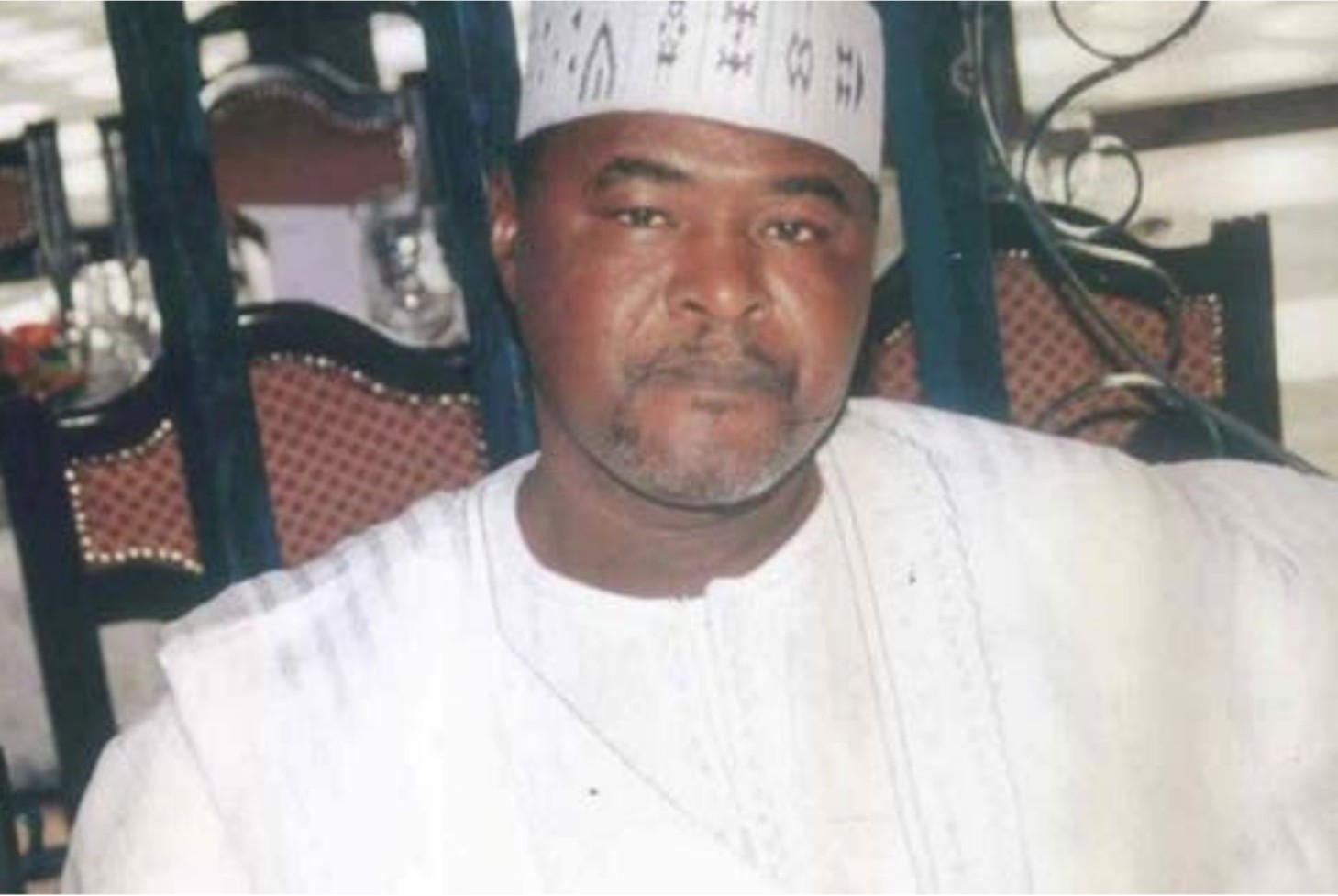
On Thursday the former chairman of the Code of Conduct Tribunal, Danladi Yakubu Umar, was remanded in prison after his arraignment by the Economic and Financial Crimes Commission, EFCC.
Justice U. P. Kekemeke of the Federal Capital Territory High Court, Maitama, Abuja, ordered the remand of Umar after he pleaded not guilty to the four-count charge brought against him by the commission.
The charges bordered on nepotism, conferment of corrupt advantage to self, to the tune of N15,587,833.76 (Fifteen Million, Five Hundred and Eighty-Seven Thousand, Eight Hundred and Thirty-Three Naira, Seventy-Six Kobo).
According to EFCC Umar allegedly diverted over N15.5 million through bank accounts belonging to his wife while serving as head of the tribunal.
The anti-graft agency stated that Umar, who also served as Chairman of the CCT Tenders Board, allegedly used his office to confer corrupt and unfair advantages on himself by directing contractors handling projects for the tribunal to pay money into his wife’s bank accounts.
In the first count, the EFCC alleged that on October 5, 2021, Mr Umar caused Kurchmives International Limited, a subcontractor engaged in the painting of the tribunal’s headquarters under a contract awarded to Momanaf Global Ventures Limited, to pay N5.5 million into a Keystone Bank account belonging to his wife, Zulaihatu Danladi Umar.
The commission said the transaction amounted to conferring a corrupt advantage on himself, contrary to Section 19 of the Corrupt Practices and Other Related Offences Act, 2000.
The second count alleged that on January 25, 2024, Portal Realities Limited, described by the EFCC as a sister company to JTF Global Links Limited, transferred another N6 million into the same woman’s Zenith Bank account
He pleaded “not guilty” to the charges when they were read to him, prompting the prosecution counsel, Christopher Mshelia, to ask the court for a trial date and to remand the defendant in Kuje Correctional Centre, Abuja, while the defence counsel, S. Edward applied for the defendant’s bail.
The judge adjourned the matter till July 15, 2026, for hearing on the bail application and ordered that the defendant be remanded in the Kuje Correctional Centre, Abuja.
In 2011, Danladi Umar, at the age of 40, was appointed as the chairman of the CCT, the adjudication unit of the Code of Conduct Bureau established under the Law of Nigeria, becoming the youngest person to hold the position. In 2024, he was removed from office by the House of Representatives over purported misconduct and inability to effectively carry out his duties. His removal was not without controversy as the lawmakers did not meet the quorum needed for his removal. Out of the 360 members of the lower chamber, 250 were needed to support his removal but fewer than 150 lawmakers were present when the motion for his removal was made.
Unar would later be removed by President Bola Tinubu after his coup-like ousting from office by the members of the House two years ago. However, his recent arrangement by the EFCC is akin to the executioner being taken to the guillotine. For many, Umar was not just the helmsman of any organisation tasked with ensuring that public officers uphold the high standards of probity, accountability and transparency but a man whom anyone in power can use for their dirty and hatchet job of hounding and persecuting those standing in their way out of office and his latest ordeal is some form of comeuppance.
During his time as the CCT boss, Umar oversaw many high-profile cases. He oversaw the removal of the then Chief Justice of Nigeria, Walter Onnoghen, in 2019 after he was arraigned before the CCT on six counts bordering on false asset declaration. Onnoghen would later be exonerated of the charges against him by the court.
He also handled a false asset declaration case involving former Senate president, Bukola Saraki, which lasted for three years. The biggest he oversaw was involving President Bola Tinubu.
In 2011, President Bola Tinubu, a former governor of Lagos State, was arraigned before the CCT. He was accused of operating multiple foreign bank accounts while serving as governor, an action that contravenes the constitution. However, no sooner had the case begun than the tribunal dismissed it. It held that the charges were fundamentally flawed because they failed to establish that the foreign accounts actually belonged to Tinubu.
The tribunal also noted that some of the accounts listed in the charge bore female names, making the prosecution’s case shaky and hard to corroborate. Despite numerous allegations against Tinubu, that was about the only time he was docked.
Then Attorney-General of the Federation, Mike Adoke, said he persuaded the Nigerian government to drop the appeal process against Tinubu.
“Even I am told that the Tinubu people think I was the one responsible for his trial at the Code of Conduct Bureau, but I was not the one. In fact, when the government wanted to appeal, I stood my ground that Tinubu should not be disgraced. I argued that there are people in Nigeria that we just cannot afford to rubbish over anything,” Adoke said in an interview.
On his part, Umar also said he was under serious pressure at the time of Tinubu’s trial.
He had said: “During the trial of Bola Tinubu, we were under serious influence. But you saw what happened. We did what we needed to do based on what was before us.”
However, Umar’s prosecution by the EFCC has sparked mixed reactions with many describing it as persecution and a political witchhunt. Those who opined that the trial of the embattled former CCT chairman has a political undertone and has little or nothing to do with the rule of law and genuine anti-graft war have pointed to the money involved. They noted that many politically exposed persons who should be prosecuted for misappropriation, embezzlement and theft of public funds running into billions of naira have been conveniently ignored by the EFCC and those whom the anti-graft at some point filed corruption charges against and began their trial have been let off the hook.
Whether Umar’s trial is a case of persecution or fair prosecution is a question whose answer will be shaped by the public perception of Tinubu’s government’s attitude towards corruption and how it influences the EFCC’s ability to perform its task.