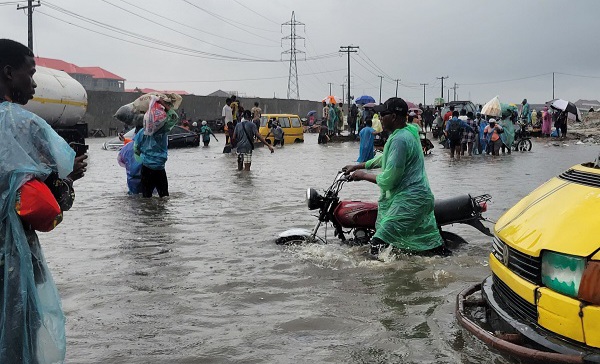
Flooding has swept through several West African countries in recent weeks, leaving a trail of deaths, displacement and damaged infrastructure, while raising fresh concerns about the region’s vulnerability to extreme weather events.
Countries including Ghana, Côte d’Ivoire, Togo, Benin Republic and Nigeria have all recorded significant flooding incidents, with many communities struggling to cope with rising water levels and persistent rainfall.
In Ghana, authorities reported at least 13 deaths after heavy downpours submerged homes, roads and vehicles across Accra, while Côte d’Ivoire recorded no fewer than 59 flood-related fatalities this year.
Nigeria has also witnessed flooding in states such as Lagos, Abia, Akwa Ibom, Delta and Cross River, prompting questions about why several coastal West African nations are experiencing similar challenges at the same time.
Experts attribute the widespread rainfall largely to the seasonal movement of the Intertropical Convergence Zone, a weather system formed when moisture-laden air from the Atlantic Ocean meets hot and dry continental air over the region.
A Lecturer In The Department Of Meteorology And Climate Change At Nigeria Maritime University, Babajide Shari, explained that the phenomenon is closely linked to the West African monsoon, which develops when land surfaces warm faster than the Atlantic Ocean during the rainy season.
“When the land gets heated up compared to the ocean, the breeze coming from the ocean tries to fill the dry air over the land, creating what is called the Intertropical Convergence Zone,” he said.
According to him, the weather system shifts northward between June and September and synchronises rainfall across countries such as Nigeria, Ghana, Liberia, Sierra Leone and Côte d’Ivoire.
Shari noted that the monsoon is a natural atmospheric process capable of producing prolonged rainfall, thunderstorms and conditions that increase the likelihood of flooding.
“When you see rainfall falling for many days, it’s as a result of this kind of monsoon,” he said.
Climate specialists, however, argue that rainfall alone does not explain the scale of flooding being witnessed across the region.
Rapid urban growth over several decades has transformed wetlands and natural floodplains into residential estates, commercial centres and transport infrastructure, reducing the land’s ability to absorb excess water.
Concrete surfaces have increasingly replaced vegetation and permeable soil, while blocked drainage systems and construction along natural waterways have further weakened flood-control capacity in many cities.
Shari said urban expansion had significantly heightened flood risks because natural landscapes that once absorbed water had been replaced by roads, buildings and paved surfaces.
“No single flood can be attributed to climate change alone,” he said.
“Climate change increases the likelihood of more intense rainfall because a warmer atmosphere can hold more moisture, but flooding is usually the result of multiple interacting factors.”
Lagos has become one of the clearest examples of how flooding can worsen even when total rainfall levels are not exceptionally high.
Although forecasts from the Nigerian Meteorological Agency indicate a longer-than-normal rainy season for the state in 2026, available weather data suggest cumulative rainfall during the first half of the year has remained below long-term averages.
Experts say the challenge lies less in the total amount of rain and more in how quickly it falls, as intense downpours over short periods can overwhelm drainage systems and trigger flash flooding.
Shari explained that many people wrongly associate flood severity solely with seasonal rainfall totals rather than rainfall intensity and infrastructure conditions.
“The severity of flooding depends on how the rain falls, where it falls and over what period of time, as well as environmental and infrastructure issues,” he said.
“A month’s worth of rainfall can fall within just one hour. When rainfall intensity exceeds the capacity of the soil, rivers or drainage systems to absorb and convey water, flooding becomes inevitable.”
Public debate has also focused on whether the Lagos-Calabar Coastal Highway project contributed to flooding in parts of Lagos.
While government officials have dismissed such claims, some environmental observers have argued that ongoing construction activities may have temporarily affected drainage patterns.
A Former Deputy Vice-Chancellor Of The University Of Lagos, Professor Babajide Alo, said the project underwent an Environmental Impact Assessment that included mitigation and monitoring measures.
“I read the environmental impact assessment myself when it was displayed for public review. It contains mitigation measures and monitoring plans supervised by the Federal Ministry of Environment,” he said.
Alo maintained that the project should not be blamed entirely for the flooding, noting that some recommended measures were yet to be fully implemented because construction remained ongoing.
“This is the first rainy season since the road was constructed. I will not support the idea that the Lagos-Calabar coastal highway is causing the flooding,” he said.
“If the mitigation measures recommended in the EIA are fully implemented, these problems will disappear. But if they are not implemented, then the problem will persist.”
The professor also identified poor waste disposal as a major contributor to flooding, stressing that blocked drains often prevent stormwater from flowing into lagoons and other natural outlets.
“Even though the amount of rainfall may not be unusually high, the little that falls is unable to drain because the canals, drains and rivulets that should carry the water into the lagoon are blocked by waste,” he said.
“People need to understand that the canals in front of their houses are not dump sites. The more they throw waste into gutters, the more their homes will be flooded.”
As concerns over climate change intensify, experts say African cities must prioritise climate-resilient housing, improved drainage systems and sustainable urban planning to reduce future flood risks.
Shari stressed that governments and developers can no longer rely on outdated assumptions when designing infrastructure for growing cities.
“We can no longer build for yesterday’s climate. We must build for the climate of today and the future,” he said.