The Federal Government has rolled out a fresh $1 billion social protection programme for vulnerable Nigerians, arriving just as officials revealed that more than N600 billion has already been paid out in cash transfers over the past three years.
The announcement, made this week at the State House Banquet Hall in Abuja, brings together five new interventions under one roof, all built around a simple pitch: move Nigerians off short-term palliatives and onto something closer to a sustainable way out of poverty.
What exactly was launched
The centrepiece of the rollout is the Household Prosperity and Empowerment Social Protection Project, better known by its acronym, HOPE-SP. First Lady Oluremi Tinubu unveiled the programme alongside four companion initiatives: the One-Humanitarian-One Poverty Response System (OHOPRS), an Emergency Cash Transfer Programme, a Ministerial Blueprint for the Federal Ministry of Humanitarian Affairs and Poverty Reduction, and a new publication called Humanity First Magazine.
Speaking at the event, the Minister of Humanitarian Affairs and Poverty Reduction, Dr Bernard Doro, described the launch as the birth of a new national architecture for humanitarian intervention. In his words, government is trying to shift “from reactive relief to anticipatory social protection”, in plainer terms, stepping in before families slide into crisis rather than only responding after the fact.
Doro didn’t shy away from naming the problem that has long dogged Nigeria’s welfare programmes: fragmentation. Different ministries and agencies, he said, have historically run their own interventions in isolation, with little coordination between federal and state governments. HOPE-SP and its sister initiatives are meant to fix that by pulling everything through a single tracking system, the Unified National Social Registry, which holds data on poor and vulnerable households across the country.
Under HOPE-SP, who gets what
According to details from the rollout, HOPE-SP is targeting about 7.6 million vulnerable households nationwide. Eligible households are expected to receive a one-off digital shock-response transfer of ₦40,000, paid directly rather than routed through third-party consultants.
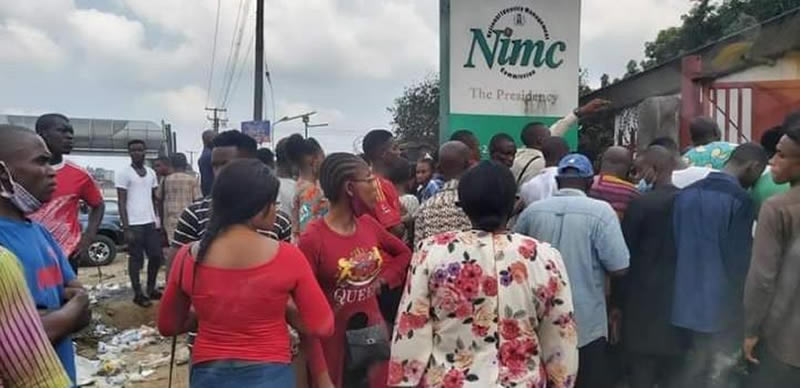
Two things determine whether a household qualifies: registration on the National Social Register, and validation using a National Identification Number. In other words, being counted as poor or vulnerable isn’t enough on its own — your identity has to check out against NIMC’s records before any money moves.
This NIN-first approach isn’t new. The government has been tightening identity verification across its welfare schemes for a while now, partly to plug leakages that dogged earlier phases of the cash transfer programme, and partly because paying out through the banking system requires a Bank Verification Number tied to a real, living, traceable person.
The N600bn number behind the headline
The $1bn launch didn’t happen in a vacuum. Hours after the ceremony, Doro sat down with Channels Television’s Politics Today and dropped the figure that’s now doing the rounds: over N600 billion in cash transfers disbursed in three tranches since President Bola Tinubu took office, reaching slightly more than 10 million households.
Using Nigeria’s average household size of around four people, that works out to roughly 40 million individuals touched by the programme in one way or another — a scale that’s hard to overstate for a country still working through the aftershocks of subsidy removal and currency reform.
Doro was candid about where the programme started. The cash transfers, he explained, were introduced primarily as a stabilisation measure once fuel subsidy was removed and the naira was floated, both of which triggered a sharp jump in the cost of living. What began as emergency cushioning has since hardened into a recurring feature of government’s poverty response.
He was just as candid about what the government still can’t say. Asked directly how many Nigerians had actually been lifted out of poverty because of the transfers, Doro admitted the data isn’t there yet — the ministry hasn’t done the impact assessment that would answer that question. He did, however, say the ministry is open to a “comprehensive and transparent” evaluation of the programme going forward, and pointed to falling inflation, down from a peak above 34 percent to around 15 percent on recent readings, as evidence that the broader economic reforms are working.
Beyond the headline cash figure, Doro mentioned that over 18,000 Nigerians have gone through vocational training, received starter kits and business stipends, and been coached on basic business management, part of a parallel push to help beneficiaries build something more durable than a one-off payment.
How to check if your household qualifies
There’s no new standalone online portal for HOPE-SP as of this launch, and that mirrors how earlier phases of the cash transfer scheme have worked. Registration has largely run through community-based targeting rather than self-service applications. Still, here’s what determines eligibility and how to find out where you stand:
1. Get listed on the National Social Register. This is the master database the government pulls beneficiaries from. If your household has never been captured, you generally can’t qualify, no matter how genuine your need is.
2. Watch for community enumeration exercises. Where a household isn’t yet on the register, enumerators are sent to communities to collect data, verify circumstances, and add qualifying households. Ask your ward head, community leader, or local government social welfare office whether an exercise is currently running in your area.
3. Have a valid NIN, and ideally a linked BVN. Both are now standard requirements. Without a properly linked NIN, verification fails and payment simply doesn’t go through, even for households already on the register.
4. Confirm your listing locally. Beneficiary lists are typically posted at a location agreed with community representatives, giving residents a chance to confirm — or dispute — who’s on it.
5. Use the official helpline. Dial 969 for guidance on the cash transfer process, including how to report errors, delays, or a payment that never arrived despite confirmed eligibility.
Households already on the register, particularly those flagged as extremely poor or vulnerable under the Community-Based Targeting method, stand the best chance of being pulled into HOPE-SP as it scales up. Anyone hoping to benefit but currently unregistered should focus on getting captured during the next enumeration round rather than waiting for an application portal that, for now, doesn’t exist.
Whether HOPE-SP marks a genuine turning point or simply repackages an existing cash transfer scheme under a new name is a question that will likely follow the programme for a while, especially with no public data yet on how many households have actually moved off the register for good. What’s clear for now is the scale of government’s ambition: a $1 billion commitment stacked on top of N600 billion already spent, aimed at a problem that, by the government’s own admission, it still can’t fully measure.
For millions of households waiting to hear whether their names are on a list somewhere in Abuja, the practical advice remains the same as it has been for the last three years — get registered, keep your NIN and BVN current, and stay close to your community leaders for word of the next verification exercise.