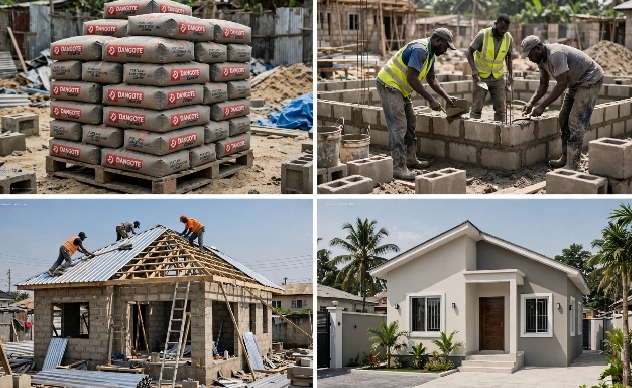
Building a house in Nigeria has become one of those projects that can start with a clear figure on paper and end with a completely different amount in reality. A person may sit down with ₦20 million, draw up a modest 2 bedroom plan and believe the hardest part is simply getting the work started. Then the foundation begins, cement prices change, steel enters the calculation, artisans collect their money, roofing arrives, and suddenly the amount that looked comfortable starts disappearing much faster than expected.
That is the reality behind the latest estimates for building a decent 2 bedroom house in Nigeria in 2026, where the difference between a modest project and a comfortable home can run into millions of naira. The headline figures may look straightforward, but the real cost becomes clearer when the house is broken down stage by stage.
The 2026 Starting Point
A decent 2 bedroom house measuring roughly 80 to 120 square metres can cost about ₦20 million to ₦40 million to construct in Nigeria in 2026, excluding the cost of land. That range gives a useful starting point, but it should not be treated as a fixed price because the final amount depends heavily on the location, size, soil condition, design, quality of materials, labour charges and level of finishing. A simple house in a smaller town can therefore cost considerably less than a similar looking property in Lagos or Abuja. Even within the same city, 2 houses with the same number of bedrooms can end up with very different construction bills once their specifications are compared properly.
The estimate becomes easier to understand when the building is divided into its major stages. Foundation and substructure can take roughly ₦3 million to ₦6 million, while blockwork and structural works may require about ₦4 million to ₦8 million. Roofing can take another ₦2.5 million to ₦5 million, with doors and windows requiring about ₦1.5 million to ₦3.5 million. Electrical and plumbing works can consume ₦2 million to ₦4 million, while tiling and ceilings may require another ₦2 million to ₦4 million. Painting and finishing can take about ₦1.5 million to ₦3 million, while the kitchen, sanitary fittings and other related items can push the bill up by another ₦3.5 million to ₦6.5 million.
Those figures explain why the phrase decent 2 bedroom house needs some context. A ₦20 million project does not necessarily look or feel like a ₦40 million project, even though both may have 2 bedrooms. The size of the rooms, number of bathrooms, kitchen specification, windows, doors, ceiling design, tiles, roofing materials and external works can completely change the final appearance. The number of bedrooms tells you what the house contains, but it does not tell you how expensive the house is to build.
Cement Sets The Pace
Cement has become one of the most important items to watch when preparing a construction budget in 2026. The Federal Competition and Consumer Protection Commission said in its preliminary findings released on August 18, 2026, that the price of a 50 kilogram bag had moved from roughly ₦9,300 to ₦9,700 in January to around ₦10,500 to ₦13,000 by the middle of the year, with prices reaching about ₦13,000 to ₦15,000 in some locations by July. Reports later in August indicated that some dealers were quoting as much as ₦16,000 per bag, showing how quickly a builder’s calculation can change.
That movement matters because a 2 bedroom house can require hundreds of bags of cement. A Lagos construction estimate for a standard 120 square metre 2 bedroom bungalow assumes around 250 bags. At ₦10,000 per bag, 250 bags would cost ₦2.5 million. At ₦13,000, the same quantity rises to ₦3.25 million, while ₦15,000 puts the figure at ₦3.75 million. If the price reaches ₦16,000, those 250 bags become ₦4 million, meaning the same house can absorb an additional ₦1.5 million simply because the price per bag moved from ₦10,000 to ₦16,000.
Cement is also needed at different stages of construction, so the effect is not limited to one purchase. It goes into foundation work, concrete, block production, columns, beams, slabs, plastering and other structural or finishing activities. A builder who buys gradually throughout a project therefore remains exposed to price changes for months. That is why a quotation prepared at the beginning of a project can become outdated before the house reaches the roofing stage.
The Cement Market Question
The cement issue goes beyond individual homeowners because the wider market has become a major part of the construction cost conversation. The FCCPC said Nigeria has installed cement production capacity exceeding 60 million tonnes annually, with some estimates putting it above 65 million tonnes, while domestic consumption is estimated at roughly 25 million to 30 million tonnes. Nigeria is also described as a net exporter of cement, yet domestic prices remain high compared with prices in some other African markets.
The Commission’s August 18, 2026 preliminary findings compared Nigerian cement prices with prices in countries including Kenya, Tanzania and Togo. Its figures put Nigeria at roughly ₦13,000 to ₦15,000 for a comparable 50 kilogram bag, compared with about ₦7,344 in Kenya, ₦6,528 in Tanzania and ₦9,180 in Togo based on the exchange rates and market information used for the comparison. The Commission has been examining whether production, transportation, energy, exchange rate and distribution costs fully explain the difference or whether other market factors may also be involved.
Manufacturers have pointed to several pressures affecting their costs, including energy expenses, the depreciation of the naira, imported machinery and spare parts, transportation and logistics. The investigation is therefore important for anyone trying to build because cement is not a small line on a construction budget. When its price changes significantly, the effect travels through almost every stage of the house.
Foundation Comes First
The foundation is where the house begins, but it is also one of the areas where a builder should resist the temptation to save money blindly. A typical estimate places foundation and substructure costs at roughly ₦3 million to ₦6 million for a decent 2 bedroom project, although that figure can rise considerably when the soil requires more extensive work.
The condition of the land matters more than many first time builders realise. Good soil can allow engineers to use a conventional foundation design suited to the building. Weak, waterlogged or problematic soil can require deeper excavation, additional concrete, more reinforcement and other engineering measures. Drainage requirements can also increase the cost, particularly on sites where water movement is a concern.
That is why 2 people can build almost identical houses and receive completely different foundation bills. The house plan may be the same, but the ground underneath it is not. Anyone planning a serious project should therefore understand the soil condition before treating a construction estimate as a final figure.
Blockwork Takes Another Chunk
Once the foundation is completed, the walls begin to rise, and this is where blocks, cement, sand, reinforcement and labour start appearing heavily on the budget. Blockwork and structural works can take roughly ₦4 million to ₦8 million within the wider national estimate, depending on the size and design of the house.
A 120 square metre Lagos estimate assumes around 2,000 9 inch blocks for its 2 bedroom bungalow model. That figure gives an idea of how much material goes into what may look like a relatively small home from the outside. Blocks also require cement and sand, while columns, beams and other structural elements require reinforcement and concrete.
The cost can rise further when the architectural design becomes more complicated. Large openings, wide living spaces, additional bathrooms and other design features can require more materials and structural work. A simple rectangular house is generally easier to construct than a design filled with unnecessary corners, projections and complicated features.
Steel Is Another Major Bill
Cement receives much of the attention because its price is highly visible, but reinforcement steel can also consume millions of naira. A 2026 construction estimate puts reinforcement steel at around ₦1 million or more per tonne depending on grade, supplier and location. The Lagos model assumes about 2.5 tonnes of reinforcement, which means steel alone can become a major part of the structural budget.
Steel is used to provide strength to concrete structures, particularly in columns, beams, slabs and foundations. The quantity required depends on the engineering design, the size of the building and the structural requirements of the site. This is another reason why builders should not simply copy quantities from another house and assume they will be enough.
Prices can also move between purchases. A builder who buys 1 tonne early and waits several weeks before purchasing another may discover that the same material has become more expensive. Construction therefore involves not just estimating quantities but managing when those materials are purchased.
Roofing Changes The Look
Once the walls and structural work are sufficiently advanced, roofing becomes the next major financial hurdle. The broad national estimate puts roofing at about ₦2.5 million to ₦5 million, although the final cost depends heavily on the design and materials.
A straightforward roof is generally easier to price and construct than one with multiple angles, valleys and complicated sections. The timber or steel structure, roofing sheets, insulation, fascia, gutters, labour and other components all contribute to the final bill. A homeowner who wants a more elaborate roof design should therefore expect the roofing budget to rise accordingly.
Roofing is also one of those stages where appearance can influence spending quickly. A basic roof can protect the building perfectly well, while a more expensive specification may improve appearance, insulation or durability. The important thing is to decide the desired standard before construction begins rather than making expensive changes halfway through the project.
Doors Windows Need Planning
Doors and windows can consume roughly ₦1.5 million to ₦3.5 million within the national estimate. The difference between those figures can become significant once a homeowner starts choosing materials, sizes and designs.
Aluminium windows, glass specifications, security features, internal doors, external doors and frames all have different prices. Large windows can require considerably more glass and aluminium than standard sizes, while premium doors can quickly increase the budget.
Security also matters. Many homeowners want strong external doors and properly protected windows, particularly in urban areas. The cost of these choices should therefore be included from the beginning rather than treated as a final decoration after the main construction budget has been exhausted.
Electrical Plumbing Costs
A house is not finished when the walls are standing and the roof is complete. Electrical and plumbing systems have to be installed before many finishing stages can be completed, and the national estimate places these works at roughly ₦2 million to ₦4 million.
Electrical work includes wiring, distribution boards, sockets, switches, lighting points and other installations required for the house. Plumbing involves water supply lines, waste pipes, bathroom connections, kitchen connections and related fittings. The number of bathrooms can therefore have a direct effect on the final cost.
A 2 bedroom house with 2 bathrooms will generally require more plumbing work than one with a single bathroom. Ensuite bathrooms, a larger kitchen and additional outdoor water points can push the cost further. These are small decisions individually, but they accumulate quickly across an entire project.
Tiles Ceilings Begin The Finish
Tiling and ceilings can require roughly ₦2 million to ₦4 million, depending on the quality of materials and the design selected. This is one stage where personal taste begins to have a major effect on the final bill.
A homeowner choosing basic tiles across a simple floor plan will spend differently from somebody choosing premium tiles, wall features and more elaborate patterns. Ceiling work follows the same principle. A straightforward ceiling design is less expensive than an elaborate POP installation with multiple layers, decorative sections and integrated lighting.
This is why the finishing stage deserves serious planning. Many builders concentrate so heavily on getting the house to roof level that they underestimate how much money is still required before the property becomes comfortable enough to live in.
Kitchen Bathroom Fittings
The kitchen, sanitary fittings and related items can account for roughly ₦3.5 million to ₦6.5 million in the national estimate. That figure can surprise people because these items are often treated as minor details until the time comes to purchase them.
Kitchen cabinets alone can vary significantly depending on materials, size and workmanship. Countertops, sinks, taps, cookers, storage units and other fittings add to the cost. Bathrooms require toilets, showers, basins, taps, mirrors, accessories and other fittings.
The difference between a basic functional kitchen and a fully fitted modern kitchen can therefore run into millions of naira. The same applies to bathrooms. A house can have the same number of rooms but a completely different construction cost simply because of the quality of its fittings.
Painting Is Not The Final Bill
Painting and general finishing can take around ₦1.5 million to ₦3 million according to the broad estimate. That covers more than simply buying tins of paint because preparation, labour, primers, undercoats and multiple finishing coats all form part of the work.
The amount of surface area also matters. A larger house requires more paint and more labour. Exterior walls require separate consideration, while decorative finishes can increase the cost further.
This is also the point where the difference between an unfinished building and a home becomes very obvious. Once the walls are painted, floors are tiled, ceilings are installed, doors are fitted and the bathrooms are equipped, the property begins to look like the house the owner imagined at the beginning.
Lagos Requires More Caution
Lagos is one of the places where I would be careful about using ₦20 million as a comfortable construction budget for a decent 2 bedroom bungalow. A current Lagos specific estimate places a standard finish 2 bedroom bungalow at roughly ₦25 million to ₦35 million excluding land.
That estimate assumes around 120 square metres, about 250 bags of cement, approximately 2.5 tonnes of reinforcement and roughly 2,000 9 inch blocks. It also assumes standard or mid grade finishing and a construction period of about 4 to 6 months.
Its estimated foundation cost is around ₦3.6 million to ₦7 million, blockwork can reach ₦4.5 million to ₦8.8 million, roofing about ₦2.2 million to ₦4.2 million, while plastering and first fix work may take ₦1.8 million to ₦3.5 million. Finishing can require about ₦4.5 million to ₦8.8 million, while electrical and plumbing work may take another ₦1.4 million to ₦2.8 million.
Those figures make the Lagos picture clearer. A person may hear that a 2 bedroom house can cost ₦20 million nationally and assume that amount will comfortably deliver a standard bungalow in Lagos. That assumption can become dangerous once the actual site, labour, materials and finishing requirements are calculated.
Abuja Has Its Own Pressures
Abuja can also move towards the higher end of the national range because construction costs are affected by more than the price of materials alone. Labour, transportation, site conditions, contractor charges and the distance between suppliers and construction sites all influence the final bill.
The same house design can therefore have different construction costs in Abuja, Lagos, Ibadan, Port Harcourt, Enugu, Benin City or a smaller developing town. The national estimate is useful as a broad guide, but location must always be attached to the number.
Transport is particularly important because materials do not appear at the construction site by themselves. Cement, sand, granite, blocks, steel, roofing materials, tiles, doors and windows all have to be moved. The longer and more difficult the journey, the more likely transportation is to affect the final cost.
Land Is Not Part Of The Figure
One of the biggest misunderstandings surrounding construction estimates is the assumption that the stated amount represents everything required to own a house. The ₦20 million to ₦40 million range refers to construction and excludes land.
That means somebody with ₦20 million cannot automatically assume they have ₦20 million worth of complete homeownership. Land purchase may still be required, alongside survey costs, title documentation, architectural drawings, structural engineering, quantity surveying, planning approvals and other professional expenses.
External works can also remain outside the headline construction figure. A homeowner may still need to pay for fencing, gates, borehole, water storage, septic tank, soakaway, drainage, paving, landscaping, external electrical work and security infrastructure.
Power requirements can add another major expense. Someone may decide to install a generator, inverter or solar system after completing the house. Those costs can easily push the overall amount beyond what was originally budgeted.
Labour Takes A Big Share
Labour can represent roughly a quarter to more than a third of construction expenditure depending on the project. That means the amount paid to the people actually building and finishing the house cannot be treated as a minor expense.
Bricklayers, carpenters, roofers, plumbers, electricians, tilers, painters, ceiling installers, aluminium workers, welders and labourers all have different roles. A project can involve several teams working at different stages, with some artisans returning more than once as the construction progresses.
Skilled labour also tends to cost more in major cities. A builder who uses experienced artisans may pay more upfront but can reduce the risk of poor workmanship and expensive corrections later. Cutting labour costs too aggressively can therefore become false economy if defective work has to be demolished and rebuilt.
Why The House Size Matters
Calling a property a 2 bedroom house does not tell you how large it is. An 80 square metre house and a 120 square metre house can both contain 2 bedrooms, but the amount of materials and labour required will be different.
The same applies to the internal layout. A compact living room, small kitchen and 1 bathroom will cost differently from a larger living area, dining space, fitted kitchen and 2 ensuite bathrooms.
Even windows can change the calculation. A house filled with large glass openings can require considerably more money than one with standard windows. Ceiling design, floor finishes, doors, wardrobes and kitchen cabinets all contribute to the final difference.
That is why the phrase 2 bedroom should never be used alone when asking a contractor for a serious estimate. The contractor needs the actual building plan, measurements, site information and specification before producing a reliable figure.
External Works Can Surprise You
The house itself is not necessarily the end of the project. Many homeowners discover this only after spending most of their money on the main building.
A fence and gate can require a significant amount depending on the size of the plot and the materials selected. Borehole drilling can add another expense, while water tanks, pumps and plumbing infrastructure are separate considerations.
Septic systems and soakaways also require money, especially where there is no suitable public sewage connection. Drainage can become particularly important during heavy rainfall, and compound paving or landscaping can further increase the final expenditure.
These items may not appear in a basic construction estimate, but they matter if the goal is a complete and functional home rather than simply a finished building.
What The Budget Could Look Like
A project around ₦15 million to ₦20 million would generally require very careful cost control, a favourable location, a compact design and relatively basic specifications. That amount may work for an economy project under suitable circumstances, but it should not be treated as a comfortable national guarantee.
A budget around ₦20 million to ₦25 million gives a modest builder more room, particularly when the design is straightforward and the site is favourable. The owner would still need to monitor material prices closely and avoid unnecessary upgrades that can quickly push the project beyond the original figure.
A budget around ₦25 million to ₦35 million is a more realistic working range for many standard 2 bedroom bungalow projects in Lagos, although individual sites and specifications can still move the figure lower or higher. A budget of ₦35 million to ₦40 million or more provides greater room for better finishing, a larger design, a difficult site or more extensive external works.
These are planning ranges rather than official market prices. Construction is too dependent on location, design, soil, material quality and timing for anybody to promise that every 2 bedroom house will fit neatly into a single price band.
Buying Could Sometimes Compete
There is another interesting part of the housing market that prospective builders should consider. Some completed 2 bedroom properties in Lagos area developments have been advertised around ₦24 million to ₦25 million, depending on the estate and terms.
That raises a practical question about whether building from scratch is always cheaper than buying a completed property.
There is no automatic answer. A developer constructing many houses can purchase materials in larger quantities and negotiate prices that an individual homeowner may not receive. The developer may also already have workers, equipment and systems in place, reducing some of the costs associated with a one off project.
The buyer, however, must examine the property’s title, construction quality, location, infrastructure, estate charges and exact specifications before comparing it with a self built house. A ₦25 million completed property is not necessarily equivalent to a ₦25 million house built on land you already own.
The ₦20 Million Question
So, can ₦20 million build a decent 2 bedroom house in Nigeria in 2026?
It can, under the right conditions, but the number should not be treated as a universal promise. A compact design, favourable soil, reasonable labour costs, careful material purchasing and basic to moderate finishing can make the lower end of the national estimate achievable.
The situation becomes tighter in Lagos, particularly when the project is around 120 square metres and the owner wants standard modern finishing. The current Lagos estimates pointing towards ₦25 million to ₦35 million provide a more cautious planning range for that kind of project.
The difference between ₦20 million and ₦30 million is therefore not simply about wanting a more beautiful house. It can come from cement prices, steel, labour, foundation requirements, roofing, doors, windows, electrical work, plumbing, tiles, kitchen fittings and everything else that has to come together before the building becomes a proper home.
The Real 2026 Picture
The clearest way to look at the Nigerian construction market in 2026 is to treat the ₦20 million to ₦40 million figure as a starting framework rather than a quotation. It provides a useful national range for a decent 2 bedroom house of roughly 80 to 120 square metres, but the actual bill will be shaped by the details of the project.
Cement has become particularly important because its price moved significantly between January and August 2026. Steel remains another major structural expense, while labour can take a substantial share of the budget. Roofing, doors, windows, plumbing, electrical work, tiles, ceilings, painting and kitchen fittings then add layer after layer to the cost.
Location changes everything. Lagos and Abuja can sit closer to the upper end of the range, while some smaller towns may offer lower labour and logistics costs. Soil can quietly increase the foundation bill, while an ambitious architectural design can increase material and labour requirements without increasing the number of bedrooms.
Then there are the costs that sit outside the headline figure. Land, professional fees, approvals, fencing, borehole, water storage, drainage, septic systems, paving, landscaping and power solutions can turn a construction budget into a much larger homeownership budget.
The most sensible approach for anybody planning to build in 2026 is therefore not to ask only how much a 2 bedroom house costs. The better question is what exact 2 bedroom house you want, where you want to build it, what the soil is like, what quality of materials you want, how much you can spend on labour and finishing, and what additional infrastructure the property will require.
For a national planning figure, ₦20 million to ₦40 million is a reasonable broad range for the building itself under the stated assumptions. For a standard 2 bedroom bungalow in Lagos, ₦25 million to ₦35 million is a safer working range for many projects, while ₦40 million or more can become realistic once the design, finishing, site conditions and external works move upwards.
The biggest lesson from the 2026 market is simple. The number on the first piece of paper is rarely the number on the final bill. Cement can rise, steel can change, labour can increase, the soil can demand more work and finishing can consume money faster than expected. Anyone entering the project with a rigid budget and no contingency can therefore find themselves halfway through a house with the roof still waiting and the money already running thin.
For prospective homeowners, the safest calculation is not the cheapest possible construction figure. It is the figure that leaves enough room for the realities of the site, the market and the final standard of the house. In 2026, that difference can be worth several million naira, and it can determine whether a 2 bedroom dream becomes a completed home or another unfinished building waiting for the next round of funding.