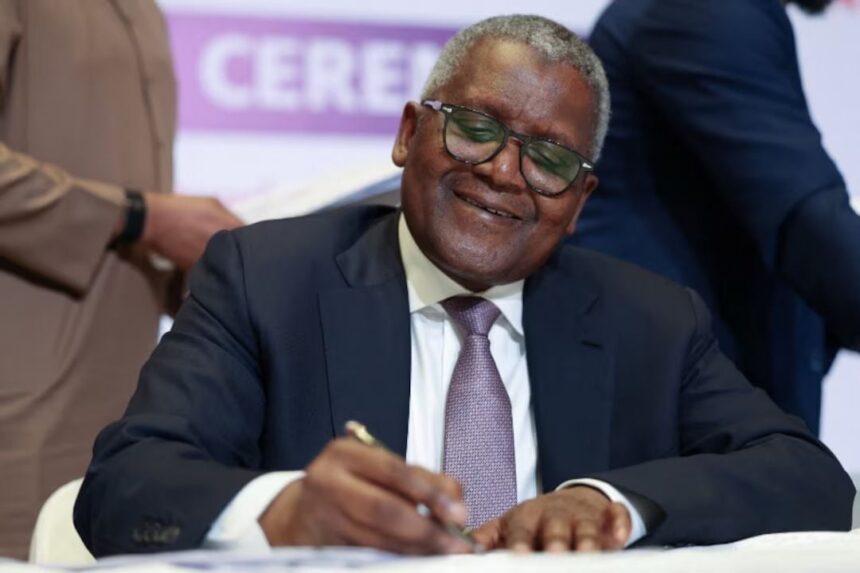
For years, Aliko Dangote has occupied a familiar position at the top of Africa’s wealth rankings, but September 14, 2026, introduced a new figure beside his name that immediately changed the scale of the conversation around his fortune. The number was so large that it appeared almost unbelievable at first glance, especially for anyone following the billionaire’s wealth through the familiar estimates that had circulated for much of the year. Yet behind the dramatic figure was a development involving one of the biggest industrial assets ever built in Nigeria, a public offering that opened a new chapter for the country’s capital market and a valuation that suddenly placed Dangote in a very different position on the global rich list.
The development did not happen because billions of dollars suddenly landed in Dangote’s personal bank account. It followed the latest valuation attached to the Dangote Petroleum Refinery as the company opened its landmark public offering on the Nigerian Exchange. The refinery, which took years to build and billions of dollars to complete, had reached a stage where its value could be assessed against its operating performance, future expansion plans and growing position in the petroleum market. That fresh valuation became central to the extraordinary movement in Dangote’s estimated personal wealth.
By the time the figures began circulating on September 14, Dangote’s estimated fortune had moved from roughly $31.4 billion to about $51.3 billion, representing an increase of approximately $19.9 billion. The change placed him around the 36th position among the world’s richest people under the latest Forbes real time estimate. For a businessman whose wealth has been built across cement, fertiliser, food, manufacturing, energy and other industrial interests, the scale of the new figure marked another major moment in the story of Africa’s most prominent industrialist.
September 14 Opens A New Chapter
September 14, 2026, became the key date because the Dangote Petroleum Refinery public offering formally opened on the Nigerian Exchange. The offer involves 4.1 billion ordinary shares priced at ₦525 each, creating a potential offer value of approximately ₦2.15 trillion if the entire offer is subscribed. The offer is scheduled to close on October 13, 2026, while the eventual listing and trading timetable remains subject to the required capital market process.
The structure immediately attracted attention because the refinery is not an ordinary company entering the Nigerian Exchange. It is one of the country’s largest private industrial investments, built at a cost of approximately $20 billion after about 10 years of development. Its emergence as a publicly accessible investment opportunity therefore represents a major development for both the company and the wider Nigerian market.
The minimum subscription was deliberately kept at 10 shares, meaning an investor can enter the offer with ₦5,250. That figure is small compared with the scale of the refinery itself, but it carries considerable significance because it gives ordinary investors a route into ownership of an asset that had previously been associated mainly with institutional investors and one of Africa’s wealthiest families.
The public offer represents only a minority portion of the refinery, estimated at approximately 3 percent. Dangote therefore retains control while opening the business to a much wider pool of investors. The structure also explains why the transaction has been presented as a people’s IPO, with the wider objective of allowing more Nigerians to participate in the ownership of a major industrial business.
The Number Behind Dangote’s New Ranking
The most striking part of the September 14 development was the movement in Dangote’s estimated wealth. Before the latest revaluation, his fortune was being placed at around $31.4 billion in the figures that circulated widely. Following the new valuation of his refinery holdings, Forbes’ real time estimate moved his fortune to approximately $51.3 billion.
That represents an increase of roughly $19.9 billion, equivalent to about 63 percent of his earlier estimated fortune. The movement was large enough to push him into approximately the 36th position on the global billionaire ranking. That ranking immediately transformed the refinery IPO from a major Nigerian financial event into a story with global significance.
The important point is that the $19.9 billion should not be interpreted as cash received by Dangote. There was no indication that $19.9 billion had been transferred into his personal account. The movement reflects a change in the estimated value of the assets attributed to him, particularly his stake in the refinery following the latest valuation associated with the IPO.
The billionaire rankings are generally based on estimated asset values. When a company becomes more valuable, the estimated value of an owner’s stake can rise even when the owner has not sold that stake or received an equivalent amount of cash. Dangote’s September 14 wealth surge is therefore better understood as a revaluation of his holdings rather than a personal cash windfall.
The Refinery’s New Valuation
The refinery valuation provides the clearest explanation for the enormous change in Dangote’s estimated wealth. The latest figures place the value of the refinery at approximately ₦63 trillion, equivalent to about $47.6 billion under the exchange rate used in the relevant calculations. Other figures have placed the valuation closer to $49 billion because of exchange rate movements and differences in rounding.
Either way, the scale is enormous. A refinery that was once primarily viewed through the lens of its construction cost had reached a point where its operating capacity, revenue, profitability, market position and future expansion plans were being reflected in a much higher valuation.
The difference becomes even clearer when the latest figure is compared with the refinery’s July 2026 private placement. Institutional investors had put approximately $2.5 billion into the company during that transaction, representing roughly 6 percent of the refinery. That deal valued the business at approximately $40 billion.
The progression is therefore significant. The July transaction placed the refinery at roughly $40 billion, while the valuation associated with the September IPO placed it around $47.6 billion to $49 billion. The higher valuation created the basis for a much larger estimated value of Dangote’s remaining interest.
The July Investment Comes Into Focus
The July 2026 private placement was an important stage in the refinery’s journey to the public market. Approximately $2.5 billion was raised from institutional investors, including development finance interests, with Africa Finance Corporation identified among the investors associated with the transaction.
That private placement provided an external valuation reference for the refinery at roughly $40 billion. It also demonstrated that major institutional investors were willing to commit significant capital to the business based on its operating prospects and expansion plans.
The terms were different from the public offer. Institutional investors participating in the private placement received shares under conditions that included a lock up period. Such restrictions can affect the price investors are willing to pay because they limit the ability to sell the shares immediately.
Retail investors entering through the public offer are therefore approaching the refinery at a higher valuation. That does not automatically mean one group has made a better investment than the other. The circumstances, timing, restrictions and investment objectives are different, while the public offer provides a different level of access and liquidity.
The People’s IPO Opens The Door
One of the most important features of the September 14 offer is the minimum subscription of ₦5,250. Ten shares at ₦525 each brings the minimum investment to that figure, allowing an investor to participate without having millions of naira available.
The low entry point is particularly significant in Nigeria, where the stock market can still appear distant to many ordinary people. The refinery offer places a recognisable Nigerian industrial brand directly in front of retail investors through a structured capital market transaction.
The opportunity, however, should not be confused with a guaranteed return. Buying the shares means becoming an investor in the business, not purchasing a fixed savings product. The value of the shares can rise or fall, dividends are not guaranteed and investors can lose part or all of the money they commit.
The official investment information also makes clear that prospective investors should read the approved prospectus and understand the risks before subscribing. That warning is especially important because the public interest surrounding the refinery has already created opportunities for fraudulent operators to target people looking for a quick route into the offer.
The Money Is Tied To Expansion
The IPO is also connected to the refinery’s next stage of growth. The facility is currently operating at approximately 700,000 barrels per day, but the long term plan is to increase capacity to 1.4 million barrels per day.
That target would represent a doubling of the current capacity. It also explains why the refinery’s future valuation cannot be viewed solely through its present operations. Investors are buying into a business with a significant expansion programme and a stated ambition to become an even larger force in the global petroleum products market.
The broader expansion programme has been estimated at about $14.3 billion, with the move toward 1.4 million barrels per day targeted for 2029. Capital raised through the market therefore forms part of a much bigger financial plan surrounding the refinery’s development.
This is important when considering Dangote’s wealth increase because the valuation is connected not only to what the refinery is producing today but also to the scale of the business investors believe it can become. The market is placing value on its existing operations, its earnings capacity, its infrastructure, its market access and its future expansion.
The Financial Numbers Tell Another Story
The refinery’s financial performance has also changed considerably. According to the figures associated with the prospectus, the business generated more than $13 billion in revenue during the first 6 months of 2026 and recorded approximately $1.82 billion in net profit during the same period.
Those figures are particularly significant when compared with the refinery’s performance for 2025. The business recorded a full year loss of approximately $476 million during that period, meaning the move into substantial profitability represents a major change in its financial position.
Revenue of more than $13 billion within 6 months places the refinery on a completely different financial footing from the period when it was still being constructed and brought into operation. The company has moved from a huge capital project into a major operating business capable of generating billions of dollars in sales.
Profitability adds another layer to the valuation. Investors are not simply looking at a refinery that has been built. They are looking at an operating facility with significant production capacity, a growing customer base and an expansion plan that could substantially increase its scale.
700,000 Barrels Per Day Changes The Picture
The refinery’s operating capacity is central to its story. At approximately 700,000 barrels per day, it has become one of the most significant refining facilities in Africa and a major part of Nigeria’s petroleum supply structure.
Its development has also changed the country’s refining conversation. Nigeria has historically depended heavily on imported refined petroleum products despite being one of Africa’s major crude oil producers. The emergence of a refinery of this scale creates the possibility of supplying a much larger share of domestic demand while also creating opportunities for exports.
The business has increasingly looked beyond Nigeria as markets across Africa and Europe become part of its commercial strategy. That international reach matters because a refinery of this size does not have to depend entirely on one national market.
The expansion to 1.4 million barrels per day would take the business into another category entirely. More production capacity means the potential for greater domestic supply, larger export volumes and higher revenue, provided market conditions remain favourable.
The Long Road To The IPO
The September 2026 IPO represents the latest stage of a project that took about 10 years to develop. The refinery cost approximately $20 billion to build and began operations in 2024.
That history helps explain why the latest valuation has attracted such attention. The project spent years absorbing enormous amounts of capital before reaching the stage where investors could assess it as an operating business.
The opening of the IPO now gives the public a way to participate in an asset that was once largely associated with private ownership. The journey from construction to operation, profitability and public offering has therefore created a clear sequence in the refinery’s financial story.
The facility is no longer being valued simply on the amount spent to construct it. Its valuation is increasingly being determined by its ability to generate revenue, make profits, process crude, supply petroleum products, serve export markets and expand its capacity.
Dangote’s Wealth Surge Gets A Global Dimension
The jump from approximately $31.4 billion to $51.3 billion places the refinery at the centre of Dangote’s latest global wealth ranking. The increase of roughly $19.9 billion is larger than the entire estimated fortunes of many billionaires.
The resulting figure places Dangote around the 36th richest person in the world under the latest Forbes real time ranking. That is a significant movement for an African businessman whose wealth has traditionally been concentrated among the world’s richest industrialists but whose global ranking has remained well below the very top positions.
The new position also reflects how much the refinery has become a central component of Dangote’s wealth. Cement remains a major part of his business empire, while fertiliser, food and other industrial interests contribute to the broader group, but the refinery’s valuation has now introduced a completely different scale to his personal wealth calculation.
The development is therefore bigger than a billionaire ranking update. It demonstrates how the valuation of a single industrial asset can influence the estimated fortune of its controlling owner on a global scale.
Forbes Numbers Require Context
The difference between wealth estimates from different sources also deserves attention. Figures circulating on September 14 were not identical across every report because billionaire wealth calculations depend on methodology, timing and the treatment of private company interests.
Forbes’ real time calculation reflected the higher value attributed to Dangote’s refinery holdings and moved his estimated fortune to about $51.3 billion. Other contemporary estimates continued to place his wealth closer to the low or mid $30 billion range because they were using different approaches to valuation or had not yet incorporated the same adjustment.
That does not automatically make one figure correct and another incorrect. Private company valuations are not as straightforward as the market price of a publicly traded share. Once the refinery begins trading publicly, the market will provide another reference point through actual share prices.
The September 14 figure should therefore be understood as an estimated wealth calculation linked to the latest valuation, rather than a statement that Dangote suddenly received $19.9 billion in cash.
The Offer Is Worth About ₦2.15 Trillion
The numbers attached to the IPO itself are also substantial. The 4.1 billion shares being offered at ₦525 each produce a total potential value of approximately ₦2.15 trillion.
At the prevailing exchange rate used in the relevant calculations, that is about $1.6 billion. The size of the transaction makes it one of the most significant public offerings in Africa and a landmark transaction for the Nigerian Exchange.
The scale also explains why the offer has attracted international attention. A company valued at approximately $47.6 billion to $49 billion is entering a market where relatively few companies have ever approached that size.
The public offer therefore gives Nigeria’s capital market a major new asset while giving the refinery another route to raise capital and broaden its ownership base.
The October 13 Deadline Matters
Investors have a defined window to consider the offer. The public offering opened on September 14, 2026, and is scheduled to close on October 13, 2026.
That period gives prospective investors time to review the approved information, understand the terms, assess the risks and make decisions through authorised channels. The minimum subscription is 10 shares at ₦525 per share, bringing the entry amount to ₦5,250.
The eventual allotment and listing timetable remains subject to the required process, with trading expected around late November based on the stated transaction timeline. Investors should therefore distinguish between the opening of the offer and the eventual commencement of trading on the exchange.
The offer is not simply an opportunity to buy into a famous name. It is a capital market investment that requires the same level of caution expected when buying shares in any other company.
SEC Warning Becomes More Important
The huge public interest surrounding the IPO has also created a serious fraud risk. Nigeria’s Securities and Exchange Commission issued an official warning on September 14, 2026, directing prospective investors to use only approved receiving agents and authorised subscription channels.
The warning specifically addressed unsolicited WhatsApp messages, fake investment platforms, social media advertisements, unverified websites and individuals promising guaranteed allotments. Investors were also warned against sending money directly to people claiming to be handling subscriptions.
That warning is significant because the ₦5,250 entry figure makes the offer attractive to a very wide audience. Large numbers of potential investors create a natural target for people attempting to collect money through fake payment links or false promises.
The SEC had already issued a cease and desist directive on June 23, 2026, after misleading promotional materials and supposed pre IPO solicitations began circulating before the offer had received the necessary approval. The latest warning therefore forms part of a continuing effort to prevent investors from being deceived.
Dangote’s Next Ambition Extends Beyond Nigeria
The refinery IPO is also part of a wider expansion strategy. Dangote has indicated plans to take the Nigerian refinery from 700,000 barrels per day toward 1.4 million barrels per day, while there are also plans for another refinery project in Kenya.
The wider ambition suggests that the refinery is being positioned as more than a single Nigerian industrial facility. Its growing production capacity, export reach and planned expansion could make it a central part of Dangote’s long term energy strategy across Africa.
There is also an ambition to bring other companies within the Dangote conglomerate to the public market. The refinery’s IPO could therefore become a model for future listings involving other major businesses under the group.
Another possibility discussed by Dangote is a secondary listing of the refinery business in the United States within 3 to 4 years. Such a move would give the business access to an even broader international investment audience if the plan eventually proceeds.
Kenya Adds Another Layer
The proposed Kenyan refinery project gives the wider story another dimension. Dangote is not treating the Nigerian refinery as the final destination of his energy ambitions.
A second refinery project would represent another major industrial undertaking and could expand the group’s presence in East Africa. It would also place the Nigerian refinery within a wider continental strategy involving refining capacity, petroleum products and international markets.
That expansion matters because the value attached to Dangote’s businesses increasingly depends on how far the group can scale its industrial operations. The refinery IPO is therefore both a major event in its own right and a possible foundation for another phase of expansion.
The combination of the Nigerian refinery, the proposed Kenyan project and the potential future listings points toward a business empire increasingly structured around large scale industrial assets that can attract institutional and public investment.
Why The IPO Matters To Nigeria
The significance of the transaction extends beyond Dangote’s personal wealth. Bringing the refinery into the Nigerian Exchange gives the local capital market access to one of the country’s most valuable industrial businesses.
The offer also has the potential to introduce a new generation of retail investors to equities. A ₦5,250 minimum investment is within reach for many people who might previously have considered the stock market an arena reserved for wealthy investors or financial institutions.
The transaction could also broaden the range of large businesses available to Nigerian investors. A refinery of this scale brings exposure to the energy sector through an operating company with substantial production capacity, significant revenue and an ambitious expansion programme.
For the Nigerian Exchange, the transaction also represents an opportunity to demonstrate that the country’s capital market can support large industrial companies while giving local investors a route into ownership.
The Real Meaning Of The $19.9 Billion
The easiest way to understand the September 14 wealth jump is to separate the headline from the mechanics behind it. Dangote did not suddenly receive $19.9 billion from the IPO. His estimated wealth increased because the value assigned to his stake in the refinery rose sharply following the latest valuation.
The difference is important. If a person owns a company valued at $40 billion and the company is later valued at almost $50 billion, the estimated value of that person’s ownership rises even if the person has not sold any shares.
That is broadly the principle behind the movement in Dangote’s estimated fortune. The refinery’s higher valuation created a much larger estimated value for his remaining stake, which was then reflected in the real time billionaire ranking.
The cash being raised through the public offering is also not the same thing as Dangote personally collecting the entire IPO proceeds. The offer is a corporate capital market transaction involving the sale of shares and the wider ownership structure of the business.
The Numbers That Define The Story
The figures surrounding the transaction tell the story more clearly than the viral headline alone. Dangote’s estimated fortune moved from about $31.4 billion to approximately $51.3 billion, creating a reported increase of about $19.9 billion and placing him around 36th among the world’s richest people.
The refinery is valued at approximately ₦63 trillion, or around $47.6 billion under the relevant exchange rate calculations, with some estimates placing the figure closer to $49 billion. The July private placement had valued the business at roughly $40 billion after institutional investors committed about $2.5 billion.
The public offer involves 4.1 billion shares priced at ₦525 each, creating an offer value of about ₦2.15 trillion or approximately $1.6 billion. The minimum subscription is 10 shares, meaning an investor can apply with ₦5,250.
The refinery currently operates at approximately 700,000 barrels per day, with a target of 1.4 million barrels per day by 2029. Its financial performance has also strengthened, with more than $13 billion in revenue and approximately $1.82 billion in net profit recorded during the first 6 months of 2026.
A Different Chapter For Dangote
The September 14 development places Dangote at the centre of one of the most remarkable wealth movements associated with an African businessman in recent years. His estimated fortune crossing the $50 billion mark under the latest Forbes calculation is closely tied to the changing value of the refinery and the opening of its public offer.
The bigger story, however, sits inside the numbers. A project that cost approximately $20 billion to build, took about 10 years to develop and began operations in 2024 has moved into a new phase where its value is being judged through production, revenue, profit, expansion plans and access to public capital.
The IPO now gives Nigerians a chance to own a small stake in that business, while Dangote retains control and seeks more capital for future expansion. The minimum entry point of ₦5,250 makes the offer unusually accessible for an asset of such scale, although the investment remains subject to the normal risks of the stock market.
The October 13, 2026 closing date will mark the end of the subscription period, but the significance of the transaction will stretch much further. The eventual listing will provide another market reference for the refinery’s value, while its performance in the years ahead will determine whether the ambitious valuation attached to the business can continue to hold.
For Dangote personally, the development has already produced a historic number. His estimated fortune has crossed into a new range, his global ranking has climbed to around 36th, and the refinery has become an even more important part of the wealth story surrounding Africa’s richest industrialist.
The $19.9 billion figure therefore tells only the beginning of the story. Behind it sits a refinery valued at tens of billions of dollars, a ₦2.15 trillion public offering, 4.1 billion shares, a ₦5,250 minimum entry point, a planned expansion to 1.4 million barrels per day and a business that has moved from a decade long construction project into one of Africa’s most closely watched industrial companies.
September 14, 2026, may therefore be remembered less for the idea that Dangote suddenly received $19.9 billion and more for the moment when the market placed a new value on what he had spent years building.