For many Ikeja Electric customers, September 2026 has brought a series of developments that go far beyond the usual complaints about whether electricity is available at a particular time of the day. Behind the daily supply situation, the company has been dealing with several customer facing issues at the same time, ranging from the return of money paid for meters under the Meter Asset Provider programme to a fresh approved meter price schedule, repeated Band A service notices, network faults, electricity debt management, safety concerns and a major power project planned for the Ogba area.
The developments have unfolded gradually since August, with some announcements affecting customers immediately while others are connected to projects that are expected to become more relevant in the months ahead. Ikeja Electric has also continued publishing operational notices covering specific feeders and areas, giving customers a clearer picture of some of the incidents affecting electricity supply across its network. For customers trying to understand the bigger picture, the dates matter because the developments are not part of one single announcement but a sequence of separate changes and interventions.
September has therefore become an important period for customers who paid for meters under the previous MAP arrangement, customers preparing to obtain new meters, Band A customers monitoring their expected service levels, communities dealing with faults and customers carrying outstanding electricity debts. At the same time, Ikeja Electric has begun positioning a proposed 12MW power project at Ogba as a future source of additional supply, while also moving forward with plans aimed at reducing losses across its distribution network.
MAP Refunds Begin For Eligible Customers
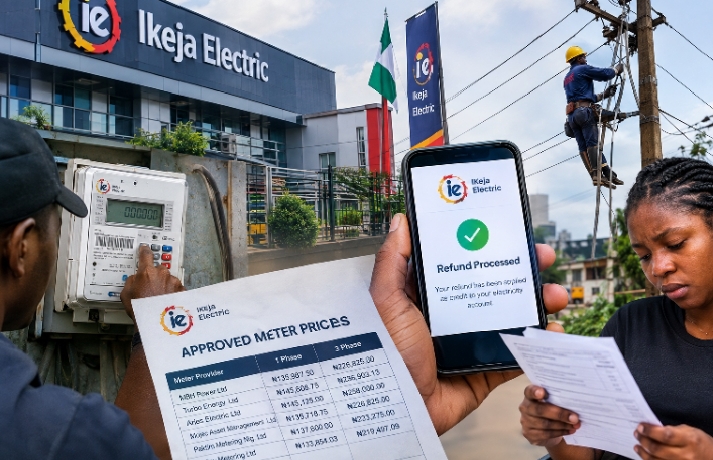
One of the most important customer related developments to emerge during September concerns refunds for customers who previously paid for electricity meters through the Meter Asset Provider programme. Ikeja Electric has started the refund process for eligible customers, with the company explaining that the approved refunds are applied as credits through electricity vending transactions over the applicable refund period rather than being presented simply as a general cash payment to customers.
The arrangement is particularly relevant to customers who paid for meters under the MAP system and have been waiting for the financial benefit associated with the refund process. Ikeja Electric’s refund system allows eligible customers to check information connected to their refund using their meter number or account number, giving customers a way to establish whether their details have been captured and how the refund is progressing.
The dashboard is designed to provide several important details, including the original meter cost, the number of refunds already made, the monthly refund amount, the total refund received, the date of the latest refund and the applicable refund token. Customers therefore have more than a general assurance that a refund is coming, because the information is intended to show the movement of the refund through the vending system.
The refund token is also connected to the contact information registered with Ikeja Electric. According to the company’s communication, the relevant token is sent to the customer’s registered phone number or email address. Customers experiencing problems with their refund have been directed towards Ikeja Electric’s official complaint channels or the company’s nearest undertaking office for further assistance.
A person who paid for a meter under the MAP programme should not assume that the refund operates like a normal transfer into a personal bank account. Ikeja Electric’s stated process connects the refund to electricity vending, meaning the customer’s refund position needs to be checked through the system provided by the company.
September Meter Prices Take Effect
Ikeja Electric published its September 2026 Approved New Meter Prices notice on September 14, 2026, with the company stating that the approved prices took effect from September 9 and will remain applicable until December 2, 2026. The announcement means customers seeking meters during this period should work with the current approved schedule rather than older price lists that may still be circulating online or through informal channels.
The latest Ikeja Electric pricing structure covers different Meter Asset Provider vendors and different meter types, with the amounts including VAT. The company’s most recently indexed detailed price schedule shows how prices vary according to the provider and whether the customer requires a 1 phase or 3 phase meter. Customers should also note that the company’s price notices state that availability can affect the ability to obtain a particular meter from a particular provider.
The previous Ikeja Electric approved schedule, published in August 2025, gives a useful picture of how the company’s vendor based pricing works. That schedule listed MBH Power Ltd at ₦135,987.50 for a 1 phase meter and ₦226,825.00 for a 3 phase meter, while Turbo Energy Ltd was listed at ₦145,608.75 for a 1 phase meter and ₦236,903.13 for a 3 phase meter.
Aries Electric Ltd was listed at ₦145,125.00 for a 1 phase meter and ₦258,000.00 for a 3 phase meter.
The same August 2025 schedule listed Mojec Asset Management Company Ltd at ₦135,718.75 for a 1 phase meter and ₦226,825.00 for a 3 phase meter. Paktim Metering Nig. Ltd was listed at ₦137,600.00 for a 1 phase meter and ₦233,275.00 for a 3 phase meter, while Holley Metering Ltd was listed at ₦133,854.03 for a 1 phase meter and ₦219,497.09 for a 3 phase meter. CIG Metering Assets Nigeria Ltd was listed at ₦150,500.00 for a 1 phase meter, while New Hampshire Capital Ltd was listed at ₦133,300.00 for a 1 phase meter and ₦231,125.00 for a 3 phase meter.
Band A Service Notices Continue
Electricity supply for Band A customers has remained another major issue through August and September. Ikeja Electric has repeatedly published notices acknowledging situations where some Band A feeders fell below the expected 20 hour minimum service level.
The notices are important because Band A classification comes with an expected minimum service level, meaning customers on affected feeders monitor their supply against the service expectation attached to that classification. Ikeja Electric’s repeated notices have therefore provided formal acknowledgement when specific feeders fail to meet the expected threshold during particular periods.
Several notices were issued during August, including notifications covering August 18 to August 19, August 19 to August 20 and August 20 to August 21. Further notices followed as the month progressed, showing that the issue was not limited to one isolated day or one particular feeder.
The pattern continued into September, with Ikeja Electric issuing notices covering August 30 to September 17, including successive 24 hour periods across the dates.
The notices do not mean that every Ikeja Electric customer experienced the same level of disruption during those periods. The affected feeders are identified separately, meaning supply conditions can vary considerably between locations even within the same distribution network. A customer on one Band A feeder can therefore have a different experience from another customer several streets away who is connected to a different feeder.
For customers following the notices closely, the repeated acknowledgements are useful because they provide an official record of specific periods when affected feeders fell below the expected service level. They also show how the company has continued communicating about supply performance rather than treating every interruption as a single network wide event.
September Faults Affect Several Areas
The Band A notices form only one part of the electricity supply picture. Ikeja Electric’s fault monitoring information has also recorded individual network problems affecting different parts of its operational area during September.
On September 8, a notification concerned the Kayode George Crescent feeder under the Ogba undertaking. The development was part of the series of specific fault and outage records being published by the company as incidents occurred across its network.
September 6 brought another significant fault update involving the 33kV Ogba New Ojodu feeder, with several areas around Ojodu affected by the incident. The feeder level detail matters because electricity distribution is organised through a network of feeders and substations, meaning a fault at one point can affect several communities connected to that particular section of the network.
September 4 also produced separate updates involving the Ago L2 33kV feeder and another incident involving Council, Owoseni, Alasia and the Isolo PTC interface. September 2 had already brought an update relating to the Isolo PTC 33kV feeder fault, adding another incident to the growing list of network issues recorded during the month.
August had its own series of faults, including a power transformer problem at Maryland PTC, an XLPE cable fault and feeder related problems around areas including Ojodu and Oke Ira. The Maryland PTC transformer issue was particularly significant because transformer faults can affect a wider area and require technical intervention before normal supply can resume.
The sequence shows that Ikeja Electric’s August and September supply situation has involved several different types of network incidents rather than one single problem. Transformer faults, cable faults, feeder faults and other operational issues have all appeared in the company’s notices during the period.
Ogba Gets A Major Power Project
One of the biggest infrastructure developments connected to Ikeja Electric during the period is the planned 12MW Independent Power Plant at the company’s Ogba Undertaking. Sahara Power Enterprises Group announced the project in late August 2026, putting its estimated investment at approximately $12 million.
The project is expected to consist of 6 gas fired generating units, with each unit designed to produce 2MW. Together, the units are expected to provide a total generation capacity of 12MW when the plant is completed and operational.
The proposed facility is targeted at industrial clusters, businesses, residential communities and public institutions around Ogba, Acme Road, Wemco Road and surrounding locations. The intention is to provide additional electricity supply within the designated areas and strengthen the reliability of electricity available to customers connected within the project area.
Sahara Power announced a completion target of the 1st quarter of 2027. That date is important because the project should not be interpreted as an immediate September increase in electricity supply. Construction and development are taking place during the current period, while the expected benefit is tied to the plant becoming operational after completion.
Ikeja Electric’s Acting Chief Executive Officer, Ogochukwu Onyelucheya, described the project as a strategic investment intended to improve the quality, reliability and sustainability of electricity supply. The project therefore represents a longer term infrastructure development rather than a short term response to individual feeder faults.
For residents and businesses around Ogba and the other identified areas, the project will be closely watched as construction progresses towards the stated 2027 completion target. Its eventual contribution will depend on completion, commissioning and the way the generated electricity is integrated into the relevant supply arrangements.
Loss Reduction Plans Move Forward
Another development emerged on September 19, 2026, when Ikeja Electric published an Expression of Interest for a Loss Reduction Franchisee Partnership. The notice points to another area of the company’s current focus, particularly efforts to address losses within the distribution network.
Electricity distribution companies deal with different categories of losses across their networks, including technical losses and commercial losses associated with issues such as energy theft, illegal connections, inaccurate metering and other forms of revenue leakage. Ikeja Electric’s franchisee partnership initiative is therefore part of a broader attempt to improve the performance of its distribution operations.
The September 19 announcement is particularly relevant because it arrived during a period when Ikeja Electric was also communicating about meter refunds, meter prices, debt management and illegal connections. Taken together, the notices show that the company’s customer and network priorities extend beyond simply restoring electricity after faults.
The loss reduction partnership is still at the Expression of Interest stage, meaning interested parties are being invited to participate in the process rather than a completed franchise arrangement already being in operation across the network. Customers will therefore need to follow subsequent announcements for details about the selected partners and the specific areas or responsibilities eventually covered.
Safety Warnings Become More Direct
Safety has also featured prominently in Ikeja Electric’s September communications. During stakeholder engagement activities, the company warned customers and communities against allowing unauthorised or unqualified electricians to interfere with electricity infrastructure.
The warning specifically addressed dangerous activities such as climbing Ikeja Electric poles, working on power lines, tampering with electrical installations, carrying out illegal connections and interfering with company infrastructure. Ikeja Electric linked unsafe activities to serious incidents and fatalities, urging customers to report dangerous situations instead of attempting to handle them personally.
The message is particularly important in communities where residents sometimes rely on informal electricians to carry out electrical work. Electricity infrastructure involving high voltage equipment presents risks that can extend beyond the individual carrying out the work, with nearby residents, workers and passersby also potentially exposed to danger.
Ikeja Electric also raised concerns about maintaining adequate clearance around high voltage lines. Encroachment and inadequate right of way can create safety problems around electricity infrastructure, particularly when buildings, structures or other activities move too close to power facilities.
Meter tampering and illegal electricity tapping were also part of the company’s September safety messaging. Ikeja Electric warned that these activities are dangerous and unlawful, meaning customers are being encouraged to use authorised procedures rather than attempting to bypass the electricity distribution system.
The safety warnings therefore sit alongside the company’s broader operational notices. While a fault may require technical intervention from electricity workers, an illegal connection or unauthorised intervention can create additional hazards and complicate efforts to maintain a safe distribution network.
Debt Management Takes Centre Stage
Ikeja Electric’s September 17 virtual stakeholder engagement also focused on Debt Management Control. The company presented the engagement as an opportunity to explain how outstanding electricity debts are handled and the payment options available to customers.
Electricity debt remains a significant customer issue because unpaid bills can accumulate over time, creating larger balances that become more difficult for households and businesses to settle at once. Ikeja Electric’s decision to dedicate stakeholder engagement attention to Debt Management Control shows that outstanding balances are receiving increased attention alongside supply and metering concerns.
Customers dealing with accumulated bills therefore have another reason to pay attention to the company’s official communication. Debt management arrangements and payment options can differ according to the customer’s account circumstances, meaning customers should obtain information through official Ikeja Electric channels rather than relying on informal advice.
The September 17 engagement also fits into the wider sequence of developments during the month. Customers are dealing with questions about refunds, current meter prices, service levels, faults, safety and outstanding bills at the same time, making accurate information particularly important for people trying to understand their individual electricity accounts.
Energy Advance Offers Short Term Relief
Ikeja Electric has also continued communicating about its Energy Advance service, which provides eligible customers with access to electricity units before making the corresponding payment.
Under the September communication, qualifying customers can obtain up to ₦20,000 worth of electricity units and pay later. The arrangement gives eligible customers a short term electricity credit option, particularly useful for customers who need electricity units immediately but may not have sufficient funds available at that exact moment.
Eligibility conditions apply, so the service should not be interpreted as a blanket ₦20,000 credit available automatically to every Ikeja Electric customer. Customers interested in the arrangement need to establish whether their account qualifies and follow the company’s stated process.
The service adds another dimension to Ikeja Electric’s September customer initiatives because it deals directly with the immediate financial pressure associated with buying electricity units. While the MAP refund programme concerns money previously paid for meters, Energy Advance operates in the opposite direction by allowing qualifying customers to receive electricity units before settling the corresponding payment.
August Developments Set The Stage
Several of the September developments make more sense when placed against the events recorded during August. The previous month saw repeated Band A service notices, feeder faults, transformer problems and cable related incidents across different parts of the Ikeja Electric network.
The Maryland PTC transformer problem was among the notable incidents during August, while faults around Ojodu, Oke Ira and other locations also appeared in operational updates. These incidents showed the range of technical problems that can affect electricity supply at distribution level.
August also provided the backdrop for the announcement of the Ogba 12MW power project. The project introduced a different dimension to the supply conversation because it focuses on additional generation capacity rather than simply responding to existing faults.
By September, the customer side of the story had expanded further. Meter refunds became a major issue for eligible MAP customers, a new meter price schedule took effect, Debt Management Control received dedicated stakeholder attention and safety messaging became more prominent.
What Customers Need To Watch
Customers following the September 2026 developments should pay particular attention to the specific category that applies to them. MAP customers waiting for refunds need to check their refund information using the available Ikeja Electric system, particularly their meter number or account number, while customers experiencing refund problems can use the company’s official complaint channels or visit the appropriate undertaking office.
Customers planning to obtain meters should pay attention to the approved price schedule effective from September 9 to December 2, 2026. Relying on older prices or figures shared without an official source could lead to confusion, especially because meter prices can change when a new approved schedule becomes effective.
Band A customers should also monitor the notices affecting their specific feeders rather than assuming that a notice covering one feeder automatically applies to every customer within the wider Ikeja Electric network. The company’s feeder based system means supply performance can vary significantly between neighbouring areas.
Customers around Ogba, Acme Road and Wemco Road have another development to follow as the proposed 12MW plant progresses towards its 1st quarter 2027 completion target. The project is not an immediate September solution, but its progress could become increasingly relevant to electricity supply discussions in the affected areas.
Customers dealing with outstanding electricity bills should also pay attention to Debt Management Control information and available payment arrangements. Those considering Energy Advance should confirm eligibility before assuming that the ₦20,000 electricity credit is available to them.
September Leaves Several Stories Unfolding
The August to September 2026 period has produced a complicated but clear set of developments for Ikeja Electric customers The company is simultaneously dealing with customer refunds, new meter pricing, Band A service performance, technical faults, electricity debts, safety risks, network losses and future generation capacity.
The MAP refund programme is particularly relevant to customers who previously paid for meters, while the new meter price schedule concerns customers seeking meters under the current approved pricing period. The repeated Band A notices provide another important record, showing instances where specific feeders fell below the expected 20 hour minimum service level.
Network fault records add another layer, with September incidents affecting areas around Ogba, Ojodu, Ago, Isolo and other locations. Those incidents sit alongside the August transformer, cable and feeder problems that affected parts of the network before September began.
The proposed $12 million 12MW Ogba power project introduces a longer term development, with 6 generating units expected to provide the planned capacity and a completion target set for the 1st quarter of 2027. The September 19 loss reduction franchisee initiative adds another operational development, while the company’s safety warnings show a stronger focus on illegal connections, meter tampering and dangerous interference with electricity infrastructure.
For customers, the biggest lesson from the latest sequence is that several separate changes are happening at the same time. A person waiting for a MAP refund has a different issue from someone trying to buy a new meter, just as a Band A customer facing a feeder outage has a different concern from a customer trying to resolve an accumulated electricity debt.
September 2026 is therefore not simply another month of electricity supply notices for Ikeja Electric customers. It has brought changes that touch the way customers receive refunds, purchase meters, monitor service levels, handle outstanding bills, access short term electricity credit and respond to safety requirements, while major infrastructure plans point towards developments that could become more significant in 2027.