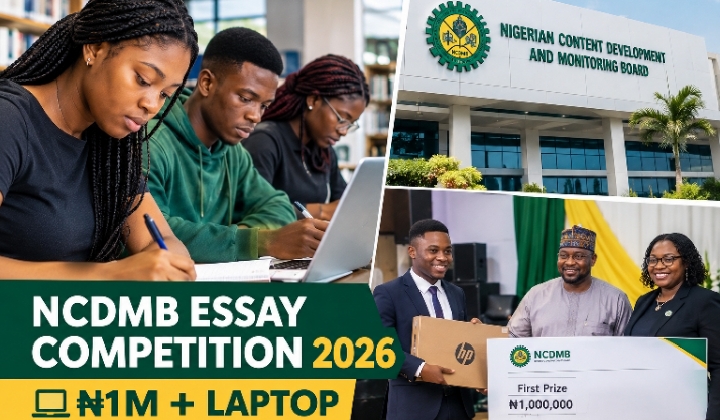
For some Nigerian undergraduates, the final week of September could bring an opportunity that goes beyond submitting another academic assignment and moving on to the next school activity. The 2026 National Undergraduate Essay Competition has opened its doors to students who meet a particular level requirement, with cash rewards, laptops and publication recognition attached to the competition. With the deadline now drawing close, students who have the required documents and can produce a strong original essay have only a limited period left to put their entries together.
The competition is being organised by the Nigerian Content Development and Monitoring Board, NCDMB, as part of its annual effort to encourage undergraduate research and writing around issues connected with Nigerian content, manufacturing and the energy sector. The 2026 edition carries a topic that places manufacturing at the centre of the discussion, giving participating students an opportunity to examine how stronger local production capacity can support sustainable local content development in Nigeria.
For students considering the opportunity, the important details go beyond the headline cash reward. The competition has specific rules on who can enter, the level of study required, the acceptable proof of studentship, essay length, originality, submission limits, judging criteria and the next stage after the written submission. Understanding those requirements could be just as important as writing the essay itself because an otherwise promising entry still has to meet the conditions set out in the official rules.
The 10th edition opens another opportunity
The 2026 NCDMB National Undergraduate Essay Competition is the 10th edition of the annual competition organised by the Nigerian Content Development and Monitoring Board. Entries for the 2026 edition opened on August 15, 2026, giving eligible Nigerian undergraduates an avenue to compete through academic writing while engaging with an issue linked to local content development and manufacturing.
This is not structured as a grant, scholarship or business loan. It is an academic writing competition in which students submit individual essays for assessment, with cash prizes and other rewards available to successful finalists. The dedicated 2026 competition portal advertises cash prizes reaching ₦1,000,000, while the competition information also provides for laptop rewards and other forms of recognition for finalists.
The competition therefore sits somewhere between an academic exercise and a national student opportunity. A participant is expected to research, develop an argument and present ideas within the required format, but the reward structure means the entry can also have a direct financial benefit for students who reach the winning positions.
The 2026 topic puts manufacturing at the centre
The official topic for the 2026 competition is “Promoting Manufacturing for Sustainable Local Content Development”. That wording gives applicants a clear direction because the essay is expected to address the relationship between manufacturing and the development of sustainable local capacity.
Manufacturing is particularly relevant to local content because local participation is not limited to having Nigerian workers involved in projects. The wider discussion also involves the ability of Nigerian businesses and institutions to produce goods, provide services, develop technical capacity and retain more value within the Nigerian economy.
A student writing on the topic therefore has room to examine how manufacturing capacity can support local content objectives, particularly within sectors connected to energy and industrial development. The subject also allows an applicant to discuss practical areas such as local production, industrial capacity, skills development, technology, supply chains, Nigerian businesses and the ability of local companies to participate more effectively in major projects.
The strongest approach will still need to remain connected to the actual topic. An essay that turns into a general discussion about manufacturing without linking the subject back to sustainable local content development may struggle to demonstrate the relevance required under the published judging criteria.
Who is allowed to enter?
The eligibility requirement is one of the first details prospective applicants need to check before spending time on their essays. The 2026 competition is specifically open to undergraduate students who are currently in 100 level or 200 level.
Eligible students can come from public universities, private universities and polytechnics in Nigeria, provided they satisfy the other requirements contained in the competition rules. The competition portal describes the participants as full time undergraduates in their first or second year.
This means the opportunity is not open to every Nigerian undergraduate. A student currently in 300 level, 400 level or a higher level does not fall within the published 100 level and 200 level eligibility requirement for the 2026 competition.
That restriction is particularly important because students sometimes assume that being an undergraduate is enough for a national student competition. Here, the level of study is specifically stated, so applicants should confirm their current academic status before submitting an entry.
Studentship documents are part of the process
Applicants are also expected to provide proof that they are students. The published rules identify a letter of admission or a signed attestation letter from the student’s Head of Department as acceptable proof of studentship.
The competition portal also identifies student identification and an admission letter among the registration documentation. Applicants should therefore gather their academic documents before starting the registration process instead of waiting until the final stage to look for them.
A recent passport photograph is also listed among the requirements on the competition portal. Current contact information is equally important because applicants are expected to provide a working phone number and email address through which competition related communication can reach them.
These requirements may appear straightforward, but they are part of the submission process and should be treated with the same attention given to the essay itself. An applicant who has spent time preparing a manuscript should also make sure the supporting documentation is properly prepared.
The cash prize reaches ₦1,000,000
The headline financial reward attached to the 2026 competition is the ₦1,000,000 first prize. The dedicated competition portal specifically advertises cash prizes up to ₦1,000,000, making the competition more than a recognition exercise for participating students.
The published 2026 prize structure lists ₦1,000,000 for the first prize, alongside a brand new laptop and publication of the winning essay in NCDMB’s Local Content Digest. The second prize carries ₦700,000 and a brand new laptop, while the third prize carries ₦500,000 and a brand new laptop.
Students who make the 4th to 10th finalist positions are also listed for brand new laptops. Certificates and additional recognition are also associated with the finalist stage of the competition.
The structure means the opportunity extends beyond the 3 highest cash positions. A student who reaches the top 10 can still receive a laptop even without taking the ₦1,000,000, ₦700,000 or ₦500,000 cash position.
Previous prize figures provide useful context
The cash figures published for the 2026 competition also have a useful point of comparison from the previous edition. NCDMB’s official announcement on the 2025 9th edition prize ceremony confirmed that the overall winner received ₦1,000,000 and an HP laptop.
The first runner up received ₦700,000 and an HP laptop, while the second runner up received ₦500,000 and an HP laptop. The other 7 finalists received HP laptops as consolation prizes.
That previous official prize information helps place the 2026 figures in context, while the 2026 competition portal itself remains the direct source for the current edition’s advertised rewards. For an applicant, the key point is that the current competition explicitly carries cash rewards, with ₦1,000,000 listed as the highest prize.
The first prize also comes with publication recognition. The winning essay is scheduled for publication in NCDMB’s Local Content Digest, giving the winner an additional form of exposure beyond the financial reward and laptop.
September 26 is the important date
The competition opened on August 15, 2026, but the date that matters most to anyone preparing an entry now is September 26, 2026. That is the published submission deadline for completed manuscripts and accompanying documents.
As of September 19, 2026, the deadline is only about 1 week away. This leaves prospective applicants with a relatively short period to confirm eligibility, prepare their documents, research the topic, write the essay, edit it and complete the online submission.
The rules state that late manuscripts will not be considered. That makes September 26 more than a suggested date because the published rules expressly require completed submissions to be made on or before the deadline.
Students who are already eligible should therefore avoid leaving the registration and document preparation until the final hours. Internet problems, document issues, editing mistakes or an incomplete registration could become difficult to resolve when the deadline is approaching.
The essay must stay within 1,500 words
The 2026 rules place a maximum of 1,500 words on the essay. Applicants therefore have to make their argument within a defined space rather than simply producing the longest possible submission.
The competition information also says the word count should be stated at the end of the essay. References and appendices are excluded from the word count calculation according to the detailed competition information.
This makes planning important. A student needs enough space to introduce the issue, develop the argument, present relevant evidence or examples and reach a clear conclusion without allowing the essay to become unnecessarily broad.
The 1,500 word limit also means every major point needs to contribute directly to the topic. Spending too much of the available space on a general introduction to manufacturing could leave insufficient room for the part of the essay that actually addresses sustainable local content development.
Each student must submit individually
The competition rules do not permit co authored entries. Each participant must prepare and submit an individual essay.
That requirement matters because students may naturally be tempted to discuss the topic with classmates and divide the research or writing process. Discussion and research preparation are different from submitting a jointly written essay, however, and the published rules require an individual entry.
Each participant is also limited to 1 submission. Sending several different essays is therefore not an option under the rules.
Students preparing their entries should decide on their argument carefully before submission and make sure the final version is the one they intend to enter. Multiple submissions can lead to disqualification according to the competition information.
Originality is a major requirement
The essay has to be original work written specifically for the competition. This is one of the areas applicants should take seriously because the published competition information states that submissions will undergo plagiarism checks.
The 2026 competition information also states that entries will undergo AI and plagiarism testing to assess originality and authenticity. Applicants therefore need to pay attention not only to the subject matter but also to how the final essay is produced.
Using information from reliable sources for research is not the same thing as copying another person’s work. A student can study reports, documents and other materials before developing an independent argument, but the submitted manuscript needs to remain an original piece of work.
The requirement also makes proper referencing important where outside information is used. A student who has researched statistics, policies or technical information should ensure that the material is properly handled rather than presented as personal research or original findings.
The judging criteria are clearly stated
The published 2026 rules provide applicants with a useful picture of the areas that judges will consider. The criteria include clarity of expression, spelling and grammar, originality of thought, depth of analysis, relevance to the industry and conformity with the contest rules.
Clarity matters because the judges need to understand the argument being presented. A student may have several interesting ideas, but those ideas still need to be expressed in a way that makes the central argument easy to follow.
Spelling and grammar are also specifically included, so proofreading should not be treated as an optional final step. Errors can make an otherwise strong argument harder to understand and can affect the presentation of the essay.
Originality of thought gives applicants room to bring their own perspective to the topic. Rather than simply repeating familiar statements about manufacturing, an applicant can develop practical ideas around how local production capacity could contribute to sustainable local content development.
Depth of analysis is another important part of the assessment. This means the essay needs more than a collection of statements. The applicant should explain the issue, examine its implications and connect the argument back to the competition topic.
Relevance to the industry matters
The judging criteria specifically mention relevance to the industry. That requirement gives the topic an important direction because the competition is organised by NCDMB and focuses on issues connected with Nigerian content development.
An applicant can discuss manufacturing from several angles, but the essay should remain connected to the industrial and local content context. Issues such as Nigerian manufacturing capacity, local suppliers, technical skills, technology transfer, industrial infrastructure and participation in energy related activities can provide areas for discussion when they are properly connected to the topic.
The goal should be to keep the essay focused rather than trying to discuss every problem facing Nigerian manufacturing. A focused argument can give the writer enough room to explain the relationship between manufacturing and sustainable local content development within the 1,500 word limit.
The rules themselves are part of the assessment
Conformity with the contest rules is one of the listed judging criteria. This is important because an applicant’s attention should extend beyond the substance of the essay.
The manuscript has specific presentation requirements. The entrant’s name is not supposed to appear on the manuscript itself. The name is placed on a separate title page, which is removed when the entry is assigned a number.
That arrangement is part of the competition process and applicants should follow the instructions rather than modifying the format based on personal preference. The purpose is to keep the submitted manuscript aligned with the competition’s assessment procedure.
A student should therefore check the final document against the official rules before uploading it. Word count, title page requirements, studentship evidence, originality, submission limits and other documentation should all be reviewed before the final submission.
The competition continues after the essay
Submitting the essay by September 26 does not necessarily mark the end of the process for every participant. The published rules provide for another stage involving shortlisted entrants.
According to the 2026 rules, shortlisted candidates will be contacted for the 3rd and final round interactive assessment on or before October 10, 2026.
This means students who make the shortlist need to remain available after submitting their essays. An applicant should not assume that uploading the manuscript means there will be no further communication or participation requirement.
The interactive assessment gives the competition another stage through which shortlisted students can engage with the process. Anyone entering should therefore keep the contact information supplied during registration active and check their communication channels after submission.
October 10 marks the shortlist stage
October 10, 2026 is the date attached to the communication of shortlisted candidates for the 3rd and final round interactive assessment. The published wording says shortlisted entrants will be contacted on or before that date.
That gives the competition a clear progression from written submission to further assessment. Students submitting entries in September should therefore keep track of announcements and communications after the deadline.
The date also helps applicants understand the expected timeline. The process is not designed to run indefinitely after September 26 because the next major stage is already identified within the published rules.
For participants, keeping copies of their submitted documents and checking their email and phone information after submission would be a sensible part of following the competition process.
October 22 is the award ceremony
The 2026 award and prize giving ceremony is scheduled for October 22, 2026. This is the date identified for the presentation of the competition’s prizes and recognition.
The timeline therefore moves from the August 15 opening date to the September 26 submission deadline, followed by the shortlisted candidate stage on or before October 10 and then the award ceremony on October 22.
For an undergraduate deciding whether to enter during the final week, this provides a clear picture of the remaining competition period. The immediate task is the submission, while the later dates concern the selection and recognition stages.
The winning essay receives publication recognition
The first prize has another feature beyond the ₦1,000,000 cash reward and laptop. The winning essay is scheduled for publication in NCDMB’s Local Content Digest.
That publication element gives the competition an academic and professional dimension. The winner is not simply receiving a cash award but also having the submitted work recognised through an NCDMB publication.
For an undergraduate, having an essay selected for publication can also form part of their academic and professional portfolio. The competition is therefore structured around both financial rewards and recognition of the student’s writing.
The publication reward is specifically attached to the first prize in the 2026 competition information, making it one of the distinctions between the top position and the other finalist rewards.
The opportunity is not a grant
One detail should remain clear when describing the competition in an opportunities list. The NCDMB National Undergraduate Essay Competition is not a grant programme.
There is no business funding application in which applicants receive capital to start or expand a company. There is also no loan repayment arrangement attached to the opportunity. Instead, students compete through an academic essay, with cash prizes awarded according to the competition’s results.
This distinction matters for students searching specifically for financial opportunities because the ₦1,000,000 figure is a competition prize rather than funding that every eligible applicant can receive.
The opportunity is therefore best described as a cash prize academic competition for eligible Nigerian undergraduates.
What applicants should prepare
A prospective applicant should first confirm that they are currently studying in 100 level or 200 level at an eligible Nigerian university or polytechnic. Once that requirement is confirmed, the next step is to gather the documents required for registration.
The student should have an admission letter or acceptable proof of studentship, student identification where required, a recent passport photograph, a working phone number and a working email address. The essay itself should address the official topic and remain within the 1,500 word maximum.
The final manuscript should be the student’s own individual work. Only 1 entry is permitted, and the applicant should make sure the final version complies with the competition’s formatting and submission requirements before uploading it.
Applicants should also remember that the deadline is September 26, 2026. Waiting until the last day can create unnecessary pressure, particularly where document preparation or online submission is involved.
The timeline is already set
The 2026 competition opened on August 15, 2026, marking the beginning of the entry period for eligible 100 level and 200 level undergraduates. Students have until September 26, 2026, to submit their completed manuscripts and required documents.
The next significant date is October 10, 2026, when shortlisted candidates are expected to be contacted on or before the date for the 3rd and final round interactive assessment. The process then moves towards the award and prize giving ceremony scheduled for October 22, 2026.
That timeline gives applicants a relatively short window between the submission deadline and the next stage. Students who enter should therefore retain their registration details and remain attentive to communication from the competition organisers.
The dates can be summarised simply: August 15, 2026 for opening, September 26, 2026 for submission, October 10, 2026 for shortlisted candidate contact and October 22, 2026 for the award ceremony.
The prize structure makes the final week important
With September 26, 2026 approaching, the NCDMB competition is now entering the final part of its submission period. The opportunity is particularly specific because it targets only 100 level and 200 level undergraduates, meaning students who meet that condition have a defined window to take part.
The rewards also make the competition notable among academic opportunities. The first prize is listed at ₦1,000,000 with a laptop and publication recognition, while ₦700,000 and ₦500,000 are listed for the second and third positions respectively, with laptops attached to those prizes. The 4th to 10th finalists are also listed for laptops.
At the same time, the competition requires more than simply submitting an essay before the deadline. The manuscript must be original, individually written, within the 1,500 word limit and relevant to the official topic. Students must also provide the required proof of studentship and other registration information.
How to apply
The 2026 competition is being handled through the dedicated NCDMB National Essay Competition portal. Applicants can use the official competition portal to access the registration process, competition information, requirements and contact details.
The portal should be treated as the main destination for applicants rather than relying on information circulating through unrelated websites or social media posts. Students should read the current 2026 requirements carefully before completing their submission.
Applicants should also ensure that the details entered during registration are accurate and that their contact information remains accessible after submission because shortlisted candidates are expected to receive further communication during the competition process.
The key details students need to remember
The NCDMB National Undergraduate Essay Competition 2026 is the 10th edition of the annual competition organised by the Nigerian Content Development and Monitoring Board. It is open to eligible 100 level and 200 level undergraduate students in Nigerian public universities, private universities and polytechnics.
The official essay topic is “Promoting Manufacturing for Sustainable Local Content Development”. The maximum essay length is 1,500 words, and entries must be original individual submissions. Applicants are required to provide proof of studentship and other documents listed by the competition portal.
The first prize is ₦1,000,000 with a brand new laptop and publication of the winning essay in NCDMB’s Local Content Digest. The second prize is ₦700,000 with a laptop, while the third prize is ₦500,000 with a laptop. Laptops are also listed for finalists placed from 4th to 10th.
Entries opened on August 15, 2026, and the deadline is September 26, 2026. Shortlisted candidates are expected to be contacted on or before October 10, 2026, for the 3rd and final round interactive assessment, while the award and prize giving ceremony is scheduled for October 22, 2026.
For students who meet the eligibility requirements, the immediate deadline is the date to keep in view. The opportunity combines an academic writing challenge with substantial cash rewards and laptop prizes, but participation still depends on meeting the published rules from the beginning of the application through the final assessment stage.