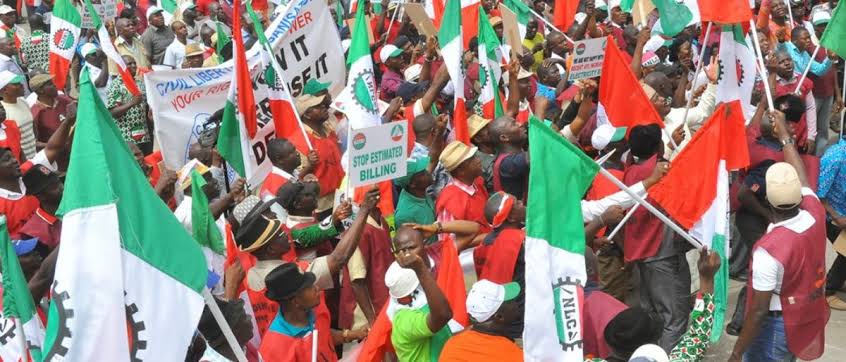
The fragile Nigerian economy may come under further strain amid an imminent move by workers to embark on industrial action over the cost-of-living crisis. This worrying development followed an announcement by public servants under the umbrella of the Joint National Public Service Negotiating Council (JNPSNC) saying they will begin a three-day warning strike on Friday over economic hardship in the country.
According to JNPSNC, it had earlier given the government until September 30 to address the rising cost of petrol and begin negotiations for a new national minimum wage. It noted that this deadline remains sacrosanct.
The grievances and demands of the association were contained in a statement on Tuesday by Gbenga Olowoyo, national secretary of JNPSNC and general secretary of the Nigeria Civil Service Union (NCSU).
Olowoyo said the council has mobilised workers to embark on a strike should President Bola Tinubu fail to announce a drastic cut in petrol price and a new national minimum wage in his Independence Day speech.
Demand of the council
The council anchors its demands on three critical and key issues that surround the cost of living in the country. It asked the president to drastically reduce the price of petrol to N500 and also ratify the wage award to ease the excruciating economic hardship that Nigerians are grappling with.
The demands are, “Reduction of fuel price to N500 per litre. The Federal Government should take urgent steps to bring down the price of Premium Motor Spirit (PMS) to N500 per litre
“The Federal Government should urgently approve a wage award for Nigerian workers to cushion the effects of the prevailing harsh economic conditions being experienced by workers, their dependants, and vulnerable Nigerians.
“It is imperative to state clearly that the Independence Day address of the President of the Federal Republic of Nigeria should adequately address these critical issues.
“Consequently, the council states that failure by the Federal Government to take the necessary steps to address these issues on or before 30th September 2026 will leave Nigerian workers with no option but to commence a three-day warning strike, with effect from Friday, 2nd October 2026, to press home their demands,” the statement reads.
Olowoyo said the council had first communicated the three demands to the president in a letter written to him on September 21, wherein they asked for the commencement of negotiations for a minimum wage of not less than N500,000 from 2027, among others.
It, however, expressed displeasure that no concrete steps had been taken on the stated demands more than a week after the letter
JNPSNC proffers solution to high petrol price
The JNPSNC national secretary said the government can reduce petrol price through the provision of an intervention fund to address the landing costs of the commodity and support oil and gas operators.
“It is equally important for the Federal Government to ensure the sale of crude oil to the Dangote Refinery and operators of modular refineries on appropriate terms to facilitate increased domestic refining and help bring down the price of petroleum products,” Olowoyo said.
He argued that the current price of PMS, ranging from N1,450 to N2,000 and, in some locations outside major communities and cities, as high as N2,500 per litre, is unacceptable to Nigerian workers.
According to him, “the council maintains that the economic hardship occasioned by the high cost of fuel is placing the survival of Nigerian workers, their dependants and the general populace under severe pressure, making it increasingly difficult for Nigerians to live normal and dignified lives”.
He said the council believes that urgent action on the demands will further enable public servants to consolidate their loyalty, commitment and productivity within the public service ecosystem.