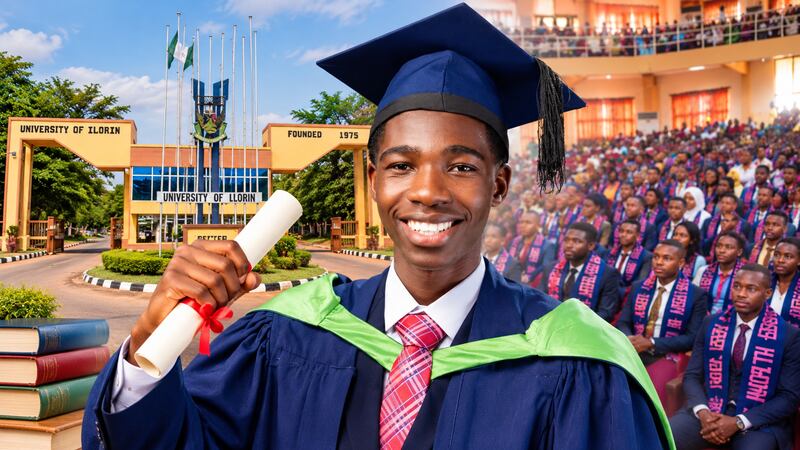
For University of Ilorin graduate, Francis Olusegun, graduating with a perfect 5.00 Cumulative Grade Point Average was the result of sustained effort, self-discipline and a willingness to adapt his study methods throughout his undergraduate years.
Olusegun, who emerged as the best graduating student in the Department of Mathematics for the 2025/2026 academic session, said his ambition to achieve the feat took shape after he saw his results in his first year.
“I began to imagine graduating with a 5.00 CGPA after seeing my 100-level results. That was when the thought came to me that we could actually break the record,” he said in an interview published by the Union of Campus Journalists, University of Ilorin.

The graduate explained that his desire to excel had existed long before university, as he consistently challenged himself to become the best student wherever he studied.
Although Mathematics is widely regarded as an abstract discipline, Olusegun said his longstanding fascination with solving mathematical problems made the course a natural choice.
“What drew me to the course was my love for it, which started in primary school. I have always enjoyed solving mathematical problems,” he said.
“There is a connection between me and Mathematics, and that made it easy for me to choose it.”
Consistency over rigid routines
Olusegun said maintaining his perfect CGPA across four academic sessions and eight semesters required confidence, consistency and the ability to change strategies whenever necessary.
“Maintaining a perfect CGPA is not easy, but the first thing is that I had already won in my mind. Even before I started reading or doing anything, I had already won in my mind,” he said.
Rather than depend on a fixed reading timetable, he adopted a flexible approach that allowed him to adjust his methods when they became less effective.
“I also do not have a fixed schedule. Once I realise that a particular approach is no longer working, I look for another one. I am very flexible, and I try to remain consistent with my academics,” he said.
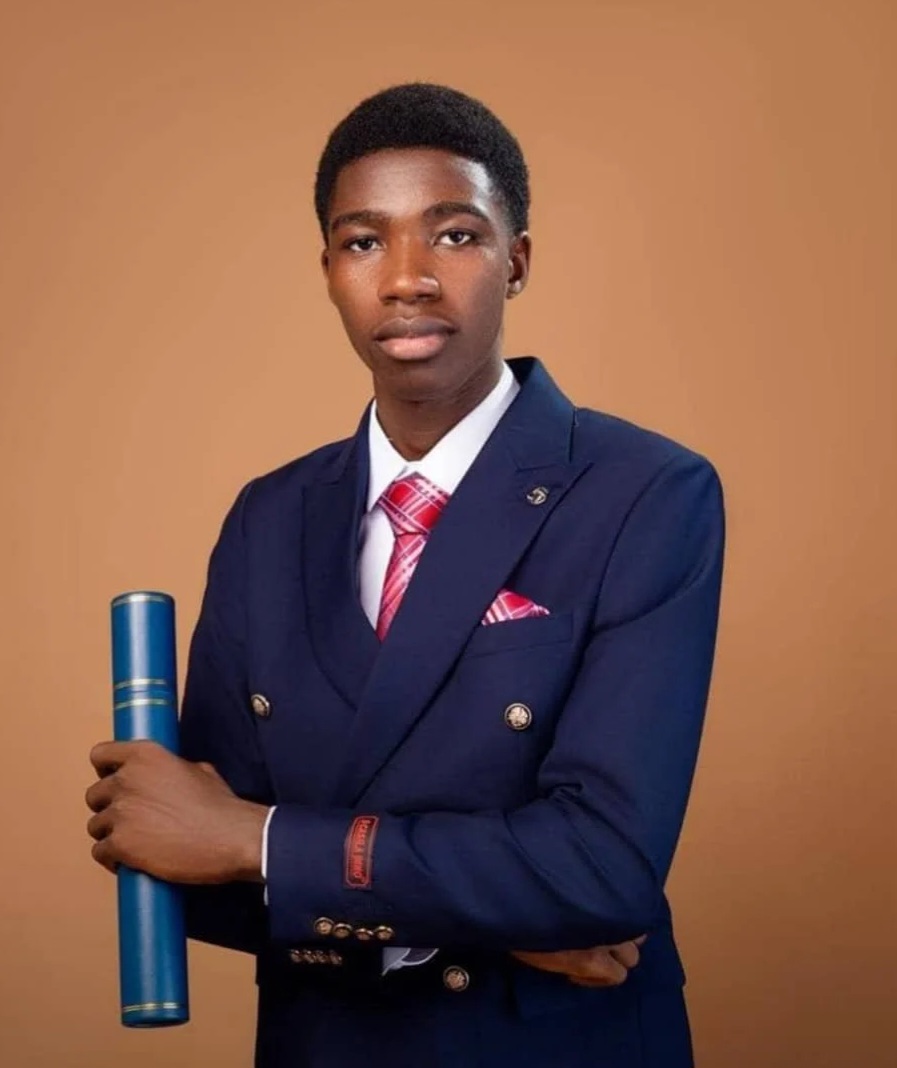
His routine included revising lessons on the day they were taught, researching difficult topics and using available tools to improve his understanding of complex concepts.
He also paid attention to continuous assessment, explaining that strong test scores helped him build a solid foundation before examinations.
“I would say that I paid close attention to my test scores because the combination of my test and examination scores determines my final result,” he said.
Olusegun added that he aimed to score above 70 per cent in assessments to give himself some margin for error.
Overcoming distractions and financial difficulties
The mathematics graduate acknowledged that social media sometimes interfered with his studies, prompting him to limit its use when academic demands required greater concentration.
“I can be distracted, especially by social media. There are times when I have to put social media aside, and there are other times when I can return to it. That is one of the things that can really distract me,” he said.
He also recounted how a faulty phone disrupted his first-year studies, leaving him without the device until after his first-semester examinations.
“One of the most difficult experiences I had was when my phone became faulty in 100 level. I could not repair it before my first-semester tests, and I did not get it repaired until after the examinations. It was a very difficult period for me,” he said.
A friend eventually lent him another phone, enabling him to continue reading and practising despite the setback.
Financial constraints also presented difficulties during his university education, but Olusegun said he sought assistance from people whenever he could not meet his basic needs.
“I believe there is no excuse for failure. If there is something I cannot handle on my own, I look for a way to get the help I need rather than allow the situation to stop me from achieving my goals,” he said.
He attributed his motivation largely to personal ambition, noting that his parents, who were not formally educated, did not constantly push him academically.
“My parents are not educated, so I cannot say that somebody was constantly pushing me academically. I pushed myself because I knew what I wanted to achieve,” he said.
He also credited his parents, church members, friends and graduates of his department with providing financial assistance, encouragement and academic guidance throughout his studies.
Research ambitions beyond graduation
Olusegun described his achievement as the fulfilment of a long-standing ambition, adding that he was the first person in his immediate family to earn a first-class degree.
“It means a lot to me. It shows me that I can do more and that this is only the beginning of my greatness,” he said.
The graduate said his next priority was postgraduate education, with the possibility of pursuing a master’s degree or proceeding directly to a doctorate.
“My next step is to further my education, either by pursuing a master’s degree or going directly for a PhD. I am interested in research, so that is the direction I want to explore,” he said.
He is particularly interested in mathematical biology and the application of mathematical models to understanding and forecasting infectious diseases.
Olusegun said he hopes to combine mathematics with emerging technologies, including artificial intelligence, to support epidemiological research and help public health agencies analyse disease patterns and make effective use of available resources.
His achievement comes as the University of Ilorin prepares to graduate 16,152 students at its 41st convocation ceremony for the 2025/2026 academic session, including 365 first-class graduates, according to the vice-chancellor, Professor Wahab Egbewole.