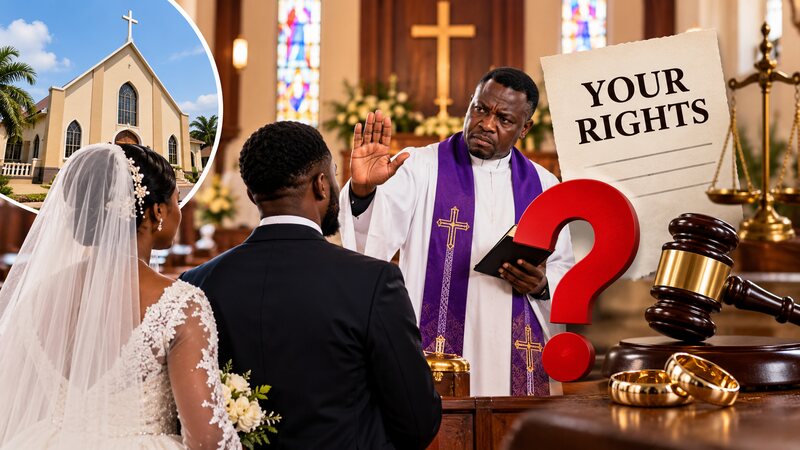
For many Nigerian couples, the journey to a church wedding involves months of preparation, financial commitments, family meetings and discussions with the pastor. The wedding date may already be printed on invitation cards, guests may have made travel arrangements, and money may have been spent on clothes, decorations and reception venues. Yet, a disagreement over the couple’s circumstances or the church’s rules can suddenly put the entire ceremony in doubt.
This happened in Aba, Abia State, in November 2023, when a church cancelled a couple’s wedding after discovering that the bride was pregnant. The families were reportedly left scrambling for another place to conduct the ceremony, eventually finding a different church willing to marry them. The incident raised questions about how much authority a church has over a couple’s wedding and whether religious rules can prevent legally eligible adults from marrying in their chosen place of worship.
The issue goes beyond pregnancy. A pastor may refuse to conduct a wedding because one partner is still married, the couple has not completed premarital counselling, the church objects to remarriage after divorce, or the intending spouses have failed to meet certain religious requirements. Nigerian law also establishes conditions that must be satisfied before a statutory marriage can be solemnised.
Understanding the relationship between church authority, religious freedom and marriage legislation helps explain when a refusal may be justified, what happened in documented cases and the options available to couples who find themselves in this situation.
The Marriage Act Governs Statutory Church Weddings
The Marriage Act provides the legal framework for statutory marriages in Nigeria, including marriages conducted in licensed places of worship. It sets out requirements relating to the minister officiating the ceremony, the necessary documentation and the circumstances in which a marriage may lawfully proceed.
Section 21 addresses the solemnisation of statutory marriages in licensed places of worship. Section 22 states that a minister must not celebrate a marriage if the minister knows of a just impediment to it, and requires the parties to deliver the registrar’s certificate or the appropriate licence before the ceremony. Section 23 addresses the places where a minister may celebrate a marriage under the Act.
These provisions mean that a pastor conducting a statutory wedding has responsibilities under Nigerian law, separate from the church’s religious expectations. If information emerges showing that the proposed marriage faces a legal obstacle, the minister must consider the applicable legal requirements before proceeding.
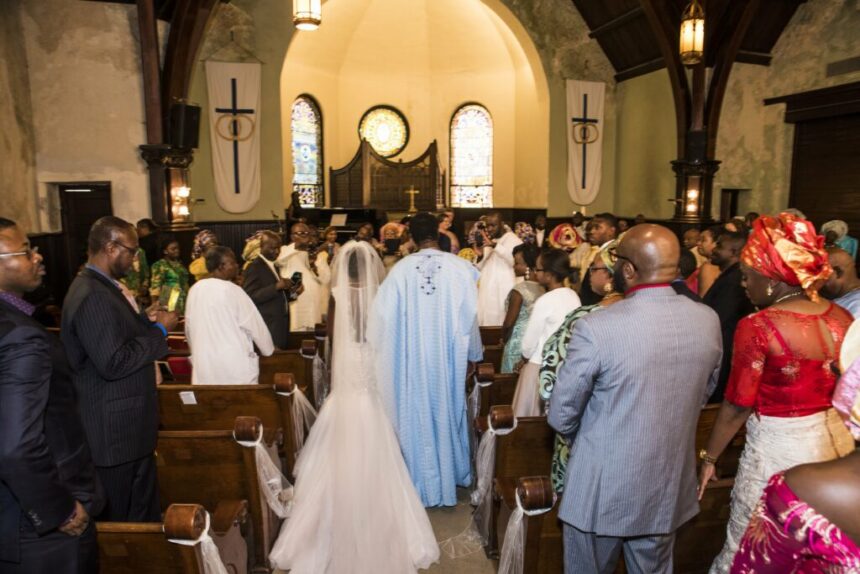
However, the legislation does not create a general obligation for every church to conduct a wedding for any couple who approaches it. A couple’s eligibility to marry under Nigerian law is different from their eligibility to participate in a particular church’s religious ceremony.
The distinction becomes particularly important when the couple has fulfilled the legal requirements but the church refuses to conduct the wedding because of its doctrine. Such a disagreement requires an examination of the church’s rules, the circumstances of the refusal and any legal obligations arising from the arrangement.
Aba Wedding Cancellation in November 2023
One of the clearest Nigerian examples of a church refusing to conduct a wedding involved an incident reported on November 27, 2023, at the Assemblies of God Church in Ehere, Ogbor Hill, Aba, Abia State.
The couple, identified in reports as Israel Kennedy and Rose, had arrived at the church with their families for a wedding scheduled to take place after the service. The ceremony was reportedly cancelled after a pregnancy test ordered by the church indicated that the bride was pregnant. The decision caused confusion as the families attempted to persuade the church leadership to reconsider.
According to the reports, the church’s position reflected its rules against conducting weddings for pregnant brides. The couple and their families had already made preparations, making the cancellation particularly difficult because the decision came on the day of the planned ceremony.
The couple eventually found another church in Aba willing to conduct the wedding. Reports published on November 29, 2023, stated that the second church agreed to proceed under its own rules, which permitted the marriage in the circumstances described. The original church was also reported to have suspended the couple under its internal regulations.
The incident illustrates how 2 churches can reach different decisions about the same couple because their religious rules are not necessarily identical. One church may impose restrictions on weddings involving pregnancy before marriage, while another may permit the ceremony after considering its own requirements.
The reports documented the church’s decision and the couple’s subsequent wedding elsewhere, but they did not establish a judicial determination that the refusal was lawful or unlawful.
The case therefore provides a practical example of a religious dispute rather than a definitive legal precedent. It also shows why couples should establish a church’s requirements before making substantial financial commitments or announcing a wedding date.
A Pastor May Refuse a Wedding Over an Existing Marriage
An existing marriage can create a more direct legal obstacle than a disagreement over church membership or premarital counselling. Where a person remains legally married under a statutory marriage, the person generally cannot enter another statutory marriage while the existing marriage remains in force.
Section 22 of the Marriage Act prohibits a minister from celebrating a marriage when the minister knows of a just impediment. The Act also contains provisions concerning prohibited marriages and circumstances in which a purported marriage may be void. The precise legal position depends on the facts, including the nature and status of the earlier marriage.
A Nigerian court case, Tongo v. Tongo (2020), provides an example of a dispute involving an alleged existing marriage and a pastor’s refusal to conduct a wedding.
The case record, as reproduced by LawCare Nigeria, recounts allegations that a woman took a man to a church on I.C.E. Road in Benin City, where he refused to marry her and the pastor also declined to conduct the ceremony because the man allegedly had a wife and children. The dispute later involved a purported marriage certificate signed at the Oredo Marriage Registry.
The details require care because the allegations in a court record should not automatically be presented as findings that the court established. Nevertheless, the case demonstrates the kind of circumstances in which a pastor may refuse to proceed because of concerns about an existing relationship or a possible legal impediment.
A previous customary marriage, a statutory marriage and a marriage that has been legally dissolved may have different consequences. A pastor cannot determine the entire legal position merely by hearing that someone was previously married. The relevant facts and applicable law must be considered.
Where a previous statutory marriage has ended, the couple should establish that it was legally dissolved before proceeding with another statutory wedding. If the church refuses to conduct the ceremony because it believes an earlier marriage remains valid, obtaining legal advice may help resolve the question.
Divorce Can Create Religious Restrictions on Remarriage
Divorce presents another situation in which legal eligibility and religious approval may differ. A person whose previous marriage has been legally dissolved may be free to remarry under civil law but still face restrictions imposed by the church they wish to marry in.
Some Christian denominations permit remarriage after divorce in specified circumstances, while others apply stricter interpretations of their religious teachings. A church may consider the circumstances of the previous marriage, the grounds for divorce or whether the person has received the required pastoral approval.
The legal position must be considered separately from the religious question. A divorce decree or other relevant court documentation may establish the status of a previous statutory marriage, but it does not necessarily mean that every denomination will agree to conduct a subsequent wedding.
A couple facing this situation should ask the church to explain its remarriage policy before making wedding arrangements. If the refusal is based on the claim that the earlier marriage remains legally valid, a lawyer can examine the relevant records and establish whether the claim is correct.
A church’s refusal to conduct a religious ceremony does not automatically establish a legal wrong. Equally, the fact that the church has a doctrine on divorce does not settle every possible dispute involving an agreement, financial loss or another recognised legal claim.
Can a Church Refuse a Wedding Because the Couple Are Not Members?
Some couples approach a church because they prefer its location, facilities or religious traditions, even though they do not regularly attend services there. Others may have attended for years without completing the church’s formal membership process.
Churches may establish rules requiring intending couples to be members, attend premarital counselling or obtain approval from the pastor. The conditions vary between denominations and individual congregations.
Where a church has clearly communicated its requirements, a couple who refuses to comply may be told that the ceremony cannot proceed. The decision may reflect the church’s internal rules rather than an allegation that the couple is legally prohibited from marrying.
The Marriage Act does not establish a general rule requiring every church to conduct a wedding for any couple who requests one. However, the legal implications of a particular refusal depend on the circumstances, including any agreement already reached and any obligations the church may have assumed.
For example, a dispute could become more complicated if a church accepted payments under agreed conditions, confirmed a booking and later withdrew its commitment. Whether the couple would have a legal claim would depend on the terms of the arrangement, the reason for the refusal and the applicable law.
Couples planning to marry outside their regular congregation should therefore confirm membership requirements, counselling procedures and payment conditions before committing money to the ceremony.
What Nigerian Courts Have Said About Religious Freedom
Section 38 of the Constitution of the Federal Republic of Nigeria 1999, as amended, protects freedom of thought, conscience and religion. This provision is relevant to disputes involving religious institutions and the practice of religious beliefs.
A significant case in this area is Olisa Agbakoba v. Attorney General of the Federation (2021), reported as LPELR 55906(CA). The Court of Appeal delivered its judgment on November 1, 2021, in an appeal involving arguments about freedom of religion and statutory provisions governing marriage.
Agbakoba, a Catholic, challenged provisions of the Marriage Act and the Matrimonial Causes Act on the grounds that they interfered with his freedom to observe the sacrament of matrimony according to Catholic canon law. His case raised questions about the relationship between religious beliefs, the state’s regulation of marriage and the legal framework governing marital disputes.
The case arose from a broader challenge to statutory regulation of marriage rather than a direct claim by a couple whose wedding had been cancelled by a pastor. It should therefore not be described as a court ruling specifically authorising churches to refuse weddings.
Its relevance lies in the wider legal questions it examined concerning religious practice and marriage legislation. It also demonstrates that disputes involving marriage, religious doctrine and constitutional rights can require judicial consideration of the particular provisions and claims involved.
For couples facing a refusal, the case provides context rather than an automatic answer. Whether a particular church’s decision can be challenged depends on the facts and the legal basis of the complaint.
Does Every Church Wedding Count as a Statutory Marriage?
A wedding conducted inside a church does not automatically become a statutory marriage simply because a pastor officiates the ceremony. The legal status of the marriage depends on the applicable requirements and the circumstances in which it was conducted.
Under the Marriage Act, statutory marriages may be solemnised in licensed places of worship, subject to the relevant requirements. Section 22 addresses the necessary certificate or licence, while Section 23 regulates where the minister may celebrate the marriage.
The distinction between a religious ceremony and a statutory marriage was discussed in Olisa Agbakoba v. Attorney General of the Federation. The case addressed the legal relationship between a church marriage conducted according to Catholic rites and a statutory marriage recognised under Nigerian law.
A couple may receive a religious blessing and regard the ceremony as meaningful within the church, but the ceremony must satisfy the applicable legal requirements to qualify as a statutory marriage under the Marriage Act. The legal effect of any ceremony that does not meet those requirements depends on its circumstances and any other applicable form of marriage.
The couple should establish whether the church is refusing a religious ceremony, declining to conduct a statutory marriage or raising concerns about the legal validity of the proposed union.
Knowing the difference can help prevent couples from assuming that a religious ceremony automatically fulfils every legal requirement.
Can Couples Sue a Church for Refusing to Conduct a Wedding?
A couple who believes that a church has acted unlawfully may consult a qualified Nigerian lawyer to determine whether a legal claim is available. The fact that a wedding was cancelled or refused does not, by itself, establish grounds for a successful lawsuit.
The reason for the refusal is central. A decision based on an existing legal impediment may raise different issues from one involving a disputed payment, a binding agreement or an alleged violation of a recognised legal right.
Couples should retain receipts, booking records, written agreements and messages exchanged with the church. These records can help establish whether the church had made a commitment, what conditions applied and whether the couple incurred expenses in reliance on that commitment.
For instance, if a church accepted payment for a ceremony and subsequently cancelled it, the legal position would depend on the agreed terms, the circumstances of the cancellation and whether the church was entitled to withdraw under those terms. A payment alone does not automatically prove that the church is liable for the couple’s losses.
Where the complaint concerns a possible violation of a fundamental right, a lawyer can assess whether a fundamental rights application or another legal procedure is appropriate. The available remedy will depend on the legal basis of the claim and the evidence.
Couples should seek advice before assuming that a court can compel a pastor to conduct a religious ceremony. The appropriate legal response depends on the specific dispute and the remedy recognised by law.
Steps Couples Can Take After a Wedding Refusal
The first step is to ask the church for a clear explanation of its decision. The refusal may concern membership, incomplete counselling, a previous marriage, missing documents or a religious rule that the couple has not fulfilled.
The couple should then establish whether the issue can be resolved. Where the problem concerns paperwork or an outstanding counselling session, completing the requirement may allow the wedding to proceed on another date. Where the disagreement concerns doctrine, the couple will need to decide whether it can meet the church’s conditions.
If the church claims that the proposed marriage would violate Nigerian law, the couple should obtain legal advice to establish whether that claim is correct. This is particularly important where the issue involves a previous marriage, the status of a divorce or the documents required for a statutory wedding.
Where the church remains unwilling to conduct the ceremony, the couple may consider another church that is willing to proceed and is legally authorised to solemnise the intended form of marriage. Depending on their circumstances, they may also explore the appropriate marriage registry.
The experience in Aba in November 2023 shows that a couple may find another church willing to conduct a wedding after an initial refusal. However, that option does not remove the need to satisfy the legal requirements for the marriage being planned.
The Legal Position Depends on the Circumstances
Nigerian churches may refuse to conduct weddings for reasons involving religious doctrine, internal procedures or concerns about legal eligibility. The Marriage Act establishes requirements for statutory marriages, while Section 38 of the Constitution protects freedom of thought, conscience and religion.
The cancellation of a wedding in Aba in November 2023 provides a documented example of a church refusing to proceed because of pregnancy. The Tongo v. Tongo case record illustrates a different situation involving a pastor’s reported refusal because a person allegedly had an existing wife. Meanwhile, Olisa Agbakoba v. Attorney General of the Federation examined broader questions concerning religious freedom and the statutory regulation of marriage.
These examples involve different circumstances and should not be treated as establishing one rule for every church wedding. The legal consequences depend on the reason for the refusal, the church’s obligations and the facts of the particular dispute.
For intending couples, the most important step is to establish whether the church’s decision concerns its religious requirements, a genuine legal impediment or a matter that may give rise to a recognised legal claim. That distinction determines the questions to ask, the records to preserve and the options worth considering before making further wedding arrangements.