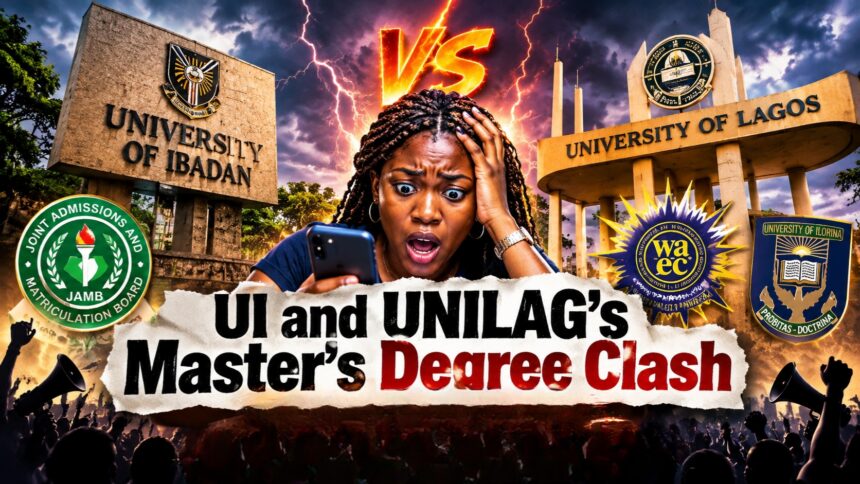
A simple request for advice about choosing a university for a master’s degree has turned into an unexpected contest involving some of Nigeria’s most recognised educational institutions. What began as a prospective postgraduate student’s question about the University of Ibadan (UI) and the University of Lagos (UNILAG) quickly attracted official responses from both universities, with each institution taking a swipe at the other’s academic reputation, communication standards and history.
The exchange moved from a disagreement over a lowercase letter to an old controversy involving a presidential announcement, international university rankings and the question of which institution deserves recognition as Nigeria’s best. Before long, the Joint Admissions and Matriculation Board (JAMB), the West African Examinations Council (WAEC) and the University of Ilorin (UNILORIN) had also joined the conversation, turning one student’s postgraduate dilemma into a wider university rivalry on X.
The discussion, which began on November 15, 2026, has attracted attention because the institutions involved are not ordinary participants in Nigeria’s education system. UI is the country’s first university, UNILAG has maintained a prominent position in higher education since its establishment, while UNILORIN has built a reputation around academic stability. Their public exchange has also brought renewed attention to the 2012 attempt to rename UNILAG, the latest Times Higher Education rankings and the factors prospective students should consider before committing to a master’s programme.
How Opeyemi’s Master’s Degree Question Started the Rivalry

The controversy started on November 15, 2026, when an X user identified as Opeyemi Asàkẹ́ Vivre, operating under the handle @Opeyemi_Nitemi, asked a straightforward question about postgraduate education. She wanted Nigerians to advise her on whether to pursue her master’s degree at the University of Ibadan or the University of Lagos, putting 2 established institutions against each other in a request that appeared to require nothing more than recommendations from graduates and people familiar with their academic environments.
Her question read, “For masters, UI or Unilag?” The University of Ibadan eventually responded through its official account, @ibadanuni, adopting a humorous biblical tone to promote its identity as Nigeria’s first university. Rather than offering a conventional admission advertisement, UI presented its response as a declaration of academic superiority, apparently warning the prospective student against choosing another institution.
The university wrote, “Dear Opeyemi, we say unto you, Do not be deceived, for some will mention schools that are not UI. But verily verily, we say unto to you, there’s only one First and the Best University in Nigeria and in the World, Our Very own University of ibadan or others.” The message was a reference to UI’s long standing slogan, The First and the Best, which reflects its position as the country’s oldest university.
Established in 1948 as University College Ibadan, the institution initially operated in an arrangement connected to the University of London before becoming an independent university in 1962. Its historical position has remained central to its public identity, making the response an opportunity to remind Nigerians of its place in the development of university education in the country. But the lowercase spelling of Ibadan in the official post provided UNILAG with an opening to enter the discussion.
UNILAG Mocks UI Over the Spelling of Ibadan
On November 16, 2026, the University of Lagos joined the conversation through its official X account, @UnilagNigeria, directing its attention towards the grammatical presentation of UI’s response. Rather than immediately promoting its own postgraduate programmes, UNILAG used the opportunity to question the writing standards of an institution that had just described itself as Nigeria’s best university.
The institution wrote, “Not to say much, but we worry for anyone who places their Masters education in the hands of a university that writes the name of a city in lowercase. To each their own.” The response was a direct reference to UI’s use of the word ibadan without an initial capital letter, an error that became particularly noticeable because the university was using its official account to promote its academic reputation.
UNILAG’s attempt to make grammar the centre of the disagreement created another problem for its own communication. The phrase “Masters education” attracted criticism because the appropriate expression for a postgraduate qualification is “master’s education” or, more naturally, “master’s degree”. The apostrophe distinguishes the possessive form associated with the qualification from the plural word masters.
The exchange consequently developed into a public grammar contest, with both institutions facing questions about the language used in their official messages. What had started as an opportunity for UI to promote its postgraduate programmes had become a situation where UNILAG was also being examined for its writing standards.
UI Brings Back UNILAG’s 2012 Renaming Controversy
UI responded by moving the argument away from spelling and bringing up one of the most controversial episodes in UNILAG’s institutional history. The University of Ibadan referred to the 2012 attempt by former President Goodluck Jonathan to rename UNILAG after the late Nigerian politician and businessman Moshood Kashimawo Olawale Abiola, popularly known as MKO Abiola.
UI wrote, “Spelling tips from the school that got renamed on live TV and needed a court to get its name back.” The statement immediately introduced a historical issue into the exchange, reminding Nigerians of the protests and legal disagreement that followed the proposed renaming of UNILAG.
The incident occurred on May 29, 2012, when Jonathan announced during his Democracy Day address that the University of Lagos would be renamed Moshood Abiola University, Lagos. The proposal was intended to honour Abiola for his role in Nigeria’s democratic struggle, particularly his association with the annulled June 12, 1993 presidential election.
The announcement generated strong opposition within the university community. Students, alumni and other stakeholders questioned the decision to change the institution’s established name without what they considered adequate consultation with its governing authorities and community. Protests followed, while legal action was initiated to challenge the proposed change.
On July 4, 2012, the Federal High Court maintained an earlier position directing parties to preserve the status quo while the dispute was being considered. The proposed renaming did not eventually take effect, and the institution retained the name University of Lagos. The episode remains an important part of UNILAG’s history because it involved questions about institutional identity, government authority and the procedures required to change the name of a public university.
UI’s reference brought the controversy back into public discussion more than 14 years after the announcement. It also changed the nature of the rivalry, with the University of Ibadan using a historical incident to challenge the institution that had criticised its grammar.
UI Challenges UNILAG Over University Rankings
The disagreement subsequently moved into international university rankings, with UI questioning UNILAG’s claims about its academic standing. The University of Ibadan suggested that its rival had previously declared itself Nigeria’s best university without properly considering the available ranking results.
It wrote, “The institution that self-crowned itself last year should check the rankings before lecturing anyone on standards. We’ll stick to excellence; you can keep the wordplay.” The statement was accompanied by a video relating to university rankings, providing another opportunity for UI to promote its academic reputation.
But the 2027 Times Higher Education World University Rankings had already introduced a significant development into the argument. Published on September 30 and October 1, 2026, the latest edition placed Covenant University, the University of Ibadan and the University of Lagos jointly at the top of Nigeria’s national ranking.
All 3 institutions occupied the global 801 to 1,000 ranking band. This means UI could not claim an exclusive first position over UNILAG using the latest edition of this particular ranking system. Both universities shared the leading Nigerian position alongside Covenant University.
The development also provided a more balanced picture of the relationship between the 2 institutions. Although UI occupied the leading Nigerian position in the 2026 edition, the 2027 results placed it alongside UNILAG rather than above it. The distinction is important because the ranking year used in the online argument determines how the institutions’ positions should be interpreted.
What the 2027 Times Higher Education Rankings Reveal
The Times Higher Education World University Rankings assess universities using several indicators covering teaching, research, industry engagement and international outlook. The 2027 edition included 2,297 universities across 118 countries and territories, making it a broad international assessment of higher education institutions.
Its methodology is organised around 5 major areas, including teaching, research environment, research quality, industry and international outlook. These categories examine issues such as the learning environment, research productivity, academic influence, industry engagement and international collaboration. The assessment therefore goes beyond simply counting the number of students enrolled or the certificates awarded by an institution.
The results showed differences between UI and UNILAG across individual performance indicators. UNILAG recorded a research quality score of 67.8, compared with UI’s 64.9, while UI recorded a teaching score of 31.2 against UNILAG’s 21.2. These figures represent performance scores within the ranking methodology rather than examination pass rates or direct measurements of the quality of every lecture delivered by the institutions.
The results also demonstrate why overall rankings should not be treated as the only measure of postgraduate quality. A university may perform better in research quality while another records a higher teaching score, yet both can occupy the same overall ranking band. For someone considering a master’s degree, the strength of the particular department, available supervisors and research opportunities may be more important than the institution’s general position.
Fisayo Soyombo Joins the Grammar Disagreement
The controversy attracted the attention of investigative journalist Fisayo Soyombo, a University of Ibadan alumnus, who examined the grammatical arguments made by both institutions. His intervention was particularly interesting because he did not simply defend UI because of his connection to the university. Instead, he questioned the language used by the 2 official accounts, highlighting the irony of UNILAG criticising another institution for a grammatical error while making one in its own response.
Soyombo wrote, “I would be more worried for anyone who picks an academic institution that hasn’t mastered the difference between ‘master’s education’ and ‘masters education’. BONUS: I’d never have a dig at any institution for erroneously writing a city in lowercase if I’m going to erroneously write ‘master’s’ in title case. Full disclosure: UI alumnus here.”
His contribution added another voice to the argument and brought attention to the responsibility of universities to maintain proper communication standards. Official institutional accounts often serve as the first point of contact for prospective students, researchers, alumni and members of the public. Their messages can influence how people perceive the professionalism of an institution, particularly when the accounts are being used to promote academic programmes.
UNILORIN Enters the Rivalry With an Academic Calendar Argument
The University of Ilorin became another participant when it decided to turn the disagreement into an opportunity to promote its own postgraduate programmes. Unlike UI and UNILAG, which had concentrated on grammar, historical identity and international rankings, UNILORIN introduced an issue that directly affects students pursuing university education in Nigeria: academic calendar stability.
The institution appealed to both universities to end their disagreement and suggested that prospective postgraduate students should consider an institution with a predictable academic calendar. Its message read, “Dear @ibadanuni and @UnilagNigeria, please sheathe the sword! There’s no need for friendly fire when the real secret to a peaceful Master’s degree is an uninterrupted academic calendar. @Opeyemi_Nitemi, come to where excellence meets predictability. It’s #BetterByFar here!”
The statement was a promotional message built around UNILORIN’s Better By Far identity. It also presented the university as an alternative for Opeyemi, whose original question had focused on 2 institutions. The reference to an uninterrupted academic calendar touched on a familiar concern among Nigerian students, particularly those who have experienced delays caused by industrial disputes and interruptions to university activities.
UI responded to the intervention with another humorous challenge, writing, “5,000 likes on your tweet, and she’s free to go to Ilorin.” The statement was directed at UNILORIN, suggesting that Opeyemi could pursue her master’s degree there if the university’s intervention attracted 5,000 likes. The exchange was clearly playful, but it gave the Ilorin institution another opportunity to promote itself to a wider audience.
JAMB Joins UI and UNILAG’s Master’s Degree Conversation
The Joint Admissions and Matriculation Board also entered the discussion, using the opportunity to remind the universities of its position in Nigeria’s tertiary admission system. Its intervention referred directly to the disagreement over uppercase and lowercase letters, connecting the grammar argument to its role in the admission process.
JAMB wrote, “Capital letter, small letter, whatever the CASE, this Master’s conversation wouldn’t exist without us.” The statement was a humorous contribution that relied on the word CASE to connect the examination body’s role with the argument over capitalisation.
There is an important distinction between undergraduate and postgraduate admissions. JAMB is responsible for conducting matriculation examinations and facilitating the placement of suitably qualified candidates into tertiary institutions. Its role is particularly associated with undergraduate admission processes, while candidates seeking master’s degrees generally apply directly through the postgraduate schools of their chosen universities.
Consequently, applicants seeking MSc, MA, MEd and other master’s qualifications do not ordinarily need to sit the UTME as a postgraduate admission requirement. JAMB’s contribution was therefore a reminder of its wider importance in Nigerian tertiary education rather than an indication that it controls postgraduate admission decisions at UI or UNILAG.
WAEC Also Reminds Universities of Its Role
The West African Examinations Council joined the exchange with a message about the academic journey that eventually takes students into universities. WAEC used the opportunity to remind both institutions that the qualifications required for many undergraduate admission processes begin with examinations conducted by the council.
It wrote, “You can debate who’s the best, but let’s not forget who helped get the candidates through the door in the first place. WAEC was there before the admission!”
The statement continued the humorous direction of the conversation, presenting WAEC as an important part of the educational process that comes before university admission. Established in 1952, the council conducts examinations and awards certificates across 5 English speaking West African countries.
Its participation added another unexpected dimension to the rivalry because the original discussion concerned postgraduate education, a stage that comes several years after students have completed their secondary school examinations. WAEC’s intervention nevertheless reminded Nigerians of the wider educational institutions involved in the academic journey.
Nigerians React as More Universities Join the Discussion
The involvement of the universities and examination bodies attracted reactions from graduates, current students, alumni and prospective postgraduate applicants. The discussion gradually expanded beyond UI and UNILAG, with Nigerians introducing other institutions based on their personal experiences and preferences.
Obafemi Awolowo University, Ahmadu Bello University, Olabisi Onabanjo University and the Federal University of Agriculture, Abeokuta were among the institutions mentioned during the wider conversation. Their inclusion demonstrated how quickly a question involving 2 universities could develop into a broader discussion about the reputation of Nigerian higher institutions.
Another interesting contribution concerned the relationship between the 2 universities, following a claim by an X user that 4 successive UNILAG vice chancellors had studied at the University of Ibadan. The observation attracted attention because it suggested an academic connection between the institutions, although the claim should be treated as an assertion made during the online discussion rather than an independently established record covering every vice chancellor.
A postgraduate applicant also shared an account of paying for a master’s programme at UI before withdrawing after seeing a proposed timetable. According to the user’s account, the schedule required attendance from 9 a.m. to 6 p.m., Monday through Friday. The experience brought attention to the practical challenges faced by students who need to combine postgraduate education with employment and other responsibilities.
The Lagos State University College of Medicine also indicated its interest in the discussion, asking, “At what point are we supposed to sub in?” The comment suggested that other institutions were prepared to participate in the growing university rivalry, even though the original question had not included them.
Opeyemi Reacts to the Unexpected University Rivalry
The prospective postgraduate student whose question started the entire exchange eventually reacted to the attention it attracted. Opeyemi acknowledged that she had not intended to trigger an inter university disagreement, although she appeared entertained by the way the institutions had taken up the challenge.
She wrote, “Trust me, to instigate inter-university war on X wasn’t my intention. But I think this is good. Let’s see who wins.”
Her response reflected how far the conversation had moved from its original purpose. Rather than receiving only recommendations from people who had studied at the 2 universities, she had attracted direct responses from their official accounts, alongside contributions from JAMB, WAEC and UNILORIN.
The institutions had effectively turned her postgraduate decision into a public promotional contest, with each participant presenting a different reason why students should consider its position in Nigeria’s education system.
UI or UNILAG: What Should a Master’s Degree Applicant Consider?
Beyond the social media exchanges, the central issue remains the choice between the University of Ibadan and the University of Lagos for postgraduate education. Both institutions have established academic histories and offer postgraduate programmes across different disciplines, but their overall reputations do not automatically determine which one is better for every applicant.
UI was established in 1948 and became an independent university in 1962, while UNILAG was established in 1962. Both have developed postgraduate programmes, research facilities and academic departments serving students across different professional and research fields. Their locations also create different considerations for applicants, particularly those who need to balance accommodation, transportation, employment and the cost of studying.
A prospective student should begin by examining the particular master’s programme rather than relying solely on the name of the university. The quality of available supervisors, departmental research activities, facilities, course structure and opportunities for academic development can influence the value of the qualification. A university with a strong overall ranking may not necessarily have the most suitable department for a particular research interest.
The timetable is another important consideration, especially for applicants who intend to continue working while studying. The difference between full time, part time, executive and other available study arrangements can determine whether a programme is practical for someone with existing responsibilities. Prospective students should also examine tuition fees, compulsory charges, accommodation costs and the realistic time required to complete their programmes.
Both universities operate separate postgraduate admission processes. UNILAG’s 2026/2027 postgraduate admission announcement covered postgraduate diplomas, academic and professional master’s programmes, MPhil and PhD qualifications, alongside applicable study arrangements. Its published application schedule gave July 24, 2026, as the closing date for form sales and July 31, 2026, as the final submission deadline.
The University of Ibadan also provides postgraduate admission information through its Postgraduate College, including general requirements and programme specific conditions. Applicants are expected to possess the relevant recognised qualifications and satisfy the additional requirements established by their chosen departments.
Official admission information is available through the UNILAG School of Postgraduate Studies website and the [UI Postgraduate College website. Checking the latest departmental information is important because admission requirements, fees and available programmes can differ across faculties.
The University Rivalry Goes Beyond Social Media Banter
The exchange between UI and UNILAG has demonstrated how quickly institutional social media accounts can turn an ordinary public question into a major conversation. A prospective student’s request for advice became an opportunity for 2 universities to promote their reputations, challenge each other’s standards and revisit an old controversy that had once generated nationwide attention.
The involvement of UNILORIN introduced academic calendar stability into the discussion, while JAMB and WAEC used their contributions to remind Nigerians of their respective roles in the country’s education system. Fisayo Soyombo’s intervention also ensured that the grammar argument remained part of the conversation, with both universities facing scrutiny over their official communication.
The latest Times Higher Education rankings provide another important detail, placing UI, UNILAG and Covenant University jointly at the top of Nigeria’s national ranking for the 2027 edition. This means neither UI nor UNILAG can use that particular ranking to establish an exclusive first position over the other.
For Opeyemi, the final decision still comes down to the actual postgraduate experience each institution can offer. The university with the most attractive slogan, strongest online following or oldest history may not automatically be the best choice for her particular programme, especially when supervision, timetable, fees and research opportunities are considered.