It started quietly in the early hours of Sunday, December 7, 2025, checks by WITHIN NIGERIA report.
By 2am, a group of armed soldiers had arrived at the home of the director of the military cabinet to Benin’s president, Bertin Bada.
That was the first sign of a brewing mutiny within the country’s armed forces.
According to officials, the attack on Bada’s residence marked the opening act of a plan to unseat President Patrice Talon.
Government secretary general, Edouard Ouin-Ouro, later disclosed that Bada escaped the assault but his wife was killed in the crossfire.
By dawn, security reinforcements had been called from the Togbin military base as reports of armed movements spread across Cotonou.
The situation quickly spiralled when Faïzou Gomina, the commander of the Togbin base, was taken hostage by the same group of mutineers who had posed as support troops.
In his briefing to the council of ministers, Ouin-Ouro said the ambush on Gomina revealed the depth of coordination among the attackers. It soon became clear that the coup had been planned from within the Togbin base itself.
Military intelligence later confirmed that the mutineers had departed the base with weapons, vehicles, and tactical gear under the guise of a standard patrol.
By 5am, the armed group advanced towards President Talon’s official residence.
However, members of the Republican Guard were already positioned to resist the attempt.
Ouin-Ouro explained that the assailants had hoped to seize the president and hold him hostage to force a power shift.
Gunfire erupted across the area for several hours, and casualties were reported on both sides.
Official casualty figures haven’t been disclosed by the government. Despite being thwarted, the rebels attempted to gain public support with a broadcast statement.
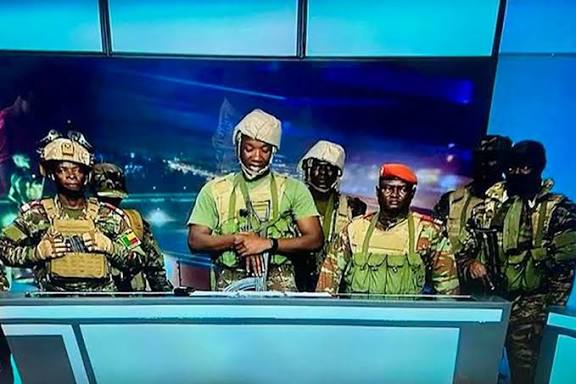
They broke into the national broadcaster’s studio and declared that the government had been overthrown, presenting themselves as members of a “Military Committee for Refoundation.”
Their message lasted only minutes before loyal troops stormed the station and regained control.
By mid-morning, the coup attempt was already collapsing. Some rebels fled into nearby districts, while others were rounded up by state forces.
Authorities described the attempt as a “reckless and short-lived mutiny.”
Still, a handful of the putschists continued to resist, holding on to armoured vehicles and weapons taken from the Togbin base.
Security forces responded by surrounding the base, sealing all exit routes.
During a follow-up meeting with security chiefs, Ouin-Ouro explained that the army high command had advised against the use of heavy artillery because the base is located near residential areas.
He said this precaution was to prevent civilian casualties.
Instead, the military opted for targeted air strikes, coordinated with allied support from neighbouring countries.
By daylight, Nigeria’s involvement in the operation became evident.
The presidential spokesperson, Bayo Onanuga, stated that President Bola Tinubu had approved limited air support following a pressing request from the government of the West African government.
Ouin-Ouro also acknowledged the intervention, saying the assistance formed part of an ECOWAS security arrangement involving troops from Nigeria and Côte d’Ivoire.
Air surveillance missions were conducted over Cotonou’s outskirts, forcing several mutineers to surrender.
Two senior officers — Gomina and army chief of staff Abou Issa — who had been abducted earlier, were later found alive in the city of Tchaourou, about 360 kilometres away.
They were rescued and flown back to Cotonou under military escort. By Monday morning, calm had returned to most parts of the capital.
At a security council meeting later that day, President Talon praised the military for what he described as “discipline, professionalism, and loyalty.”
He expressed appreciation to Nigeria and Côte d’Ivoire for their support in safeguarding regional stability.
Officials have since confirmed that an investigation is underway to identify those behind the mutiny and to determine how the plot was organised within the armed forces.
Leaders in the region, via the Economic Community of West African States (ECOWAS), are urging caution amid fresh democracy threats in West Africa.
Though short-lived, the failed coup has revived discussions about the fragility of civilian rule in West Africa.
Experts believe the incident shows how quickly military discontent can escalate into political turmoil if not handled carefully.
For now, Benin remains under control, but the lessons from its 24-hour rebellion continue to echo beyond its borders.