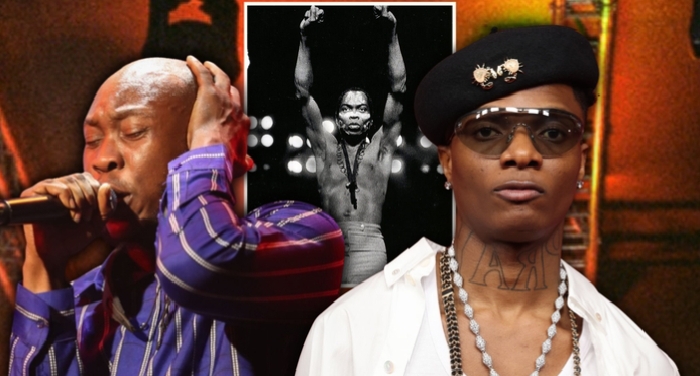
It did not begin as a declaration; it began as a drift. A fan comparison floated across timelines with confidence and bravado. Many in Wizkid’s fanbase, known widely as Wizkid FC, began to claim the pop star had eclipsed every other Nigerian artist, including Fela Kuti. That comparison was a spark. It was meant to flatter, but in the realm of Nigerian music history, Fela’s name carries gravity that cannot be lightened by fandom.
Seun Kuti stepped in not as an opponent but as a voice of caution. He made clear early on that comparisons unsettled him when they touched his father’s legacy. In an Instagram response, Seun wrote back to Wizkid’s volley with a measured rebuke: “Just be yourself short man. You are also great,” explicitly resisting the escalation and affirming his respect for history while maintaining his position.
That was the pivot point. The moment this could have existed as an argument about influence and history instead hardened into something messier and far more personal.
Wizkid’s Fame, Power and the Trap of Modern Scale
Wizkid’s influence is undeniable in the landscape of contemporary Afrobeats. He is a Grammy Award-winning artist whose global tours and streaming dominance have placed him among the most visible Nigerian musicians of his generation. In response to the online tension with Seun Kuti and Wizkid FC, Wizkid himself finally broke his silence with a series of Instagram and X posts that shocked many observers.
In one widely shared Instagram story, Wizkid directly taunted Seun Kuti, declaring “@bigbirdkuti I’m Big Wiz everyday bigger than your papa!! Wetin u one do fool?” and calling him a “hungry bastard.” On X he amplified the provocation with further insults and a pointed contrast between what he presented as Fela’s historical struggle and Seun’s fight with fans: “Fela fight for freedom this fool dey fight fc! Oloshi omo ale!”
These statements underscored a shift in tone from defending commercial achievement to dismissing his opponent’s lineage, and with it, something deeper about the weight of history versus the scale of global success. In attempting to defend himself with braggadocio, Wizkid framed the argument in ways that many critics felt underestimated the cultural significance tied to Fela’s name.
Seun Kuti and the Burden of Inherited Memory
To Seun Kuti, the name Fela is not merely a stage name or a trademark of music innovation; it is a living reference to fearless protest, political disruption, cultural identity, and irreversible influence. That context bore into his posture in the clash. His earlier live stream comments sought to articulate a clear position: comparisons based solely on fame metrics undermine the depth of his father’s life work, fights, and sacrifices that transcended music.
Despite the harsh words flung in his direction, Seun’s reply to Wizkid’s barrage did not counterattack with anger but reaffirmed his stance, insisting that Wizkid remains great on his own terms. He reminded the public of his own viewpoint with pointed restraint: “Just be yourself short man. You are also great.”
In one of his early public responses before Wizkid’s outburst, Seun also challenged fans, condemning casual comparisons as disrespectful: he insisted Wizkid FC should “keep Fela’s name out of their mouths… It is actually an insult to compare Wizkid to Fela,” arguing that such comparisons show ignorance of history and context.
The Line Wizkid Crossed When He Made It Personal
Words matter differently when spoken by someone with the platform that large. When Wizkid wrote that he was “bigger than your papa,” what many heard was less an assertion of achievement and more a dismissal of legacy. These remarks did not exist in isolation. They were laced with personal insults, and on social media they were magnified without context.
What changed everything was not the claim itself, but the way it was delivered, taunting rather than reflective, dismissive rather than contextual. In the heat of those comments he also wrote “Pussy boy @bigbirdkuti ok I big pass your papa!! Wetin u one do? Fool at 40!”, a line that became emblematic of how the confrontation spiraled out of nuance into hostility.
That language, unfiltered and raw, shifted public perception. Critics argued that he moved from defending success to attacking reputation. Deleting some of these posts did not erase the impact; instead it reinforced a narrative that he lost control of the argument once it escaped the realm of measured discourse.
Motunrayo Kuti and the Explosion of Family Defense
When Motunrayo Kuti, daughter of Fela Anikulapo-Kuti and sister to Seun, entered the public fray, the emotional stakes of the debate changed fundamentally. In a now-viral video, she addressed the clash directly. Her words did more than defend her father’s legacy; they sought to challenge the very foundation of Wizkid’s claim by invoking family history and deeply personal references.
Her speech was blunt and unfiltered, emphasizing that her father’s legacy outweighed that of Wizkid’s parents, and directly confronting the narrative that placed fame over historical impact. In her own voice: “Wizkid is bigger than Fela abi? Wizkid, you are also bigger than your father… Our father Fela is now bigger than your father, Muniru Olátúnjí Balogun and your mother… Yes Fela big pass those two.”
Those remarks ignited fresh controversy and placed the argument at the intersection of legacy, family memory, and emotional resonance. Many Nigerians across social media reacted not just with shock that such language was used, but with reflection on why a name like Fela’s still evokes visceral defense.
Other Kuti Family Voices and the Closing of Ranks
Beyond Motunrayo’s intervention, other family voices also stepped into the discussion. Seun’s sister publicly challenged Wizkid’s fanbase on social media, questioning why comparisons involving Fela’s name kept resurfacing. Her argument was not just defensive, it was admonitory, calling attention to what she described as repeated disrespect toward a cultural icon.
Commentators and personalities also joined in. For example, media personality Daddy Freeze urged restraint, warning Seun Kuti not to let the feud drag Fela’s legacy into needless controversy and advising that history be treated with respect and care.
At the same time, nightlife influencer Idowu Adeyemi, known as Yhemolee, criticised Seun for how he handled the clash, emphasizing that many younger Nigerians from Wizkid’s fanbase might not have deep historical knowledge of Fela’s work, and questioning whether the intense reactions benefited the legacy conversation. In his words: “Fela died 29 years ago… But you are fighting teenagers and Gen Z’s that know absolutely nothing about him… Make it make sense.”
This kaleidoscope of perspective, from family to social commentators to public influencers, underscored just how charged the moment had become.
Public Reaction and the Shift in Moral Sympathy
As the exchanges multiplied, public reaction evolved rapidly. The initial spectacle of a feud shifted into debate about respect, memory, and generational understanding. Many Nigerians affirmed that Fela’s revolutionary music and cultural resistance earned him a place that transcends commercial success. Some aligned with Seun’s plea for respect, while others argued that artists of different eras should not be irrevocably compared.
Critics of the feud argued that the intensity of words from both sides, especially the personal nature of some attacks, diluted the potential for constructive discussion about legacy and influence. Others called for a return to respect and nuance.
Commentators pointed out that the argument, initially fueled by fandom and scale, had ballooned into something that engaged historical pride, generational identity, and emotional investment from those who grew up with Fela’s activism and those who grew up with Wizkid’s global stardom.
Why This Moment Will Follow Wizkid for Years
This episode will not erase Wizkid’s achievements. His place in Afrobeats history is secure. But it has now become a reference point, a moment where an argument about influence spiraled into a public confrontation over legacy.
Wizkid will now forever be associated with a statement that claimed superiority over a national icon, and that will echo inwardly whenever discussions about legacy and scale arise in Nigerian music and culture.
The lesson here is not merely about respect for icons. It is about understanding that cultural legacy functions on a deeper emotional plane than metrics, numbers, or fame. When one talks about legacy in a society with such layered history, one must be precise in words and conscious of context.
The Lesson at the Heart of the Clash
What this clash exposed is a cultural fault line, one that measures greatness by different standards depending on context. One side anchors greatness in global reach, playlists, and commercial triumphs. The other anchors greatness in history, impact, and symbolic resistance.
Neither measure is wrong in its own universe, but they cannot be conflated without consequence. Wizkid’s journey is remarkable and deserving of celebration. Fela Kuti’s legacy is monumental and enduring in ways that defy simple comparison.
The moment Wizkid stopped defending his own fame and started attacking legacy, control slipped. Once it became about who could publicly shame whom, it stopped being about music and became about pride, legacy, and narrative control.
The moment strength confronts history, clarity must prevail. In this case, clarity was lost, and the controversy revealed more about collective memory than the individual claims themselves.
And Nigeria watched as the argument now belongs to a larger conversation about how a nation honours its past while celebrating its present.