NADECO is an acronym of the National Democratic Coalition. It was a pro-democracy organization founded on May 15, 1994, in reaction to MKO Abiola’s victory in the postponed June 12, 1993, presidential election.
Restoring democracy and acknowledging Moshood Kasimawo Abiola (MKO) as the legitimate winner of the annulled election were the objectives of NADECO. Prominent individuals like Chief Anthony Enahoro and Chief Michael Adekunle Ajasin spearheaded it. Politicians, activists, and pro-democracy organizations from all around Nigeria made up the coalition.
The coalition’s demands include honoring the June 12 mandate and Abiola’s presidency, restoring civil rule and transitioning away from military rule, and maintaining the significance of the canceled election.
Despite facing tremendous persecution, including arrests, assassinations, and exile, NADECO pursued its objectives through a series of public protests, international campaigns, and strategic alliances.
However, Nigeria’s military dictatorship ended in 1999, when civil authority was restored. In 2018, the Buhari administration publicly designated June 12 to be Democracy Day. Additionally, the administration recognized MKO Abiola as the true winner of the 1993 presidential election.
Former President Muhammadu Buhari posthumously gave Abiola the title of Grand Commander of the Federal Republic (GCFR), Nigeria’s highest national honor, in recognition of his electoral triumph. In a same vein, former Military President Ibrahim Babangida, who annulled the election, later conceded in his book that Abiola won, claiming that he met all constitutional requirements, including obtaining a majority of votes and geographical distribution.
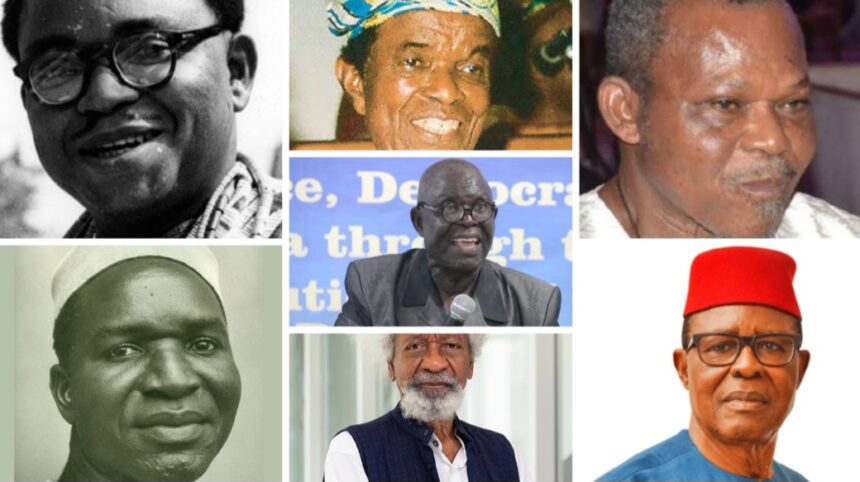
Here are key figures who participated in the NADECO’s struggles for return of democracy:
Chief Anthony Enahoro

He was born in Ogbahon, Edo State, Nigeria, in 1923. He established the Daily Express newspaper in 1949. He was elected to the Western House of Assembly in 1951. He was named Minister of Home Affairs in 1954, and Minister of Information in 1959.
He co-founded and chaired the National Democratic Coalition, or NADECO, which opposed military authority and lobbied for the recognition of MKO Abiola as the winner of the 1993 presidential election.
During the Abacha era, Enahoro was persecuted and forced into exile in 1996 owing to murder threats. He returned to Nigeria in 2000 and continued to push for democratic reform.
Michael Ajasin

He was born in Igbalaye, Ondo State, in 1930. He worked as a commissioner in Ondo State from 1979 to 1983. He became a founder member of NADECO (1994), an organization dedicated to democracy and human rights. He was NADECO’s National Chairman under the Abacha administration. He was targeted and harassed by the military regime. He returned to politics during the democratic transition in 1999.
Abraham Adesanya

He was born July 24, 1922, in Ijebu Igbo, Ogun State. He was a significant member in Nigeria’s pro-democracy movement, serving as deputy leader of the National Democratic Coalition (NADECO).
Adesanya, a lawyer, was elected to the Western House of Assembly in 1959 and later served as a senator for the Unity Party of Nigeria under the Second Republic. He was a founding member of the National Democratic Coalition (NADECO) and contributed significantly to Nigeria’s democratic transition in 1999.
He survived a 1997 assassination attempt planned by the Abacha dictatorship. He was recognized for his steadfast dedication to democracy and human rights. He died on April 27, 2008, at the age of 85, leaving a legacy as a supporter of democracy and social justice.
Ayo Opadokun

He was born on August 26, 1948, in Offa, Kwara state. He is a Nigerian lawyer who served as Secretary-General of NADECO, pushing for democracy during Nigeria’s military government. The Abacha dictatorship incarcerated him for 24 months due to his activities. He is a well-known global author on law, activism, and government.
Bola Tinubu

He was born on March 29, 1952, in Lagos State, Nigeria. He was elected as a Senator for Lagos West in 1992. He was elected as a governor in 1999 and served two terms. He is now the President of the Federal Republic of Nigeria.
He was a key figure in the National Democratic Coalition (NADECO), a pro-democracy group that fought for the restoration of democracy in Nigeria after the annulment of the June 12, 1993 presidential election won by Chief Moshood Abiola. He was among the founding members of NADECO and played a significant role in mobilizing support for the restoration of democracy.
Wole Soyinka

He was born on July 13, 1934 in Abeokuta. He’s a playwright, poet, and activist. He studied in Nigeria and the United Kingdom. He was a significant figure in NADECO, a pro-democracy alliance that opposed Sani Abacha’s military government. He rallied foreign support, delivered harsh condemnation of the leadership, and called for democratic reforms. He supported the group in obtaining global recognition.
Gani Fawehinmi

He was born in 1938 in Ogbomosho, Oyo state. He was a lawyer, human rights activist, and politician from Nigeria who made important contributions to the country’s democratic movement. He was a founder member of the National Democratic Coalition (NADECO), a pro-democracy organization that opposed military government in Nigeria.
He was essential in the fight against military dictatorships. He was an outspoken opponent of the annulment of the June 12, 1993 presidential election, which was largely thought to have been won by Chief MKO Abiola. He also advocated for human rights, utilizing his legal abilities to represent victims of human rights violations.
Rear Admiral Godwin Ndubuisi Kanu

He was born November 3, 1943, in Ovim, Abia State. He joined the Nigerian Navy in 1962 and served as a cadet in India. He fought for Biafrans during the Nigerian Civil War before returning to the Nigerian Navy. He was the military governor of Imo State from 1976 to 1977, and Lagos State from 1977 to 1978.
He played a significant role in Nigeria’s pro-democracy movement, particularly within the National Democratic Coalition (NADECO). He became NADECO’s chairman in 2013 and was instrumental in lobbying for the revalidation of the annulled presidential election on June 12, 1993.
Commodore Ebutu Ukiwe

He was born on September 27, 1942, in Itsekiri, Delta state. He was a Nigerian Navy officer. He was Nigeria’s de facto Vice President from 1985 to 1986, under General Ibrahim Babangida. He participated in the National Democratic Coalition and advocated for democracy. He advocated for state formation and regional cooperation.
He was an important player in Nigerian history, serving as the country’s de facto Vice President under General Ibrahim Babangida from 1985 to 1986. He’s also known for his work with the National Democratic Coalition (NADECO), a pro-democracy organization that fought for the annulment of the June 12, 1993 presidential election.
He established the Council for Unity and Understanding (CUU), which eventually worked with NADECO to advocate for the restoration of democracy. The CUU sought to bring together elites from the East, West, and Middle Belt to advocate for national reform and solve concerns such as sectional oppression.