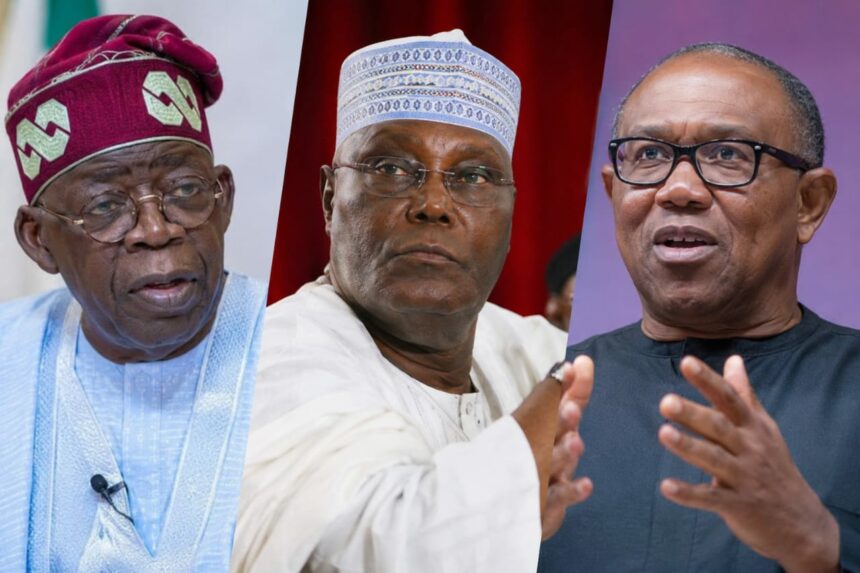
Nigeria’s political atmosphere is gradually shifting from internal party contests to preparations for what is expected to become another defining presidential election in the country’s democratic history.
The conclusion of party primaries across major political platforms has once again brought familiar political figures to the forefront while also exposing new alliances and strategic calculations ahead of the January 16, 2027 election.
At the centre of the unfolding contest is President Bola Tinubu, who secured the presidential ticket of the All Progressives Congress after a sweeping victory in the party’s nationwide direct primary.
The APC primary was conducted across the country’s 8,809 wards covering all 774 local government areas.
Tinubu polled 10,999,162 votes to defeat businessman Stanley Osifo, who secured 16,503 votes.
Declaring the result in Abuja, the chairman of the APC Presidential Primaries Election Committee, Pius Anyim, said the President met the constitutional requirements and guidelines of the party to emerge as its flagbearer.
Speaking after accepting the nomination, President Tinubu thanked party members for their support during the exercise.
“Thank you all of you. You changed the landscape, looking at the figure that you returned,” Tinubu said.
Opposition battle gathers momentum
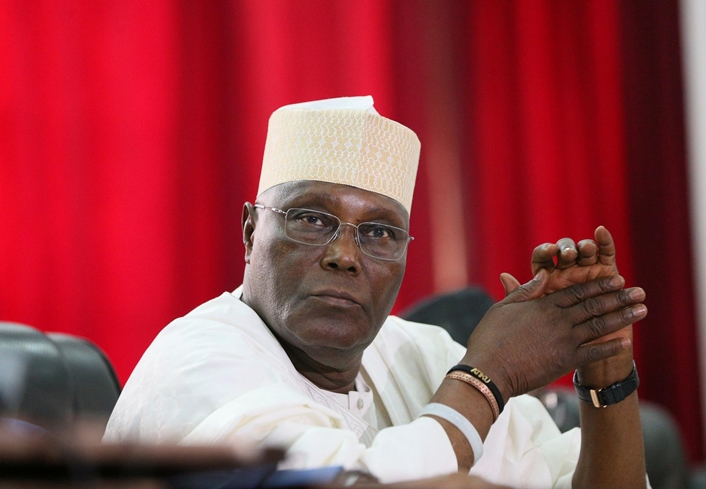
Tinubu’s emergence has now paved the way for another political confrontation with former Vice President Atiku Abubakar, who clinched the presidential ticket of the African Democratic Congress.
The ADC announced that Atiku secured 1,846,370 votes to defeat former Governor Rotimi Amaechi of Rivers State, who polled 504,117 votes, while businessman Mohammed Hayatu-Deen recorded 177,120 votes.
Reacting after the primary, Atiku described the exercise as evidence that democratic practices were still functioning within the ADC despite wider concerns surrounding opposition politics in Nigeria.
“We demonstrated that while democracy is being strangled and squashed by its ruling party and its operatives, democracy is alive and well in the African Democratic Congress,” he said.
The former Vice President also urged party members to unite ahead of the general election while criticising the administration of the ruling APC.
However, the ADC primary was followed by disagreement after Amaechi rejected the outcome and alleged widespread voter disenfranchisement during the process.
Hayatu-Deen also raised concerns over alleged vote manipulation and irregularities in the exercise.
Obi, Kwankwaso and fresh alliances
Another major development ahead of the election is the political movement involving former Governor Peter Obi of Anambra State and former Governor Musa Kwankwaso of Kano State.
Obi had initially aligned with the ADC alongside several opposition figures before later moving to the Nigeria Democratic Congress with Kwankwaso.
The NDC subsequently announced plans to adopt affirmation for its presidential primary, a decision widely interpreted as favourable to Obi’s emergence as the party’s candidate.
Political observers have also continued to speculate that Kwankwaso could eventually emerge as Obi’s running mate.
The realignments have revived the possibility of another three-way presidential race similar to the 2023 election involving Tinubu, Atiku and Obi.
During the February 2023 presidential election, the Independent National Electoral Commission declared Tinubu of the APC winner after he secured 8.79 million votes representing 36.61 per cent of total votes cast.
Atiku, who contested under the Peoples Democratic Party in 2023, secured 6.98 million votes representing 29.07 per cent.
Obi of the Labour Party recorded 6.10 million votes representing 25.40 per cent, while Kwankwaso of the New Nigeria Peoples Party polled 1.49 million votes representing 6.23 per cent.
Familiar names dominate political calculations
Ahead of 2027, Tinubu is expected to rely significantly on incumbency advantages and political alliances with governors elected under the APC platform.
Atiku, meanwhile, continues to maintain influence across parts of the North through longstanding relationships with serving and former political office holders.
The former Vice President is also widely regarded as one of the country’s most experienced coalition builders because of his decades-long involvement in national politics.
Obi’s support base remains strongly connected to younger voters, urban residents and the “Obidient” movement that emerged prominently during the 2023 election cycle.
Supporters of the former Anambra governor also point to his reputation for prudence and accountability as factors strengthening his political appeal.
Beyond the leading contenders, other parties have also unveiled candidates ahead of the election.
Human rights activist Omoyele Sowore emerged as the presidential candidate of the African Action Congress during the party’s primary held in Abuja.
Accepting the nomination, Sowore said, “We are here not only to change the course of history but also to bring revolutionary change.”
The Peoples Democratic Party also announced former Cross River governorship candidate Senator Sandy Onor as its consensus presidential candidate following consultations and voice votes conducted across states.
As political parties conclude their primaries, attention is steadily shifting towards nationwide campaigns, coalition negotiations and voter mobilisation ahead of what could become another fiercely contested presidential election.