The 2026 FIFA World Cup, which will be hosted across the United States, Canada and Mexico in an expanded 48-team format, will not only be a celebration of football’s global reach but also a stage for some of the most compelling family narratives in the sport’s history.
Several pairs of brothers, each sharing the same upbringing and bloodlines, will represent different nations when the tournament kicks off in North America.
From the plains of West Africa to the shores of Europe, these siblings have taken separate international paths, and their stories speak to the increasingly complex intersection of identity, heritage, and modern football.
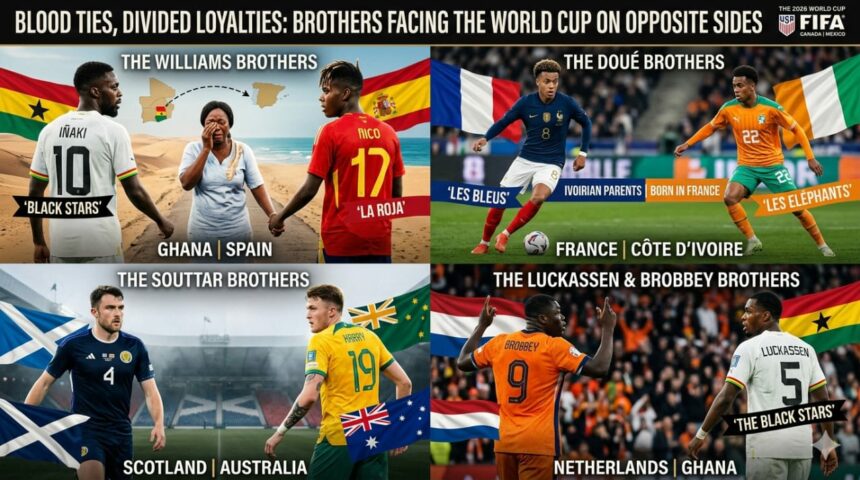
Perhaps the most talked-about sibling rivalry involves the Doué brothers — Désiré, who will represent France, and Guéla, who has committed his international future to Côte d’Ivoire.
Both brothers were born in France to Ivorian parents, yet their allegiances have taken them in vastly different directions.
Désiré has cemented himself as one of the most thrilling young attackers in European football and forms part of France’s next generation as Les Bleus target a third world title.
Guéla, a defender, chose to honour his parents’ roots and has become a key figure in the Côte d’Ivoire setup, with the Elephants set to represent the African continent on the grandest stage in the sport.
The story of The Williams Brothers, Iñaki and Nico, is perhaps the most emotionally resonant of all the sibling tales heading into the tournament.
Their parents endured an extraordinarily dangerous journey from Ghana to Spain, crossing the Sahara Desert and the Mediterranean Sea, with their mother reportedly heavily pregnant with Iñaki during the perilous crossing.
Iñaki initially played for Spain at the senior level before switching his international allegiance to Ghana ahead of the 2022 World Cup in Qatar.
His younger brother Nico, meanwhile, elected to remain with La Roja and has since grown into one of the most feared wingers in European football.
Their contrasting choices mean that should Ghana and Spain meet in North America, it would mark one of the more extraordinary individual storylines the tournament has produced in recent memory.
Brothers John and Harry Souttar will also arrive at the World Cup representing different nations, despite both having been born in Scotland.
John, a central defender, has remained committed to Scotland, the country of his birth, whilst Harry pursued eligibility through family ties and has since become a pivotal figure for Australia’s Socceroos.
Harry played a significant role in Australia’s qualification campaign and is regarded as one of the most dependable defenders in the Socceroos’ squad heading into the competition.
The fourth sibling pairing of note involves Derrick Luckassen and Brian Brobbey, both products of the Dutch football system who share Ghanaian heritage but have chosen different international paths.
Brobbey is expected to play a prominent role for The Netherlands as the Oranje seek to win their first ever World Cup title.
Luckassen, on the other hand, made the decision to switch his allegiance to Ghana, joining The Black Stars as they prepare to mount what they hope will be a deep run in the tournament.
The four sibling stories collectively underline a broader shift in international football, where questions of identity and belonging are no longer straightforward, particularly for players with dual heritage growing up between cultures.
The expanded format of the 2026 tournament means the chances of these brothers meeting on the pitch — though not guaranteed — are greater than at any previous edition of the competition.
Whether their paths cross or not, the stories of the Doués, the Williamses, the Souttars, and the Luckassen-Brobbey pairing will lend an added layer of human drama to what is already the world’s most-watched sporting event.