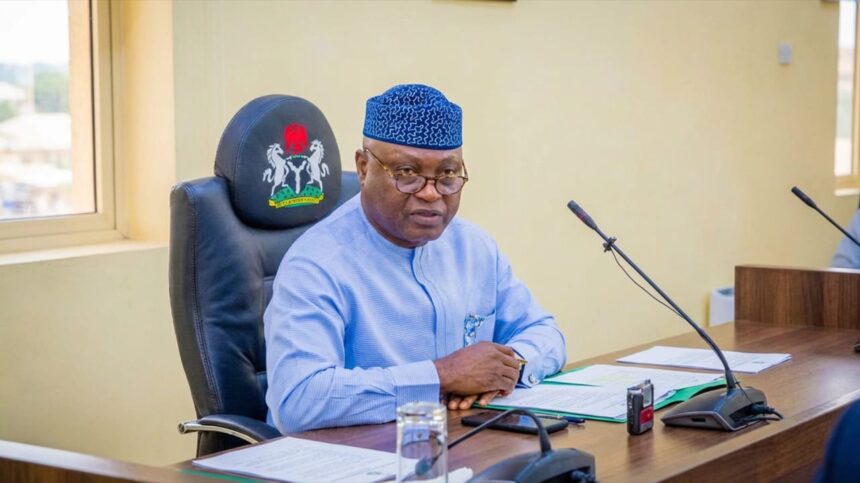
Governor Biodun Oyebanji’s victory in Saturday’s governorship election has secured him another four years in office and placed him in a unique position within Ekiti State’s political history.
The candidate of the All Progressives Congress polled 319,224 votes to defeat the Peoples Democratic Party’s candidate, Wole Oluyede, who secured 40,543 votes, while Dare Bejide of the African Democratic Congress garnered 12,872 votes.
Beyond the margin of victory, the outcome drew attention because it disrupted a political pattern that had endured throughout the Fourth Republic.
For nearly three decades, Ekiti cultivated a reputation as one of Nigeria’s most unpredictable electoral battlegrounds, where incumbent governors repeatedly failed to secure consecutive terms in office.
Since the state was created out of the old Ondo State in 1996 and democratic rule returned in 1999, voters consistently denied sitting governors the opportunity to remain in office through immediate re-election.
The recurring trend created a perception among political observers that the electorate preferred periodic political change rather than uninterrupted administrations.
A STATE KNOWN FOR POLITICAL REVERSALS
Ekiti’s democratic journey has been characterised by shifting political loyalties and dramatic changes in leadership.
The state’s first civilian governor, Niyi Adebayo, emerged on the platform of the defunct Alliance for Democracy in 1999 but was voted out of office four years later.
His defeat paved the way for Ayodele Fayose of the Peoples Democratic Party, whose administration lasted until his impeachment in October 2006.
Following the political turmoil that accompanied Fayose’s removal, the then Speaker of the State House of Assembly, Friday Aderemi, briefly laid claim to the governorship.
Biodun Olujimi, who served as deputy governor, also declared herself governor, creating a constitutional crisis that resulted in competing claims to power.
To restore order, former President Olusegun Obasanjo suspended the contending political actors and appointed retired Brigadier General Tunji Olurin as sole administrator of the state.
The PDP retained control when Segun Oni won the governorship election in 2007.
However, Oni’s tenure was overshadowed by prolonged legal disputes and rerun elections that eventually altered the state’s political direction.
The outcome of those contests opened the door for Kayode Fayemi to assume office in 2010.
The cycle of political reversals continued in 2014 when Fayose returned to Government House under the PDP after defeating the incumbent administration.
Four years later, Fayemi staged a comeback under the APC and reclaimed the governorship in another dramatic shift of political fortunes.
These repeated changes reinforced Ekiti’s image as a state where incumbency offered no guarantee of electoral success.
OYEBANJI’S HISTORIC FEAT
Against that backdrop, Oyebanji’s re-election represents a significant departure from the state’s established electoral culture.
His success ended a pattern that had survived changes in political parties, administrations and alliances for 27 years.
By securing consecutive terms, he achieved what previous governors had been unable to accomplish since the beginning of democratic rule in 1999.
The result effectively places him in a category of his own within Ekiti’s contemporary political history.
Unlike many of his predecessors who faced intense electoral resistance during their re-election bids, Oyebanji entered the contest from a position of considerable strength.
The political environment largely favoured the APC candidate as opposition parties struggled with internal and organisational challenges.
Observers also pointed to factors such as regular salary payments, infrastructure development projects and a relatively stable political atmosphere as issues that resonated with sections of the electorate.
OPPOSITION CHALLENGES
While the APC consolidated its position ahead of the election, the PDP entered the contest burdened by internal disagreements that complicated its preparations.
The party was divided between rival factions aligned with different political interests.
Oluyede belonged to the camp associated with Kabiru Turaki, while another faction linked to the Minister of the Federal Capital Territory, Nyesom Wike, retained official recognition from the electoral commission.
The dispute generated legal battles that overshadowed the party’s campaign activities.
The Independent National Electoral Commission initially excluded Oluyede’s name from both its provisional and final candidate lists because of unresolved issues arising from the leadership dispute and the conduct of the party’s primary election.
It was only after a Court of Appeal ruling that INEC formally recognised him as the PDP candidate.
The prolonged crisis weakened the opposition’s cohesion and reduced its ability to mount a robust challenge against the incumbent governor.
The ADC also struggled to establish a significant presence across the state, limiting its capacity to influence the outcome of the election.
Ultimately, a combination of APC dominance, opposition fragmentation and favourable political conditions enabled Oyebanji to secure re-election and rewrite a chapter of Ekiti’s electoral history that had remained unchanged for nearly three decades.