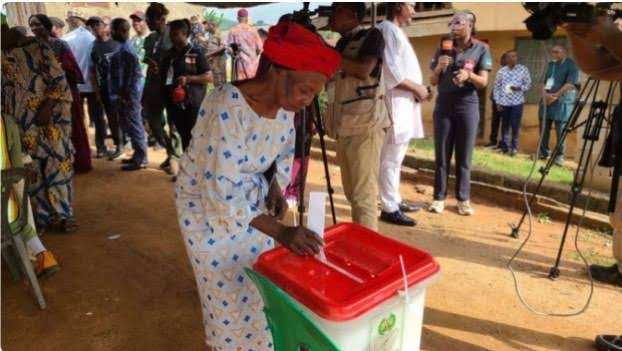
The June 20, 2026 Ekiti gubernatorial election has concluded. Eligible voters turned out and cast their ballots, with incumbent Biodun Oyebanji of the All Progressives Congress (APC) among the candidates.
Prof. Adenike Oladiji, Vice Chancellor of FUTA, served as Returning Officer. While announcing the results at INEC’s headquarters in Ado-Ekiti, she reported that 988,251 voters were registered. Of those, 384,940 were accredited, 382,109 votes were cast, and 375,777 were valid.
The Independent National Electoral Commission declared Biodun Abayomi Oyebanji of the All Progressives Congress the winner. He secured 319,224 votes to defeat Olumayokun Oluyede of the PDP, who polled 40,533 votes. Oluwadare Oluwadare of the ADC finished third with 12,872 votes.
With this win, Oyebanji made history as the first incumbent governor to win re-election in Ekiti State. The election was largely peaceful, though there were isolated cases of violence. Still, observers, candidates, INEC, and civil society groups all flagged challenges that shaped the outcome.
FEAR OF INTIMIDATION
Many Ekiti residents expected widespread violence on election day, but most areas remained calm. Security flashpoints including Ado-Ekiti, Oye, Ikole, and Ilejemeje recorded no major disturbances. The only serious incident occurred in Ilawe Ekiti, Unit 4, Ward 2, where an ADC member was injured and taken to hospital.
Ado-Ekiti LGA, earlier flagged as highest-risk due to the concentration of political actors, was largely peaceful. Across the state, observers documented 24 incidents of violence in 10 LGAs.
PDP candidate Oluyede alleged intimidation by security operatives in unofficial vehicles at his Ikere polling unit. The PDP also accused the APC of using police “Form K” to detain opposition members.
ELECTORAL MALPRACTICE
Observers noted discrepancies in party numbers across election materials. Ballot papers listed 19 parties, Form EC8A result sheets only had space for 15, and INEC’s final list recognized 14 candidates.
EU observers also flagged mismatches between the parties shown on ballot papers and those on the result sheets.
VOTE BUYING
Observers reported organised vote-buying during the Ekiti poll. Voters’ PVC and NIN details were collected in exchange for cash and food items.
In Ikole, Ikere, Irepodun, Ifelodun, Ekiti East, and Ekiti West, some voters also had their bank account details taken in exchange for their PVCs.
TECHNOLOGY AND LOGISTICS
BVAS worked 96% of the time, but still caused delays. Elderly voters struggled with fingerprint and facial capture, while Babafemi Ojudu and others reported slow accreditation due to BVAS malfunctions.
PDP candidate Oluyede said only 5 voters were accredited in 1.5 hours at his polling unit, blaming INEC delays.
Seven CSOs rated INEC’s preparedness at just 34% as of April 14, citing funding delays and structural weaknesses.
INEC itself listed vote buying, political thuggery, fake news, transport problems, and insecurity in hard-to-reach areas as the main threats to the election.
VOTER APATHY
Only 30% of registered voters turned out for the election. INEC said this continues a long decline, from roughly 60% in 1999 to about 30% now.
CSOs blamed the low turnout on perceptions of predetermined outcomes, economic hardship, and growing distrust in the electoral process.