Agitations for the creation of additional states have once again gained momentum across Nigeria, but the constitutional hurdles surrounding the process continue to cast doubt on whether any of the proposals can materialise before the end of the current National Assembly.
The renewed calls come despite long-standing concerns over the financial sustainability of many of the country’s existing 36 states, most of which remain heavily dependent on federal allocations.
According to the report of the House of Representatives Committee on Constitutional Review submitted on June 6, lawmakers received 56 separate requests for new states from the six geopolitical zones.
The development reflects a persistent demand for greater political representation and administrative restructuring, particularly from areas that believe they remain disadvantaged under the current arrangement.
FROM MILITARY DECREES TO CONSTITUTIONAL PROCESS
Nigeria’s journey towards its present 36-state structure has largely been shaped by military administrations.
The last successful creation of a subnational entity by a civilian government occurred in 1963 when the Midwest Region was carved out of the old Western Region through a referendum.
Since then, every additional state has been established through military decrees rather than constitutional procedures.
Former Heads of State Yakubu Gowon, Murtala Muhammed, Ibrahim Babangida and Sani Abacha collectively created 36 states, while successive military administrations exercised powers that were not constrained by the constitutional requirements now in force.
Many of those states emerged from agitations by communities seeking greater political inclusion and protection against perceived marginalisation.
Unlike the military era, however, democratic governments are required to comply with detailed constitutional procedures before new states can be created.
THE CONSTITUTIONAL HURDLES
Section 8 of the 1999 Constitution outlines a multi-stage process that every state creation proposal must satisfy before it can become law.
The process begins with a formal request backed by at least two-thirds of members representing the affected area in the National Assembly, the relevant State Houses of Assembly and the affected local government councils.
The proposal must subsequently secure the approval of at least two-thirds of eligible voters in the affected area through a referendum.
Thereafter, the outcome must receive the endorsement of a simple majority of all state assemblies and the approval of a simple majority of Nigeria’s states.
The final stage requires a two-thirds majority in both chambers of the National Assembly.
Deputy Speaker of the House of Representatives and Chairman of the House Committee on Constitutional Review, Benjamin Kalu, had earlier observed that previous proposals failed to satisfy these constitutional conditions.
“Although we have received 31 requests for state creation, none has met the constitutional requirements for amendment,” he said during a constitutional review session in February 2025.
REFERENDUM REMAINS THE BIGGEST TEST
Among the constitutional requirements, analysts consider the referendum provision the most difficult to fulfil.
The Constitution requires at least two-thirds of eligible voters in the affected area to approve the proposal before it can proceed to the next stage.
Election experts have consistently pointed to low voter turnout, challenges with voter registers and Nigeria’s limited experience with referendum-based exercises as significant obstacles.
Since the return to democratic rule in 1999, no recall process involving elected lawmakers has successfully crossed the referendum threshold prescribed by the Constitution.
The relatively low participation recorded during recent general elections has further reinforced concerns about meeting the required benchmark.
PROPOSALS ACROSS THE COUNTRY
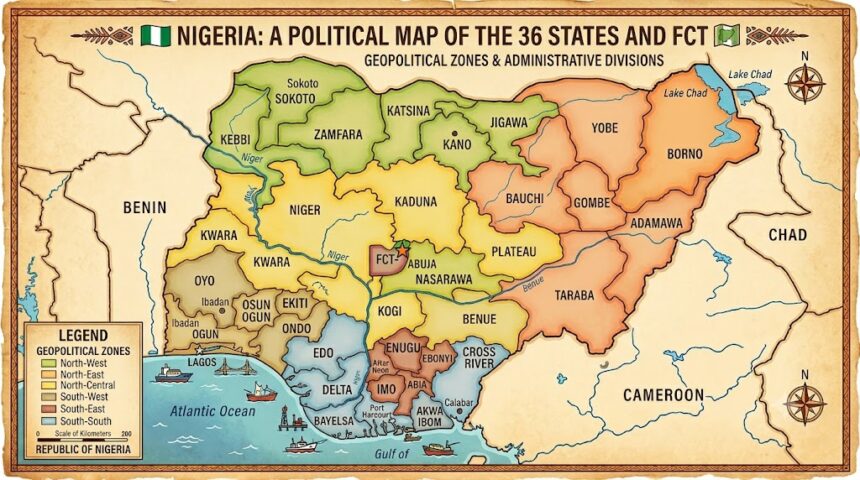
The House Committee on Constitutional Review reported receiving proposals from every geopolitical zone.
The North-Central submitted 14 requests, while the South-South and South-West presented 10 each.
The North-East and North-West recorded eight proposals apiece, while the South-East submitted six.
Among the requests are proposals for Okun, Okura and Confluence states in Kogi State, Apa and Benue Ala in Benue State, Ibadan State in Oyo State, Lagoon State in Lagos State, Ijebu State in Ogun State and several others across the federation.
The South-East has continued to advocate the creation of an additional state to place the region on the same footing as other geopolitical zones, most of which have six or seven states.
However, disagreements have also emerged within some of the affected areas.
The proposal for Anioma State from Delta State, championed by Senator Ned Nwoko, has attracted opposition from some stakeholders over its proposed alignment with the South-East geopolitical zone.
Similarly, differing opinions have surrounded the proposed Orlu State in the South-East.
ECONOMIC CONCERNS PERSIST
Beyond constitutional requirements, questions surrounding economic sustainability continue to influence the debate.
According to the 2025 State of States Report by BudgIT, 28 states relied on Federation Account Allocation Committee allocations for at least 55 per cent of their total revenue during the 2024 fiscal year.
The report also showed that 21 states depended on FAAC receipts for at least 70 per cent of their revenues.
The figures have strengthened arguments that creating additional states may increase administrative costs unless new entities develop stronger internally generated revenue sources.
As part of ongoing constitutional review discussions, the Joint Committee on Constitutional Review recommended the creation of one additional state in Southern Nigeria to address regional imbalance.
“In the interest of fairness, national cohesion, and balanced representation, it was recommended that one additional State be created in the Southern region to bring it at par with other geopolitical zones in terms of the number of States,” the committee stated.
The South-South subsequently proposed Toru-Ebe State, while the South-East put forward Anim State.
Both proposals, however, remain subject to the constitutional procedures that have repeatedly frustrated previous attempts at state creation.
With less than a year left in the life of the 10th National Assembly, the combination of constitutional requirements, political disagreements and economic considerations suggests that the long-standing agitation for additional states may remain unresolved for the foreseeable future.