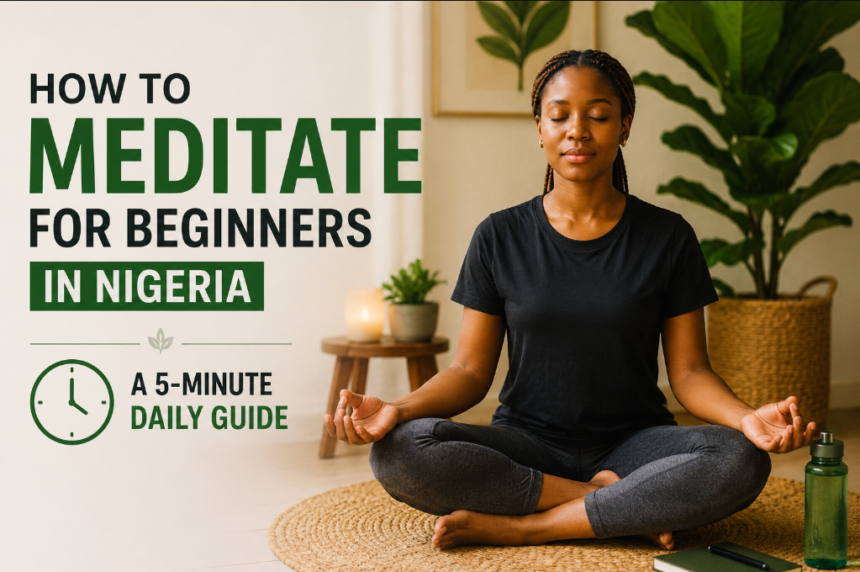
There is a particular kind of exhaustion that has no clinical name but that most Nigerians know intimately. It is the fatigue of carrying too much in a country that rarely slows down long enough to let you set anything down. The traffic on the Third Mainland Bridge at 7 a.m. The generator that did not start again. The phone calls that are never purely social. The cost of everything going up and the sense that things will continue to go up. This is not the abstract stress of wellness brochures; it is the specific, grinding pressure of daily life in Nigeria, and millions of people are carrying it with no real outlet.
Nigeria’s mental health landscape makes this worse in a particular way. According to Prof. Taiwo Obindo, the former president of the Association of Psychiatrists in Nigeria, fewer than 200 psychiatrists are available for a population of over 200 million people, leaving the country at roughly one psychiatrist per million Nigerians. That figure, shared at the APN’s 55th annual conference in Ilorin in November 2024, represents not just a healthcare gap but a cultural one: when professional help is this inaccessible, most people simply endure. A 2024 cross-sectional survey across sub-Saharan Africa, published in PLOS One in June 2025, found that Nigerians reported the highest prevalence of severe and extremely severe mental health conditions among all the countries studied. The structural response to that finding is slow. The personal one does not have to be.
Meditation does not fix economic hardship or repair failing infrastructure. What it does is interrupt the loop: the racing thoughts, the cortisol buildup, the sense that the mind has no off switch. And it does not require money, a therapist, a yoga mat, or forty minutes carved out of a schedule that does not have them. Five minutes is enough to start.
Why Nigerians Need Meditation More Than They Know
The numbers behind Nigeria’s mental health situation are stark, and they matter because they explain the context in which any self-care practice has to be evaluated. The PLOS One study from 2024 was not a marginal or narrow finding. It drew on data from university staff and students across multiple sub-Saharan African countries using a validated diagnostic instrument, the Depression, Anxiety and Stress Scale-21. Of all the nations represented, Nigerians showed the highest prevalence of severe and extremely severe conditions across anxiety, depression, and stress. This was not a surprise to mental health professionals in the country, but it was a quantification of something many people already felt.
The access problem compounds the burden. Nigeria has fewer than 200 practicing psychiatrists for a population that has surpassed 220 million. That ratio, roughly one specialist per million people, sits far below the World Health Organisation’s recommended benchmark of one per 10,000. Prof. Obindo, speaking at the 2024 APN conference, described the remaining practitioners as overworked and poorly remunerated, with three out of every five newly trained psychiatrists leaving the country within a year of completing their programs. The brain drain, which Nigerians have taken to calling the Japa syndrome, is particularly brutal in mental health, where the workforce was already thin.
What this means practically is that the formal mental health system cannot serve most people who need it. About 80 per cent of Nigerians with severe mental health needs have no access to professional care, according to a 2024 systematic review published in Cambridge Prisms: Global Mental Health. The gap between need and provision is not closing quickly enough for the person dealing with chronic stress in Yaba or anxiety in Maiduguri today. Self-managed approaches, where the evidence supports them, become not a supplement to professional care but an important first line.
Beyond access, there is also stigma. Survey research cited in a 2024 review in the journal South African Journal of Psychiatry found that the bulk of Nigerians seeking help for mental distress go first to religious settings, with only ten per cent obtaining the minimum standard of medical mental health treatment. This is not a failing of faith; it is what happens when a community has no credible secular alternative. Meditation sits in an interesting position in this landscape because it does not require abandoning religious practice. It is compatible with Islam and Christianity alike, and both traditions contain centuries of contemplative prayer and quiet reflection that share the same core mechanics as basic mindfulness.
How to Meditate for Beginners in Nigeria
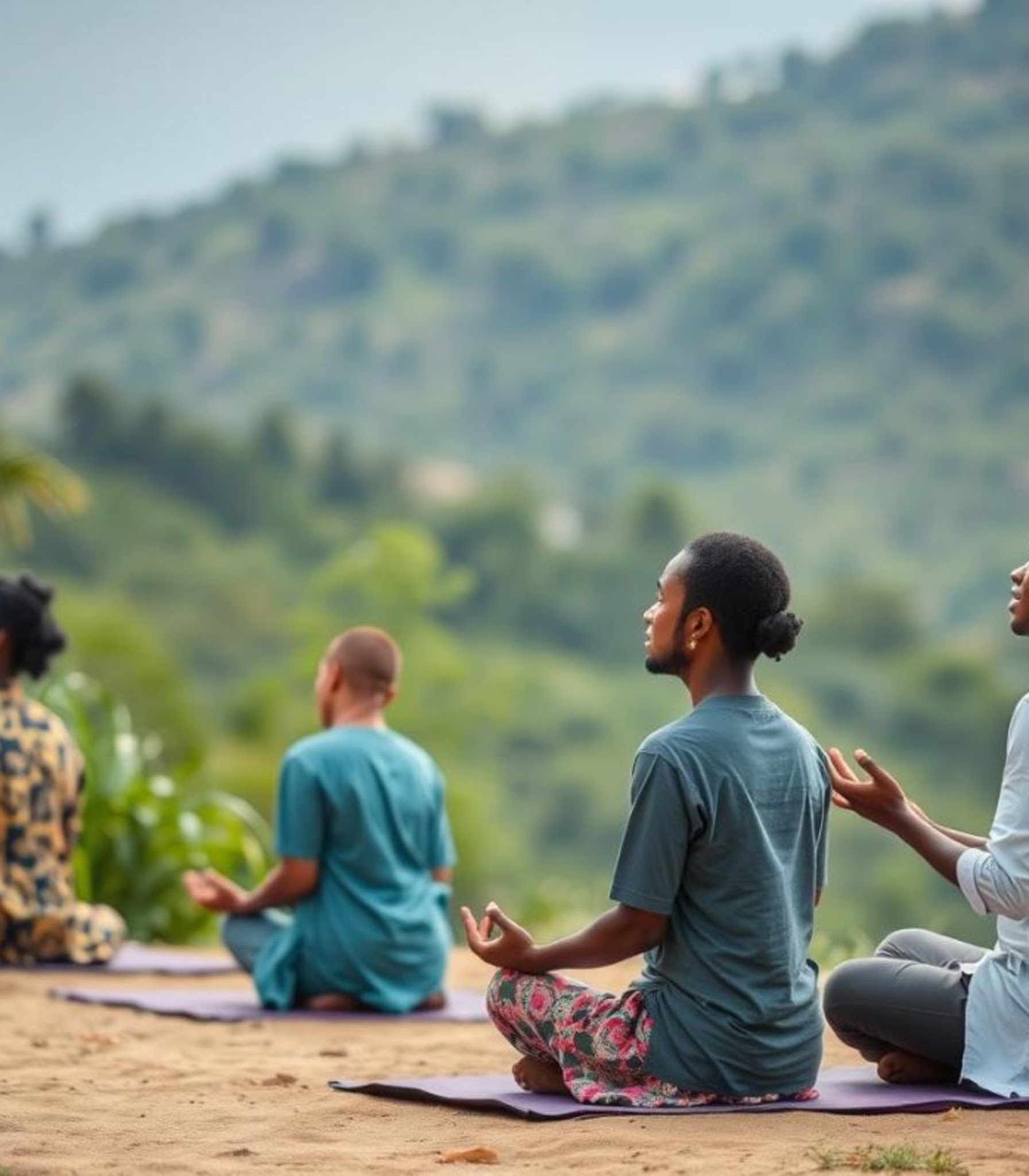
Knowing how to meditate for beginners in Nigeria means understanding that the practice has to fit the reality of the life being lived, not some imported template of silence and cushions and mountain retreats. The five-minute daily approach described in this guide is built for that reality: for people with inconsistent light and noise and a hundred competing demands. It draws on verified research about what actually works, strips out the mysticism that puts many Nigerians off, and gives a practical, immediately usable starting point.
What Actually Happens in Your Brain When You Meditate
The case for meditation is no longer just experiential. The neurological evidence has been building steadily since the early 2000s, and a systematic review published in Biomedicines in November 2024 brought the findings together clearly: meditation induces neuroplasticity, increases cortical thickness, reduces amygdala reactivity, and improves brain connectivity and neurotransmitter levels. These changes translate into real outcomes, including improved emotional regulation, stronger cognitive function, and greater resilience to stress.
The amygdala finding is particularly relevant for people dealing with daily, chronic pressure. The amygdala is the brain’s primary threat-detection and alarm system; when it is chronically activated, the body stays in a low-level state of emergency. Gaelle Desbordes, a neuroscientist at Massachusetts General Hospital, demonstrated in 2012 that changes in amygdala activation following meditation training persist even when the person is not meditating and is performing ordinary tasks. The calm, in other words, does not stay inside the meditation session; it begins to bleed into the rest of the day.
Sara Lazar, an assistant professor of psychology at Massachusetts General Hospital and Harvard Medical School, found that regular meditators preserve gray matter in the prefrontal cortex in ways non-meditators do not. In an interview with the Washington Post, she stated: “It’s well-documented that our cortex shrinks as we get older, it’s harder to figure things out and remember things. But in this one region of the prefrontal cortex, 50-year-old meditators had the same amount of gray matter as 25-year-olds.” Her study participants meditated an average of 27 minutes a day, but measurable changes appeared after just eight weeks of practice.
Cortisol, the hormone the body produces in response to stress, drops with consistent meditation practice. Meditation also lowers heart rate and blood pressure over time. A review in ScienceDirect noted that regular practice is associated with elevated heart rate variability, a reliable marker of the nervous system’s ability to move flexibly between stress and recovery states. For Nigerians dealing with the kind of sustained, ambient pressure that characterises life in Lagos, Abuja, Kano, or any other city where nothing quite works as it should, the physiological argument for meditation is not about calm for calm’s sake. It is about preserving the body’s ability to recover.
Five Myths About Meditation That Stop Nigerians From Starting
The first and most durable myth is that meditation is incompatible with Christianity or Islam. This has prevented more Nigerians from trying the practice than any other single factor. The confusion is understandable; some forms of meditation are embedded in Eastern religious traditions, and this history generates suspicion in communities where religious identity is strong. But the kind of meditation that the scientific literature supports for stress reduction, typically mindfulness-based, breath-focused practice, has no religious content. It does not involve chanting mantras or visualising deities or adopting any worldview. It is, in mechanical terms, nothing more than intentional attention training. A Muslim in the middle of Ramadan and a Pentecostal pastor preparing a Sunday sermon can both do it without it touching their faith.
The second myth is that you have to empty your mind. This expectation is responsible for a disproportionate number of abandoned first sessions. People sit down, the mind immediately produces a grocery list or a replay of a difficult conversation, and they conclude that they are doing it wrong or that they are simply not built for meditation. The mind wandering is not a failure of the practice. It is the practice. The entire point is to notice that the mind has wandered and to return attention, gently, to the breath. That moment of noticing and returning is the repetition that builds the cognitive muscle.
Third myth: you need silence, and Nigeria does not have it. Generators, traffic, neighbours, market noise, rain on zinc roofing. These sounds are real. But meditation can be done with background noise. The breath is always present and always accessible regardless of the sound environment. A number of experienced meditators actually use ambient noise as part of their practice, treating each sound as something to notice and release rather than resist.
Fourth myth: you need a special time, a special space, and at least twenty minutes. None of this is true for a beginner. Research published in The Mindful Counselor in February 2026 reviewed a study of over 280,000 people using meditation apps and found that consistency of practice, how often you sit down to do it, predicts benefits more reliably than session length. Five minutes every morning beats thirty minutes on a Sunday once a fortnight. The habit is the asset, not the duration.
Fifth myth: it is for people going through something. Some Nigerians associate meditation with crisis, therapy, or a kind of spiritual seeking that feels culturally foreign. But the evidence does not support that framing. The brain changes documented in the research happen in ordinary people living ordinary lives. Meditation is preventive as much as it is remedial. Building the practice before the difficult period arrives means the tool is already developed when it is needed most.
The Five-Minute Beginner Routine: Step by Step
This routine requires nothing but a seat, five minutes, and a phone with a timer. It is the same basic approach used in the research trials that produced the evidence cited earlier in this piece, stripped to its essential elements.
Step one: Choose your position. Sit on a chair, a mat on the floor, or a bench. The back should be reasonably upright but not rigid. If sitting is uncomfortable, lying down is acceptable for beginners, though it increases the likelihood of falling asleep. Hands rest in the lap, uncrossed. Eyes can be closed or resting softly downward at an angle. There is no correct hand position; the index-finger-to-thumb gesture common in photographs is not necessary and not part of the practice.
Step two: Set a timer for five minutes and put the phone face down. This removes the temptation to check the time. The timer replaces the need for any clock-watching.
Step three: Take three slow breaths to settle. Breathe in through the nose, out through the mouth. These three breaths are transitional; they signal to the nervous system that something is shifting. After the third exhale, return to breathing normally.
Step four: Shift attention to the breath. Not to controlled breathing, just to noticing it. The sensation of air entering the nose. The chest or belly rising. The exhale. Nothing else is required. You are not analyzing the breath or trying to slow it down; you are observing it the way you might watch water moving.
Step five: When the mind wanders, and it will, notice that it has wandered, and bring attention back to the breath. This does not need to be dramatic. The thought was there, now it is gone, back to the breath. This moment of returning is the core of the practice. It can happen twenty times in five minutes. That is normal. That is not failure. That is the work.
Step six: When the timer sounds, open your eyes slowly and stay still for a few seconds before moving. Notice how the body feels. This is not required, but it makes the transition back to activity gentler and reinforces the sense that the five minutes were distinct from the rest of the day.
That is the complete routine. It can be done at 5 a.m. before the household wakes up, in a parked car before entering the office, or in the two minutes before Isha prayer. The container does not need to be elaborate. The consistency is what builds the result.
The Best Time to Meditate When Your Day Has No Empty Slots
There is no universally correct time to meditate. Research on habit formation suggests that morning sessions are slightly easier to sustain because they happen before the day’s demands accumulate and begin replacing intentions with urgencies. In the Nigerian context, this often means meditating before the first phone call, before the generator is switched off, before the children need something. For people who leave home early for long commutes, the car or the bus stop can serve as the location if the house is too chaotic.
Evening meditation is also effective, particularly for people who wake up already running. The challenge is energy; after a full Lagos workday, a two-hour commute, and an evening of domestic responsibilities, sitting still can slide quickly into sleep. If that is the pattern, switching to a seated position rather than lying down helps. Some people find that meditating ten minutes before dinner rather than immediately before bed keeps them alert enough to complete the session.
The technique called habit stacking, pairing a new behavior with an established one, is particularly practical in the Nigerian context. After making morning tea. After brushing teeth. After Fajr prayer. After the school run. The existing routine acts as an anchor; the meditation slides in immediately after without needing its own scheduled slot. Over time, the sequence becomes automatic enough that skipping one feels like skipping the other.
The worst time to meditate is the time that never arrives. Any five minutes that is actually completed is worth more than the optimal twenty minutes that keeps getting postponed. Pulse Nigeria’s beginner guide for Nigerian meditators makes this point simply: even five minutes of consistent practice shifts the baseline. The research backs that up entirely.
Mistakes Beginners Make and How to Correct Them
The most common mistake is judging the session while it is happening. Beginners evaluate their meditation in real time: the mind wandered too much, the position was uncomfortable, nothing felt different. This evaluation is itself a form of mind-wandering, and it creates a layer of self-criticism on top of the practice that makes the session feel worse than it was. The instruction is simple and worth repeating: the mind wandering and returning is the practice working, not the practice failing. Twenty distractions and twenty returns in five minutes is an active session, not a poor one.
The second mistake is inconsistency driven by the expectation of immediate results. Meditation does not produce a felt effect in most people after one or two sessions. The neurological changes documented in the research took weeks to manifest measurably. People who start with enthusiasm, feel no particular difference after three days, and then quietly stop are not unusual. The realistic expectation for a beginner is that the practice will feel awkward and unremarkable for at least the first two weeks. What accumulates is not a dramatic internal experience but a gradual shift in how quickly the nervous system returns to baseline after a difficult event.
Third mistake: treating comfort as optional. Physical discomfort during meditation is distracting in a way that makes the practice harder without adding any benefit. If a cross-legged position on the floor causes knee pain, sit on a chair. If the room is too hot, open a window first. Asceticism is not the goal. The goal is attention, and physical discomfort competes directly with it.
Fourth mistake: using guided meditations as a crutch without eventually developing an independent practice. Guided meditations, the kind available on YouTube or apps like Headspace, are excellent entry points and have genuine value for beginners. But someone who can only meditate when a voice is guiding them has not yet built the internal skill. After two to four weeks of consistent guided practice, spending even one session without the guide and noticing what happens is useful. The silence is different. It is also more portable, since it requires nothing but a timer.
Free Tools That Work Even Without Steady Data
The cost of meditation is genuinely zero. No equipment, no subscription, and no particular tech setup is required to do what this article describes. That said, guided tools help beginners in the first few weeks, and several are available without cost.
Headspace offers a free tier that includes a ten-day beginner course on the basics of mindfulness. The sessions start at three to five minutes, which is appropriate for someone who has never sat still with intention before. The app works on both Android and iOS and does not require continuous data once the session is downloaded. For Nigerians with intermittent connectivity, downloading a session on Wi-Fi and running it offline is a practical workaround.
YouTube carries an enormous library of guided meditations, many of them free and ranging from two minutes to an hour. A search for five-minute morning meditation or five-minute breathing exercise returns results that are appropriate for a complete beginner and require no account or payment. The Insight Timer app, similarly, has a free library of thousands of guided sessions. For those who prefer to meditate without narration, both apps offer a simple timer function with optional bell sounds at the start and end.
For Nigerians with very limited data or older phones, the simplest tool remains the clock app. Set a timer. Sit. Breathe. No app can do the practice better than that combination. The research supporting meditation’s benefits was not conducted on app users specifically; it was conducted on people who sat down and paid attention to their breath, often with nothing more sophisticated than a watch.
When Five Minutes Becomes a Habit
The science on consistency is unambiguous. A 2023 study of over 280,000 people using meditation apps, described in a February 2026 review in The Mindful Counselor, found that frequency of practice predicted improvements in mood, equanimity, and resilience better than session length did. People who meditated for longer gaps between sessions showed smaller improvements than people who showed up briefly but regularly. A separate 2025 longitudinal study following meditators over four years found the same pattern: frequency, not duration, drove the long-term gains.
This is relevant for Nigerians because it removes the pressure of the long session. There is no threshold of time that must be crossed before the practice counts. Five minutes every morning for thirty days produces a measurably different nervous system response than five minutes done occasionally when things feel particularly difficult. The habit is the intervention. Building it small and building it daily is not a compromise; it is the correct strategy according to the evidence.
The progression from five minutes to longer sessions tends to happen naturally and without forcing. Sharon Salzberg, a widely cited meditation teacher, put it plainly: “The most important moment in your meditation practice is the moment you sit down to do it.” The act of sitting is the commitment. Once the five-minute habit is stable, typically after three to four weeks of daily practice, extending to eight or ten minutes usually happens because the practitioner wants to, not because they set a goal to do so. The brain that has been trained to return to the breath for five minutes every morning tends to be comfortable staying there a little longer.
Consistency also creates accountability without external enforcement. Missing one session produces a mild but real sense of something incomplete, which is one of the most reliable internal motivators for maintaining a habit. This is not guilt; it is recognition. The practice has become part of the day, and its absence registers the way the absence of any regular activity does.
What Sitting Down for Five Minutes Can Change
Nigeria’s structural mental health problem will not be resolved by individual meditation. The access gap, the psychiatrist shortage, the stigma, and the chronic underinvestment in mental health infrastructure are policy failures that require policy solutions. No amount of mindful breathing fixes an economy that keeps raising the cost of living while wages stagnate. This article is not making that argument.
What the evidence does support is that the individual capacity to regulate the body’s stress response is trainable, that the training is free, that it requires no special equipment or conditions, and that five minutes a day is enough to begin building it. The neurological changes are real. The cortisol reduction is real. The preserved gray matter and the calmer amygdala are real. These are not claims from the wellness industry; they are findings from peer-reviewed neuroscience published in respected journals.
For a Nigerian dealing with the specific pressures of this moment, whether that is an unstable naira, a long job search, a difficult home situation, or simply the accumulation of a decade of stress that was never properly processed, the practice described in this guide is one concrete thing that costs nothing and is available right now. The commute will not improve tomorrow. The light situation in many states will not change this week. But the five minutes before any of that starts can.