
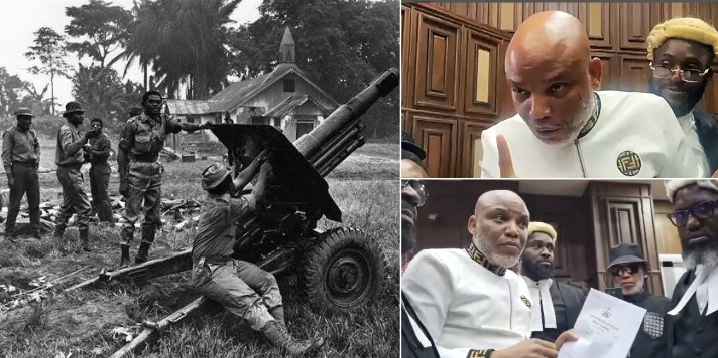
Abuja’s courtroom corridors smelled faintly of polished wood and paper, but the air seemed heavier than ordinary proceedings demanded. Every footstep echoed like a drumbeat of memory, as if the very walls remembered the cacophony of 1967. Nnamdi Kanu’s presence in the courtroom carries more than the weight of legal jeopardy; it carries the invisible, persistent shadow of history.
Charges of terrorism and treasonable felony swirl around him, yet the attention drawn is not merely legal. Observers sense an unresolved national anxiety, a reflection of wounds inflicted decades ago but never fully healed. Cameras click, whispers circulate, and each subtle motion of the accused is dissected not just for guilt or innocence but for symbolic meaning.
Kanu sits with his hands folded, a figure both defiant and reflective, embodying the tension between a state asserting its authority and a historical memory that refuses to be silenced. His trial has become a prism through which Nigeria’s enduring struggle with identity, governance, and unity is refracted, forcing citizens to confront both the present and the unresolved past.
The courtroom proceedings unfold as a delicate choreography of law and memory. Each motion filed, every witness called, reverberates with echoes of conflicts. Judges, lawyers, and spectators alike navigate this space under the weight of historical consciousness, where legal interpretation and national memory intersect.
The Arrest That Resurfaced Old Wounds
Kanu’s arrest in 2021 remains a flashpoint that continues to shape the trajectory of his trial. Captured in Kenya under circumstances that sparked international attention, his rendition to Nigeria reignited debates about sovereignty, legality, and human rights. The operation itself was executed with the precision of intelligence agencies yet carried the unavoidable symbolism of historical suppression. For many in the Southeast, it echoed the raids and military strategies of 1967, when the state acted decisively to quell secessionist aspirations. The apprehension was not merely about law enforcement but about a narrative of control, authority, and the enduring struggle over who has the right to define nationhood.
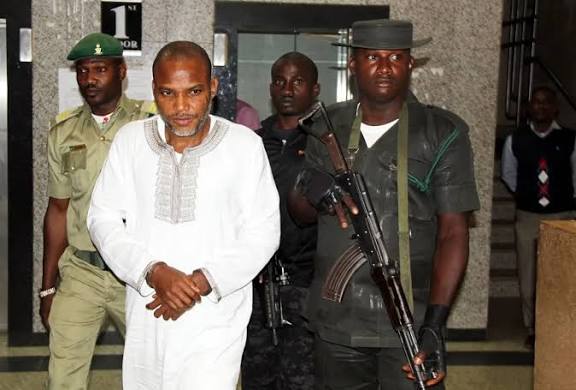
Legal experts scrutinized every procedural step of Kanu’s arrest, noting its implications for domestic and international jurisprudence. Questions about extradition legality, human rights obligations, and state authority became intertwined with public sentiment. Critics argued that the methods employed resurrected anxieties about arbitrary power, while supporters contended that the action was necessary to uphold national security. The narrative surrounding his capture was thus both immediate and historical, an intersection of modern legal frameworks and collective memory, reinforcing the sense that Kanu’s trial was destined to be laden with symbolic resonance.
Public perception of the arrest amplified the already intense scrutiny of the subsequent trial. Citizens in different regions interpreted the event through the lens of identity politics, historical grievances, and regional loyalties. Citizens could see in Kanu’s experience not only a man facing the machinery of the state but a reflection of a collective memory still grappling with the unresolved legacy of past years.
1967 Revisited: Historical Parallels
The echoes of the Biafran War are unmistakable in Kanu’s trial. In 1967, a declaration of secession triggered military action, mass displacement, and a humanitarian crisis that left indelible marks on Nigerian society. Today, Kanu’s calls for self-determination, though nonviolent in intent according to some accounts, are interpreted by authorities as a symbolic continuation of a conflict that the nation has never fully reconciled.
Memories of the past shape the legal and political calculus. For judges, lawyers, and officials, there is an acute awareness that any decision could resonate far beyond the courtroom. Conviction or acquittal will not merely resolve a criminal case; it will influence public sentiment, regional politics, and historical interpretation. The nation is reminded that the Biafran War did not end with a peace treaty alone—it left unresolved narratives that continue to animate public life.
Communities affected by the 1967–1970 war observe Kanu’s trial through the prism of lived memory. Families that endured displacement, starvation, and loss watch closely, interpreting events as either vindication or repetition of historical injustice. For younger generations, the trial becomes an entry point into a history they did not experience directly but that continues to shape their identity, sense of justice, and perception of national unity.
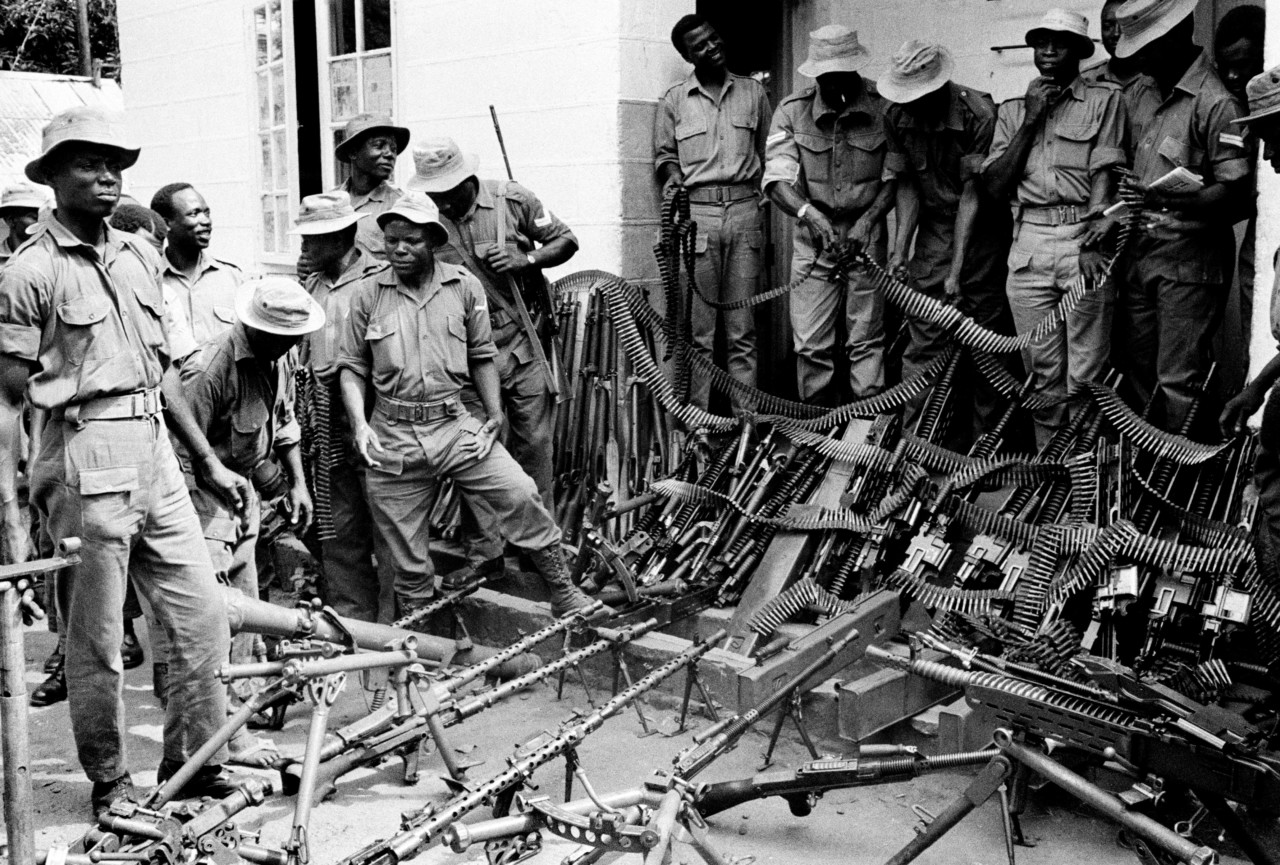
The resonance is not abstract. Every accusation, every defense argument, every media report is filtered through decades of collective memory. Legal documents are read alongside personal stories of loss, and the courtroom becomes a forum where history asserts itself as urgently as any evidence or testimony.
IPOB, Identity, and Modern Secessionist Movements
The Indigenous People of Biafra (IPOB) under Kanu’s leadership has evolved into more than a political movement; it is a repository of identity, memory, and historical consciousness. IPOB frames its demands not merely as political grievances but as extensions of a story interrupted by civil war. In doing so, the movement taps into an enduring sense of marginalization, drawing legitimacy from the historical injustice of 1967–1970.
IPOB’s activities—rallies, sit-at-home orders, media campaigns, and cultural mobilization—are interpreted variably across Nigeria. For southeastern communities, the organization symbolizes resistance and the reclamation of dignity. For other Nigerians, the movement is often seen as a threat to national cohesion, recalling the violence and chaos of the original secession attempt. These contrasting perceptions underscore the complex moral and political landscape surrounding Kanu’s trial.
The trial itself highlights the friction between national law and cultural memory. Legal arguments pivot around definitions of treason, terrorism, and sedition, yet public discourse constantly reframes these issues in moral and historical terms. The courtroom, in effect, is a microcosm of a larger debate: whether historical grievance can justify modern activism, and whether a nation can reconcile unity with the aspirations of a people who feel historically disenfranchised.
For IPOB members, Kanu’s presence in court is both a symbolic and practical focal point. His speeches, now scrutinized as evidence, echo past appeals for autonomy and dignity. The courtroom proceedings resurrect older questions about sovereignty, legitimacy, and the right to self-determination—questions first ignited in 1967, questions that remain unresolved more than half a century later.
The Trial That Reopened National Debates
The 2025 trial of Nnamdi Kanu became more than a legal proceeding; it turned into a lens through which Nigeria’s historical and contemporary struggles collided. Seven charges, including terrorism and treasonable felony, framed the legal battle, yet the courtroom drama cannot be understood without acknowledging the political and social undertones that trace back to the secessionist crisis of 1967. Each hearing carried an almost theatrical tension, where procedural objections and evidentiary disputes mirrored a larger narrative of a nation still grappling with questions of self-determination, regional identity, and the lingering trauma of civil war.
March 2025 marked a pivotal moment when Kanu filed two new suits demanding both unconditional release and a writ of mandamus. These filings were not mere legal maneuvers; they were declarations that challenged the legitimacy of the trial itself, citing violations of constitutional rights and procedural fairness. The suits illustrated how legal strategy and historical memory intersect, invoking the unresolved grievances of communities that felt marginalized during the Biafra conflict. By positioning the trial as a contested space, Kanu reframed the courtroom as both a site of legal contestation and a symbolic arena reflecting the unresolved tensions of 1967.
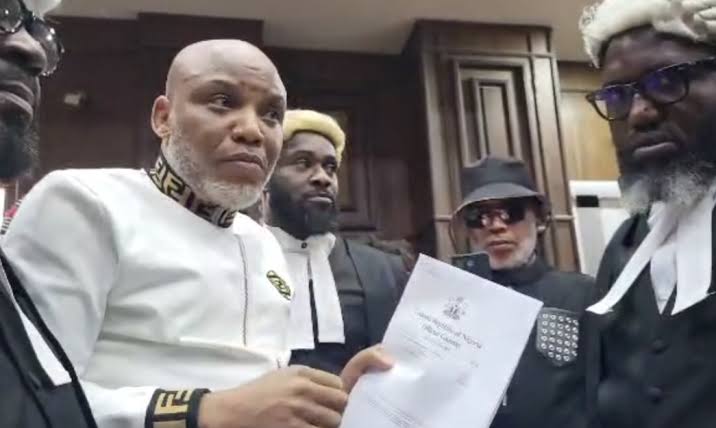
The withdrawal of Kanu’s lead counsel in October 2025 added another layer of complexity, transforming the trial into an intensely personal narrative. By choosing to represent himself, Kanu assumed direct control over the articulation of his defense, challenging jurisdictional authority and demanding extended time to call 23 witnesses, including political figures and former security chiefs. This act of self-representation amplified the trial’s symbolic weight, suggesting that the legal battle was inseparable from historical claims of legitimacy, voice, and agency. Each motion filed and objection raised carried the resonance of a historical struggle that stretched back decades, evoking the memory of a people whose aspirations had been violently suppressed.
Court proceedings themselves unfolded amid constant tension. After re-entering a not-guilty plea under Justice James Omotosho in March, Kanu engaged in the meticulous cross-examination of prosecution witnesses, extending well into May. Adjournments punctuated the schedule, with the court setting dates from late May into June, only to defer a critical ruling on his no-case submission until October. This procedural pause highlighted a duality: while the law demanded careful deliberation, the elongated timeline evoked historical delays in justice, reminiscent of the protracted struggles that followed the 1967 secession, when grievances remained unresolved for decades.
Legal objections offered another window into the trial’s complexity. The defense highlighted reliance on a repealed terrorism law, questioned the court’s jurisdiction, and challenged the authenticity of medical reports used in proceedings. These arguments intertwined technical legal reasoning with historical consciousness, suggesting that the trial was not merely about individual culpability but about the legitimacy of state power and the integrity of judicial processes. The courtroom became a space where procedural law, human rights, and collective memory converged, reflecting both the stakes of 2025 and the unresolved questions left by the Civil War.
The political dimension of the trial further amplified its significance. IPOB’s public condemnation, framing the proceedings as unconstitutional, underscored the deep entanglement of legal and political narratives. Citizens interpreted the trial through a historical lens, comparing contemporary judicial maneuvers to the military actions of 1967. Every adjournment, witness testimony, and filing carried symbolic weight, demonstrating how the courtroom acted as a microcosm of national tensions. Kanu’s trial was therefore more than a trial; it became a living dialogue between past and present, an arena where the unresolved issues of secession, autonomy, and identity continued to play out on a legal stage.
The stakes could not have been higher. With a judgment date set for 20 November 2025, every legal maneuver, objection, and procedural argument carried the potential to reshape political narratives and regional perceptions. Beyond the courtroom, the trial reverberated through communities still haunted by memories of displacement, hunger, and violence from 1967. The resonance of history was palpable, reminding the nation that Kanu’s trial was both a legal reckoning and a reflection of collective memory, bridging the unresolved past with the urgent debates of the present.
International Dimensions and Diplomatic Implications
Nnamdi Kanu’s trial did not unfold in isolation; its reverberations crossed borders, drawing attention from Britain, the United States, and international human rights organizations. His dual citizenship and rendition from Kenya in 2021 had already triggered debates about sovereignty, extradition legality, and international law. The courtroom in Abuja, while physically confined, became a stage where the global community watched a nation wrestle with questions of justice, fairness, and political legitimacy. Every filing, adjournment, and objection was scrutinized not only domestically but also through the lens of international standards, highlighting the intersection between local law and global norms.
The diplomatic stakes were amplified by Kanu’s claims of procedural irregularities, including reliance on a repealed terrorism law and alleged forgery of medical reports. Human rights advocates and civil society organizations seized upon these issues, arguing that the trial could set significant precedents for how Nigeria treats dissent and separatist movements. Foreign observers framed the trial as a test of Nigeria’s adherence to the rule of law and its capacity to balance national security with civil liberties. These external pressures added another layer of complexity, intensifying the scrutiny under which both the prosecution and defense operated.

The geopolitical dimension also linked directly to historical memory. Just as in 1967, when external actors closely monitored the Biafra conflict, Kanu’s trial drew comparisons to past international reactions to Nigeria’s internal strife. Critics suggested that the trial’s handling could influence Nigeria’s diplomatic relationships, particularly with Western governments concerned about human rights practices. The echoes of Biafra were unmistakable: the world once again watching as Nigeria struggled to reconcile the imperatives of state authority with the rights of citizens asserting historical grievances.
Even within diplomatic corridors, the trial generated cautious speculation. Analysts considered the potential impact of a conviction or acquittal on regional stability in the Southeast, the dynamics of Nigerian politics, and the global perception of Nigeria as a democracy capable of upholding due process. The courtroom thus operated on multiple planes: local adjudication, national symbolism, and international observance. Kanu’s case illustrated how the legacy of 1967 remained alive, reminding the world that Nigeria’s internal struggles are inseparable from historical memory and the ongoing negotiation of justice, sovereignty, and legitimacy.
Potential Outcomes, Legal Precedents, and Historical Reckoning
The stakes of Kanu’s trial extended far beyond his personal freedom. A conviction on charges of treason or terrorism would carry severe penalties, but the symbolic implications were equally profound. The trial threatened to either cement or fracture public trust in Nigeria’s judicial system, particularly in regions historically affected by the Biafra conflict. Legal scholars observed that the court’s handling of no-case submissions, procedural objections, and self-representation could establish precedents for future cases involving political activists or separatist movements.
Kanu’s insistence on self-representation, combined with his extensive witness list, introduced unprecedented dynamics into the courtroom. High-profile figures, from governors to former security chiefs, were positioned to testify on matters touching the very foundations of state authority and governance. Their testimony could set new legal benchmarks for accountability, evidence evaluation, and procedural fairness. At the same time, these developments reflected the persistent shadow of 1967, when questions about legitimacy, authority, and self-determination led to violent conflict. The courtroom became a controlled microcosm of historical and legal reckoning.
Political and regional implications added further weight to potential outcomes. Any perceived miscarriage of justice could exacerbate tensions in the Southeast, heightening the risk of civil unrest and deepening distrust of federal institutions. Conversely, a verdict seen as fair and procedurally sound could reinforce the credibility of the judiciary and serve as a case study in balancing national security with constitutional rights. In either scenario, the trial’s conclusions promised to resonate far beyond the legal sphere, shaping both public perception and the broader discourse on Nigeria’s historical struggles.
The trial’s culmination also invited reflection on unresolved historical questions. Just as the Biafra secession left lingering wounds in national consciousness, Kanu’s legal battle revived debates about state power, regional autonomy, and the enduring quest for justice. Citizens, political actors, and observers saw in the courtroom not merely the adjudication of one man’s fate, but a symbolic confrontation with the unresolved issues of identity, authority, and memory that have haunted Nigeria for decades. The potential outcomes, therefore, were as much about historical reckoning as legal resolution.
Summing-up: The Shadow That Endures
Even as the gavel falls and headlines fade, the shadow of 1967 lingers over Nigeria’s consciousness, threading its way through every deliberation in Kanu’s trial. The courtroom may close, judgments may be delivered, but the questions it has resurrected—about identity, belonging, and the limits of state authority—refuse to be silenced. History, it seems, does not wait quietly in archives; it sits in the seats of courts, whispers through streets, and shapes the hearts of those who carry memory as both burden and compass.
Nnamdi Kanu’s 2025 trial is not merely a chapter in legal annals; it is a mirror held to a nation still negotiating with its past. The faces of spectators, the murmurs of lawyers, the tense pause of a judge’s pen—all testify to a collective reckoning that law alone cannot resolve. The trial becomes a prism, refracting decades of fear, hope, and defiance, reminding citizens that the pursuit of justice is inseparable from the confrontation with history itself.
As Nigeria stands at this crossroads, the outcome of a single trial seems both finite and infinite. Finite in its immediate legal resolution, yet infinite in the questions it leaves behind: What does it mean to belong? How do we honor memory without perpetuating division? How can a nation reconcile its wounds while moving forward? The answers remain elusive, yet the dialogue persists, echoing like a distant drumbeat from 1967, refusing to be forgotten.
In the end, the shadow over Nnamdi Kanu’s trial is not simply about a man or a verdict—it is the living reflection of a nation wrestling with its own fractured past, and the persistent, unyielding quest to define what it truly means to be whole.