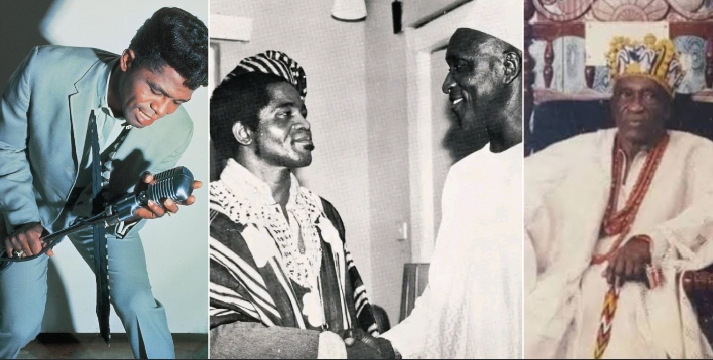
The sound arrived before the man. Somewhere between the rippling tide of the Lagos lagoon and the echoing bustle of the old Marina, a rhythm began to spread — part rumor, part revelation. It was December 1970, and word had slipped through the heat: James Brown, the Godfather of Soul, had touched Nigerian soil. The city did not yet have skyscrapers scraping the Gulf breeze, but it had something more electric — a pulse that understood rhythm as second nature. Taxi radios blared his voice, market women whispered his name, and the youth, still recovering from years of civil war, waited to see the man whose voice had traveled farther than many ships that ever left the ports of Apapa.
When Brown’s aircraft touched down at Ikeja Airport, Lagos was no longer merely a city; it became a heartbeat. Security struggled to hold back the flood of fans, some barefoot, some in borrowed suits, all carrying the kind of energy only hope could summon. The air smelled of dust, diesel, and anticipation. He waved from a limousine, his trademark cape glinting under the humid sky. But what followed next — his visit to the palace of Oba Adeyinka Oyekan II, the revered monarch of Lagos — would transform that week into something deeper than celebrity. It became a ritual of reconnection: the diaspora’s greatest performer returning to the continent’s spiritual capital of rhythm.
Brown had come to perform; Lagos had come to witness history. But the visit to the Oba’s palace would transcend music. It would become a dialogue — between Black America’s pain and Africa’s pride, between rhythm and royalty, between a man who sang about freedom and a king who embodied continuity. What happened inside those palace walls remains one of the most overlooked cultural moments in the Black Atlantic story — a meeting where soul met sovereignty.
The Man Who Carried America’s Pulse
By 1970, James Brown was not just a musician; he was a movement wrapped in a man’s body. From Augusta, Georgia, to Harlem, his name carried the weight of revolution. His songs — Say It Loud, I’m Black and I’m Proud, It’s a Man’s Man’s Man’s World — were both dance anthems and declarations of war against invisibility. When he decided to tour Africa, it was not merely a commercial venture; it was a pilgrimage. For Brown, Africa was the spiritual mirror of his struggle — the place his rhythm unknowingly echoed back to.
The Nigerian Civil War had just ended that January. The wounds were fresh, the memories raw. Lagos, though spared direct devastation, was a city humming with post-war fatigue and economic uncertainty. But it was also a city of emergence — the Federal capital, the heartbeat of a young republic, and a cradle of African modernity. The air of 1970 Lagos was filled with contradictions: a nation grieving yet dancing, rebuilding yet restless. When the world’s most powerful Black entertainer landed there, it felt symbolic — as though Africa itself was about to reclaim its song.

Brown’s arrival was not small-scale diplomacy; it was spectacle and spirit. Reports from Billboard magazine described how thousands flooded the airport to greet him, chanting his name and waving banners that said, “Welcome Home, Brother.” It was the first time Lagos had seen a Black American star of his magnitude visit since independence in 1960. He had crossed the Atlantic not as a stranger, but as a prodigal son whose rhythm had circled the globe and found its way home.
The Road to the Palace
That same afternoon, his convoy rolled through Lagos Island. The roads shimmered under the December sun as soldiers and police cleared paths through the crowd. Yet Brown’s first destination was not a concert hall, not the stadium that would host his electrifying shows, but the palace of the Oba of Lagos. Tradition demanded it — the city’s most honored guest must first pay respect to its custodian.
The palace of Oba Adeyinka Oyekan II, located near Iga Idunganran, was a colonial-era structure that fused European architecture with Yoruba majesty. Inside its courtyard, the scent of burning incense mingled with the sea breeze. Palace guards in white flowing agbadas stood in formation as the American motorcade approached. Lagosians gathered beyond the gates, trying to glimpse the man whose music had traveled farther than any royal decree.
James Brown stepped out dressed not as a visiting foreigner, but as a man embracing something sacred. His tailored suit shimmered with the sharpness of Harlem, yet his eyes reflected a humility uncommon in global fame. When the palace drums began — the royal talking drums that announce lineage, history, and welcome — he paused, visibly moved. Those rhythms, older than slavery, older than the Atlantic crossing, spoke his name in tones only ancestry could translate. For a moment, Lagos stood still. The man who had electrified Apollo Theater now bowed before Yoruba royalty.

Oba Oyekan II, dignified and serene, extended his hand. “Welcome home,” he said. Though the record does not preserve every word, witnesses recalled a profound stillness in that exchange — the monarch representing a lineage centuries old greeting a son of the diaspora whose fame had carried the African spirit across oceans. The palace that day was not a relic of tradition; it became a bridge between worlds.
Royal Ceremony: When Soul Met Sovereignty
According to Billboard’s September 1971 feature, Brown spent over an hour at the palace. The Oba conferred on him the honorary title of Freeman of Lagos — a distinction reserved for dignitaries who contributed to the city’s cultural prestige. Alongside the scroll bearing the royal seal, Brown received a chain of office, a gleaming symbol of unity between Lagos and the African diaspora.
For the palace attendants and Lagos elites who witnessed it, the event was more than ceremony. It was a convergence of rhythm and ritual, modernity and monarchy. Brown, known for his ferocious stage energy, became uncharacteristically quiet, absorbing the solemnity. The Oba, whose reign spanned the years of Nigeria’s greatest transformations — independence, civil war, reconstruction — understood the gravity of this meeting. It was not just about honoring a musician; it was about affirming cultural kinship across oceans.
Outside the palace, Lagos continued to dance. Children beat imaginary drums, and traders told each other the story of how the Godfather of Soul had been welcomed by the King of Lagos. It was a story too symbolic to fade — a reminder that even across centuries of separation, sound could still find its source. Brown later described the moment to American journalists as deeply emotional, saying that meeting the Oba “was like seeing where it all began.”
The Oba’s palace was no concert stage, yet that afternoon, it became one. The talking drums conversed with the echoes of Cold Sweat and I Got the Feelin’. The cultural choreography of the Yoruba court — its gestures, prostrations, and rhythm — mirrored the syncopations of James Brown’s music. It was not imitation; it was reflection. Both traditions, after all, sprang from the same heartbeat.

A City in Transition
Lagos in 1970 was a city suspended between eras. Colonial influence lingered in the streets named after British lords, yet Afrocentric pride was rising through music, fashion, and politics. Fela Anikulapo-Kuti had just returned from his own American sojourn, charged with revolutionary sound. Sunny Ade was beginning to modernize juju. Nightclubs like Kakadu and Caban Bamboo pulsed with rhythm long after curfew. James Brown arrived at the crossroads — not to plant a flag, but to validate a new identity already forming.
For Lagosians, Brown represented the proof that Blackness could be global and glorious. For the Oba, he symbolized the continuity of African expression — the resilience of a people who had survived the middle passage and remade rhythm into resistance. And for Brown himself, Lagos became a mirror that reminded him that soul did not begin in America; it only found its microphone there.
The city embraced him not as a visiting star but as kin. Newspapers chronicled his every movement. Photographers followed his entourage from the palace to the stadium. His concert drew one of the largest audiences Lagos had ever seen, rivaled only by independence celebrations a decade earlier. It was more than entertainment; it was emotional archaeology — uncovering a shared history buried under centuries of displacement.
The Freeman of Lagos
The title “Freeman of Lagos” carried weight beyond ceremony. Historically, it symbolized acceptance — the right to move, trade, and belong within the kingdom’s domain. For a Black American to receive it in 1970 was both political and poetic. Nigeria had just survived a war that questioned unity, and here came a man whose music spoke of solidarity and pride. The Oba’s gesture transformed a concert tour into diplomacy. It was soft power before the term became fashionable.
Brown, moved by the recognition, reportedly promised to return with more artists — a gesture toward building a cultural bridge between African Americans and Africans. Though that grand vision never fully materialized, the palace encounter set a precedent. It showed that Lagos, with its blend of tradition and modernity, could serve as the world’s stage for Black excellence.
Within months, African-American artists and activists began to look toward Lagos — and by 1977, the city would host FESTAC ’77, the world’s largest Black arts festival. In many ways, Brown’s palace visit was a preview of that global convergence.
The Oba Who Opened the Gates
Oba Adeyinka Oyekan II was not a monarch content with ritual alone. A pharmacist by profession, a veteran of the Second World War, and a man of quiet intellect, he had witnessed colonial Lagos transform into the capital of independent Nigeria. His reign, spanning from 1965 to 2003, was marked by restraint, dignity, and bridge-building. Unlike many traditional rulers, he viewed the palace as a living institution capable of dialogue with both history and modernity. By receiving James Brown with full royal honors, Oyekan positioned Lagos not merely as a political hub, but as a cultural capital — a space where global Black identity could be recognized and celebrated.
The Oba’s gesture reflected a deeper Yoruba worldview — one that treats visitors as potential kin rather than strangers. In Yoruba cosmology, to honor a guest is to honor the ancestors. This philosophical lens transformed the palace from a political space into a site of spiritual significance. When Brown knelt respectfully, and the Oba draped the chain of Lagos around his neck, the act became more than ceremonial protocol; it was a ritual of reconnection, affirming that the diaspora’s journey across the Atlantic had not severed its ancestral ties.
Observers recall the quiet dignity of that moment. The palace courtyard, usually dominated by ceremonial routine, became charged with an unusual energy. Drummers struck patterns that both welcomed and praised, creating a dialogue between Yoruba tradition and the diasporic rhythms Brown embodied. The visual of the American musician kneeling before the Lagos monarch symbolized a mutual recognition: centuries of history, displacement, and resilience converging in a single gesture.
By the end of the visit, it was evident that the Oba had opened more than palace gates; he had opened a bridge across time and geography. The event demonstrated that Lagos could host the world without losing its own voice, and that cultural and spiritual continuity could coexist with the vibrant modernity emerging in post-war Nigeria. For both the monarch and the musician, the meeting affirmed a shared ancestry expressed through respect, rhythm, and presence.
Soul Across the Atlantic
What made James Brown’s Lagos journey unforgettable was not the scale of the concert, but the symbolism of the palace visit. The meeting represented the reunion of cultural fragments scattered by centuries of slavery. Brown’s music — built on call-and-response, polyrhythms, and repetition — echoed West African traditions that survived bondage, adapting into a new language of empowerment. When those rhythms returned to Lagos, it was a cyclical moment: the African diaspora reconnecting with its source, not just metaphorically, but through the palpable energy of performance and ceremony.
For African-American audiences, the visit validated their cultural significance on the global stage. For Nigerians, it reinforced the notion that soul, funk, and rhythm and blues were inherently African at their core. Lagos, already a city defined by layered histories and identities, became a physical and symbolic meeting point. In that courtyard at Iga Idunganran, centuries of diaspora memory collided with local tradition, producing an electric acknowledgment of kinship beyond borders.
The event also had ripple effects on the continent’s music scene. Fela Anikulapo-Kuti, who was experimenting with new styles after his American experiences, reportedly drew inspiration from Brown’s disciplined funk structures. Afrobeat, which would come to define African popular music globally, absorbed elements of this transatlantic exchange, marrying Yoruba percussion with the tight grooves of funk. Brown’s visit, therefore, was not just ceremonial; it planted seeds for decades of musical innovation.
Finally, the symbolism extended beyond the music itself. Drums spoke, voices echoed, and gestures communicated across cultures. Brown’s recognition of Yoruba ritual, and the Oba’s embrace of diasporic artistry, formed a dialogue without words — a shared understanding that identity, rhythm, and heritage could survive displacement. That December, Lagos was both a stage and a sanctuary, where soul literally and figuratively came home.
After the Music Faded
James Brown departed Lagos after a whirlwind week of concerts, interviews, and royal honors, but the city’s memory of him lingered. Market vendors, street musicians, and youth alike told stories of the Godfather of Soul bowing before Oba Oyekan II, blending recollection with reverence. Over the decades, the tale became folklore, part memory, part music. Even after the Oba’s passing in 2003, older Lagosians recounted the palace encounter as a benchmark of cultural pride — the day global fame and local tradition intersected seamlessly.
The visit has since been recognized as one of the earliest tangible cultural exchanges between postcolonial Africa and Black America. Historians note that it predates Muhammad Ali’s Rumble in the Jungle in Zaire, Stevie Wonder’s diplomatic trips, and the FESTAC ’77 festival. In essence, it was a prototype of what African-American engagement with the continent could look like: respectful, celebratory, and rooted in mutual recognition. Brown bowing before the Oba symbolized the completion of a cultural circle, a gesture that restored rhythm to its ancestral home.
Beyond ceremony, the event became a touchstone for Lagosians navigating the postwar period. The city was rebuilding and redefining itself, and Brown’s presence validated Lagos as a space where African heritage and modernity could coexist. Observing the international attention drawn by the visit, local elites and cultural leaders began to see Lagos as a city capable of hosting global Black excellence, further cementing its reputation as a cultural capital.
Ultimately, the legacy of that week extended far beyond music and media. It was a social affirmation of belonging, an assertion that the diaspora’s achievements resonated on the continent. Brown’s visit exemplified how cultural diplomacy could operate outside politics — through music, ritual, and presence — leaving an imprint that would inspire generations of artists, leaders, and ordinary Lagosians alike.
Legacy and Reverberation
Over fifty years later, the palace of Iga Idunganran stands as both a historical landmark and a living symbol of Lagos continuity. The surrounding streets have changed: coral structures replaced by concrete, procession routes intersected by modern traffic, yet the memory of James Brown’s visit remains vivid in collective consciousness. Musicians, dancers, and students continue to reference the event, consciously or unconsciously extending that symbolic handshake between rhythm and royalty into new creative expressions.
The encounter also solidified the concept of transatlantic dialogue in cultural terms. Scholars examining diaspora connections often cite Brown’s palace visit as a pivotal moment — proof that music, ceremony, and respect can serve as vehicles for reconciliation and reconnection. The gestures performed in that courtyard conveyed ancestral memory, bridging continents and generations. Brown’s humility and recognition of Yoruba tradition reinforced the idea that true artistry transcends borders.
Moreover, the event provided a template for future cultural exchanges. FESTAC ’77, Afrobeat’s global rise, and subsequent African-American tours to Nigeria all drew inspiration from the precedent set that December. The palace had been more than a ceremonial site; it had been a forum for dialogue, mentorship, and mutual appreciation between artists and cultural custodians. Through it, Lagos announced itself as a city capable of hosting not only music but also history and heritage.

Finally, the story endures because of its human resonance. Beyond headlines or archival images, it lives in personal memory, rhythm, and narrative. For Lagosians, for Africans, and for the diaspora, the December 1970 palace visit symbolizes a moment when the drum spoke clearly, when history and culture embraced a returning son, and when the pulse of Africa recognized itself in the music of its progeny. It was, and remains, an enduring testament to the power of presence, rhythm, and kinship.
Final Thoughts: When the Drum Came Home
The drums that greeted James Brown in Lagos were not welcoming a foreigner; they were welcoming a returning son. The palace that received him was not hosting an American celebrity; it was receiving back a rhythm that had crossed oceans and survived centuries. Oba Oyekan II understood that ceremony better than anyone. Brown may not have known every word of the talking drums that day, but he felt their meaning — that soul, at its deepest, is ancestral memory set to sound.
When the limousine finally departed the palace gates, the crowd erupted again, chasing after the motorcade. The Oba’s courtyard fell silent, but the air still vibrated with rhythm. Somewhere between the palace and the sea, Lagos exhaled — proud, soulful, and whole again.
More than fifty years later, the story of James Brown’s palace visit remains one of Lagos’s quiet miracles — proof that history is not only written in treaties and wars, but in music and gestures, in the brief moment when a king and a musician met and, without words, completed the rhythm of a scattered people.