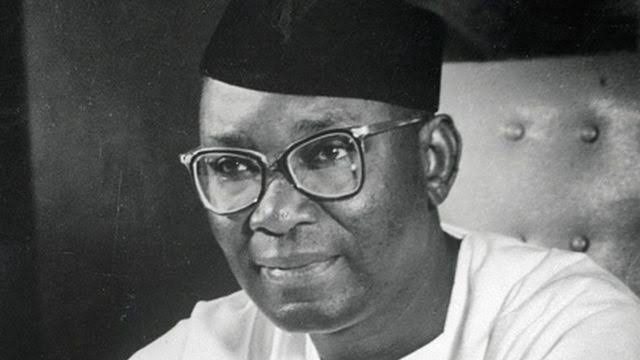
On this day, May 11 in 1996, Nnamdi Benjamin Azikiwe, first president of Nigeria during the First Nigerian Republic died at the age of 92 in his home state, Enugu.
Azikiwe was born on 16 November 1904 in Zungeru, Northern Nigeria. His father, Obed-Edom Chukwuemeka Azikiwe (1879–3 March 1958), a native of Onitsha, was a clerk in the British Administration of Nigeria, who traveled extensively as part of his job.
Azikiwe’s mother was Rachel Chinwe Ogbenyeanu (Aghadiuno) Azikiwe (1883–January 1958), who was sometimes called Nwanonaku and was the third daughter of Aghadiuno Ajie. Her family descended from a royal family in Onitsha, and her paternal great-grandfather was Obi (Ugogwu) Anazenwu.
Azikiwe had one sibling, a sister, named Cecilia Eziamaka Arinze. Azikiwe also became directly involved in political movements.
In 1937 he joined the Nigerian Youth Movement, leaving it for the Nigerian National Democratic party in 1941. In 1944, on Azikiwe’s initiative, the National Council of Nigeria and the Cameroons (NCNC) was founded to “weld the heterogeneous masses of Nigeria into one solid block.”
Azikiwe was elected the council’s general secretary and in 1946 its president. In this period his major political writings, apart from his newspaper articles, were Political Blue Print of Nigeria and Economic Reconstruction in Nigeria(both 1943).
Between 1947 and 1960 Azikiwe, as leader of the NCNC, held a number of elected public offices. He was a member of the Nigerian Legislative Council (1947- 1951), member of the Western House of Assembly (1952-1953), premier of the Eastern Region (1954-1959), and president of the Nigerian Senate (1959-1960).
During these years he had continued to play the single most vigorous role in Nigeria’s march toward independence. While premier, he greatly expanded educational facilities in the Eastern Region and laid the foundation of the University of Nigeria at Nsukka, formally opened in September 1960.
On Oct. 1, 1960, Nigeria became independent, and Azikiwe was appointed governor general with the primeministership going to Sir Alhaji Abubakar Tafawa Balewa, deputy governor general of the Northern People Congress, the largest single party of the federation. On Oct. 1, 1963, Nigeria became a republic, and Azikiwe was named its first president, a position he held until he was deposed by the military coup of Jan. 15, 1966.
In the Nigerian-Biafran civil war, May 1967-January 1970, Azikiwe at first reluctantly supported Biafra, but in August 1969 came out against Biafran secession and in favor of a united Nigeria.
From 1978-1983 Azikiwe led the Nigeria People’s Party (NPP); he was the NPP’s candidate in the presidential elections of 1979 and 1983. He retired from politics in 1986.
Azikiwe died in eastern Nigeria on May 11, 1996, following a long illness.