
A caterer in Oshodi registers her business name, prints complimentary cards, and starts taking orders. Two years later, a hotel in Ikeja wants to give her a contract worth six figures, but their procurement officer calls and says they only deal with registered companies. Not business names. Companies. She does not know there is a difference. Many Nigerians registering with CAC for the first time do not either, and that gap in understanding costs people contracts, opportunities, and sometimes their personal savings when things go wrong.
The confusion is understandable. The Corporate Affairs Commission handles both, and both will get you a CAC certificate. But the legal reality sitting underneath each registration is completely different. A business name and a limited liability company are not two versions of the same thing. They are two different legal structures with different implications for who owns what, who owes what, who can invest, and what happens if the business goes under. What you register determines how protected you are, how credible you appear, and what doors open or stay closed.
Business Name and Limited Company
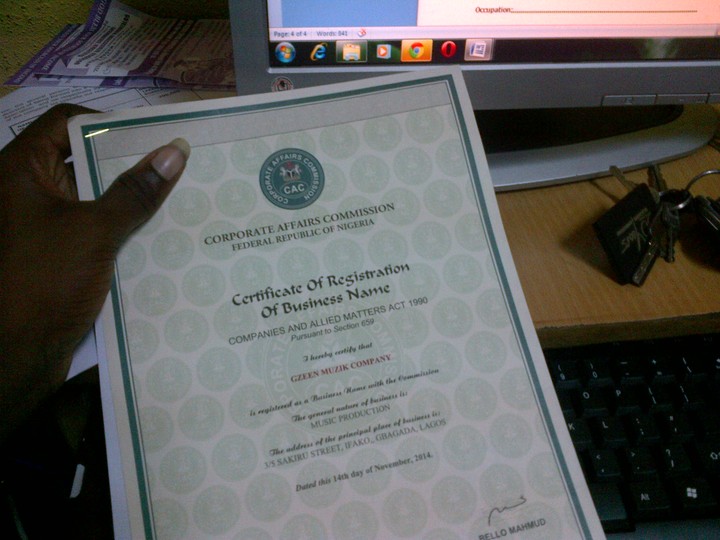
The distinction between a business name and limited company under Nigerian law is not about size or seniority. A market trader and a tech startup can both register a limited company. A freelance consultant and a small trading firm can both register a business name. What matters is the legal structure each one carries, because that structure shapes everything from how profits are taxed to whether your landlord can come after your personal property if the business owes money. Understanding what you are actually registering gives you the foundation to make the right call for where your business is going.
What It Actually Means to Register a Business Name in Nigeria
A business name registration, sometimes called an enterprise or sole proprietorship, is covered under Part E of the Companies and Allied Matters Act 2020, the legislation that governs all business registrations in Nigeria. When you register under this structure, the CAC gives you a certificate with a BN number. It looks official, and it is official, but the critical thing to understand is that the law does not treat your business as a separate person from you. You and the business are, in legal terms, the same entity.
This matters in ways that are easy to underestimate. If your business name takes on a debt it cannot pay, your personal bank account, car, property, and savings are all fair game for creditors. There is no wall between your personal finances and your business finances. Whatever the business owes, you owe. This structure works under the assumption that the owner is the business and the business is the owner, and Nigerian courts will hold you to that.
A business name can be owned by one person, which makes it a sole proprietorship, or by two or more people, which makes it a partnership. Both fall under the same registration category with the CAC. Partners in a business name share not only profits but also liabilities. If your partner runs up a debt on behalf of the business, you are equally on the hook for it, regardless of how informally your arrangement was structured.
The BN registration is popular for good reason. It is fast, straightforward, and relatively cheap. The CAC processes it within 24 to 72 hours for most applicants. It allows a fashion designer, a food vendor, a freelance writer, or an Ajo organizer to operate under a recognized business name, open a business bank account, and invoice clients legitimately. For small-scale operations where the owner is comfortable absorbing the risk personally, it is a reasonable starting point.
How a Limited Liability Company Works Under CAMA 2020
A limited liability company, shortened to Ltd and known locally as a limited company, is a different legal animal entirely. Under Section 18 of CAMA 2020, once a company is incorporated, it becomes a legal person. It can own property, sign contracts, open bank accounts, sue in its own name, and be sued. It exists independently of whoever owns it. If all the shareholders died tomorrow, the company would still legally exist until it is formally wound down.
The ownership structure is defined by shares. Whoever holds shares in the company is a shareholder, and their liability is limited to whatever they paid for those shares. If the company owes creditors 50 million naira and goes under, the shareholders personally owe nothing beyond what they already put in. Their personal assets are protected. This is the core offer of limited liability, and it is what the Ltd designation signals to the world: the owners are not the business.
One of the more significant changes that CAMA 2020 introduced was allowing a single individual to incorporate a limited company. Before the 2020 law, you needed at least two shareholders. Now, a one-person company is valid. This means someone who would have previously registered a business name purely for simplicity now has the option to incorporate a company with all the protections that brings, without needing a partner.
The company must have at least one director and, depending on its size, may be required to appoint a company secretary. It must have a registered office address in Nigeria. Its ownership, directors, and other particulars are publicly filed with the CAC, which is why large organizations and government agencies can run background checks on your company before doing business with you. Transparency is built into the structure.
The Liability Gap: Why This Difference Changes Everything
In practical Nigerian terms, the liability difference is what separates a business name from a limited company most sharply. Consider a supplier who delivers goods worth 5 million naira to your business on credit, and the business cannot pay. Under a business name, the supplier’s lawyers can come after your house in Lekki. Under a limited company, they can only pursue what the company owns. Your personal property sits outside the reach of business creditors, unless you personally guaranteed the debt or engaged in fraud.
This distinction becomes particularly sharp when something goes wrong in sectors with high financial exposure: construction, real estate, trading in large volumes, or any business where significant credit is extended. Many Nigerian entrepreneurs discover the vulnerability of a business name only after it is too late, when a debt they thought was a business problem becomes a personal crisis.
There is also the question of continuity. A business name is tied to its owner. If the sole proprietor dies or becomes incapacitated, the business effectively ceases to exist in its registered form. Assets have to go through estate processes, contracts may lapse, and relationships with clients and vendors are disrupted. A limited company, by contrast, has perpetual succession. The company does not die when a shareholder or director does. Shares pass to heirs, the company continues, and operations can proceed without starting over from scratch.
For a small business with a single person running everything day to day, this may feel theoretical. But for a business that has built up client relationships over years, holds long-term contracts, or employs staff, continuity is not a minor consideration. It is one of the reasons banks and institutional clients in Nigeria tend to insist on dealing with incorporated companies rather than business names.
Registration Process and Cost: What You Will Pay at CAC
For a business name, the official CAC fees as of the May 2025 gazette are straightforward. Name reservation costs 1,000 naira. The registration itself costs 10,000 naira. That brings the statutory minimum to 11,000 naira. In practice, portal charges and processing can push the total to around 21,000 naira when all fees on the CAC’s online platform are included. The certificate arrives digitally within 24 to 72 hours if your documents are in order.
A limited liability company registration costs more and depends on share capital. The CAC charges 10,000 naira per 1 million naira of share capital for private companies. So a company with a 1 million naira share capital pays a statutory registration fee of 10,000 naira. A company with a 5 million naira share capital pays 50,000 naira in registration fees alone, before portal charges and any professional fees. All in, incorporating a limited company typically costs between 40,000 and 100,000 naira or more, depending on the share capital chosen and whether you use a lawyer or accredited agent to handle the filing.
The documents required are also more involved for a limited company. Beyond personal identification, you need a Memorandum and Articles of Association, details of all shareholders and directors, and a stated share capital. The CAC processes incorporated companies within 2 to 5 working days when documents are complete, though queries from the CAC can extend this timeline. For a business name, the documentation is lighter: personal ID, a passport photograph, and your business address details are the main requirements.
It is worth noting that in September 2025, the CAC partnered with SMEDAN to offer free business registration to 250,000 micro and small enterprises across Nigeria, foregoing roughly 3 billion naira in fees as part of the initiative. That programme was targeted at business names, not limited companies, and slots were limited. Outside government-sponsored schemes like that one, registration fees apply as standard.
Compliance Obligations After Registration
Both structures require you to file annual returns with the CAC every year, but the rules are different. For a business name, Section 822(1) of CAMA 2020 requires you to file your returns by June 30 of each year, except for the calendar year in which your business name was registered. The fee under the current CAC schedule is 5,000 naira per year. Filing late attracts penalties, and prolonged non-filing can result in your business name being struck off the CAC register.
Limited companies operate under Section 421(1) of CAMA 2020, which requires annual returns to be filed within 42 days after the company’s Annual General Meeting. For small private companies, the annual returns fee is 5,000 naira. For larger private companies, it rises to 10,000 naira. Public companies pay 20,000 naira. Beyond the basic returns fee, companies that file late face additional penalties of 1,000 naira per officer of the company for each year of late filing.
Limited companies carry heavier ongoing compliance requirements in general. Every limited company is expected to maintain a register of directors, a register of shareholders, and under CAMA 2020’s transparency requirements, a register of beneficial owners. A beneficial owner is any person who holds 5 percent or more of the company’s shares or exercises significant control. This register must be maintained at the company’s registered office and relevant details submitted to the CAC.
A limited company must also appoint a company secretary, particularly as it grows. The company secretary is responsible for ensuring board minutes are recorded, statutory filings are made on time, and the company’s records are current and accurate. For a one-person small company, this can be handled by the director themselves, but the obligation exists. Business names have no such requirement. The administrative load of running a limited company is simply higher, which is the trade-off for the legal protections it provides.
Taxation: How Each Structure Affects What You Pay to FIRS
The tax treatment of a business name and a limited company in Nigeria is fundamentally different, and this difference compounds over time as a business grows. For a business name, the profits of the business are treated as the personal income of the owner. There is no separate corporate tax bill. The owner declares business income on their personal income tax return and pays Personal Income Tax under the Personal Income Tax Act, at progressive rates that start at 7 percent and rise to 24 percent on annual income above 3.2 million naira.
A limited company, by contrast, pays Companies Income Tax on its profits. The rate structure has three tiers: small companies with gross turnover of 25 million naira or less pay zero percent CIT, effectively exempting them from corporate income tax entirely. Medium-sized companies with turnover between 25 million and 100 million naira pay 20 percent. Large companies above 100 million naira pay 30 percent. These thresholds mean that a growing small business operating as a limited company may not pay corporate income tax for its early years at all, while the same business operating as a registered business name would be paying personal income tax on every naira of profit.
There is also the question of how profits are extracted from the business. A limited company cannot simply transfer business money to a director’s personal account without that being treated as either salary, which attracts PAYE, or dividends, which carry a 10 percent withholding tax. This requires more deliberate financial management. A business name owner, by contrast, has no formal distinction between business and personal funds, which simplifies cash management but removes the tax planning flexibility that a corporate structure can offer.
Additionally, limited companies must file their tax returns with FIRS separately from their annual returns with CAC. The company files audited accounts and tax calculations within six months of the end of its financial year. Business names file personal income tax with the relevant state tax authority, since personal income tax in Nigeria is administered at the state level, not by FIRS. This jurisdictional difference matters for compliance: a Lagos-based business name owner pays personal income tax to the Lagos Internal Revenue Service, not to FIRS.
Which Industries Cannot Use a Business Name in Nigeria
Not every kind of business can choose to operate as a registered business name. The CAC and various sectoral regulators in Nigeria have made limited company registration compulsory for certain industries, and operating in those sectors under a business name is not permitted.
Schools cannot be registered as business names. If you are running a private nursery, primary, secondary, or tertiary institution, the CAC requires you to incorporate as a limited liability company before you can formally register the school. The same applies to pharmacies, which must comply with the Pharmacists Council of Nigeria’s licensing requirements, and those requirements mandate company incorporation rather than a simple business name. Travel agencies must register as limited companies under the Nigerian Civil Aviation Authority’s framework. Insurance companies operate under the National Insurance Commission and cannot function under a business name for obvious financial regulatory reasons.
Banks and other financial institutions, including microfinance banks, fintech companies operating under CBN licensing, and investment firms regulated by the Securities and Exchange Commission, must all be incorporated. If you are building a product or service in any of these regulated spaces, a business name registration is not just insufficient, it is legally non-compliant.
The practical implication for Nigerian entrepreneurs is that your business model should determine your registration choice, not just your current scale. If the business you are building today or planning to build tomorrow falls into any regulated sector, starting as a limited company from day one saves the cost and complication of converting later.
When to Move From a Business Name to a Limited Company
Many Nigerian entrepreneurs start with a business name because it is faster, cheaper, and simpler. There is nothing wrong with that. For a freelancer, a market trader, a food vendor, or someone testing a business concept, a business name gets you into legitimate operation quickly. The question is when that structure starts working against you instead of for you.
The most common triggers are when corporate clients start asking for your RC number, when an investor or partner wants a formal equity stake in the business, when you want to apply for a government grant or contract that requires company registration, or when the business has grown to the point where personal liability becomes a real financial risk. Banks also tend to offer better facilities, including larger overdrafts and business loans, to incorporated companies than to business name holders.
Converting from a business name to a limited company is not a straightforward upgrade in Nigeria. Under the CAC’s framework, you cannot simply change your existing business name registration into a company. You register the new limited company from scratch, complete with a new name, new RC number, and new certificate. Many founders register a company with a name that incorporates their existing brand, so clients and vendors see continuity even if the legal structure underneath has changed. You then effectively move operations, banking, and contracts to the new entity.
The decision also has timing implications. If your business is already generating significant revenue and you switch to a limited company, the zero percent corporate income tax exemption for small companies becomes attractive. But if your turnover is growing quickly, you want to be incorporated before you hit thresholds where personal income tax rates become unfavorable or where you need to onboard investors who require equity structures that only a company can provide.
Making the Right Registration Decision for Your Business
The difference between a business name and a limited company in Nigeria is not cosmetic, and it is not just about prestige. It is a legal distinction that determines how exposed you are, how much trust you can command with institutional clients, how your profits are taxed, and what happens to your personal finances when the business hits difficulty. Both are legitimate structures under CAMA 2020. Both serve real purposes. But they serve different purposes, and registering the wrong one for your situation has real costs.
A business name suits someone operating at a modest scale, comfortable absorbing personal risk, not seeking external investors, and working in sectors where company incorporation is not mandated. A limited company suits anyone who wants liability protection, is targeting institutional or government clients, needs to onboard co-founders or investors formally, or is building in a regulated industry that requires incorporation from the start.
Nigeria’s business environment has become more accessible for company registration since CAMA 2020 took effect. The allowance for single-member companies removed the old barrier of needing a second shareholder just to incorporate. The CAC portal handles most of the process online. The fees, while higher than a business name registration, are not prohibitive for most serious ventures. If your business is going somewhere, registering the structure that protects you and positions you for that growth is not an extra step. It is the right first step.