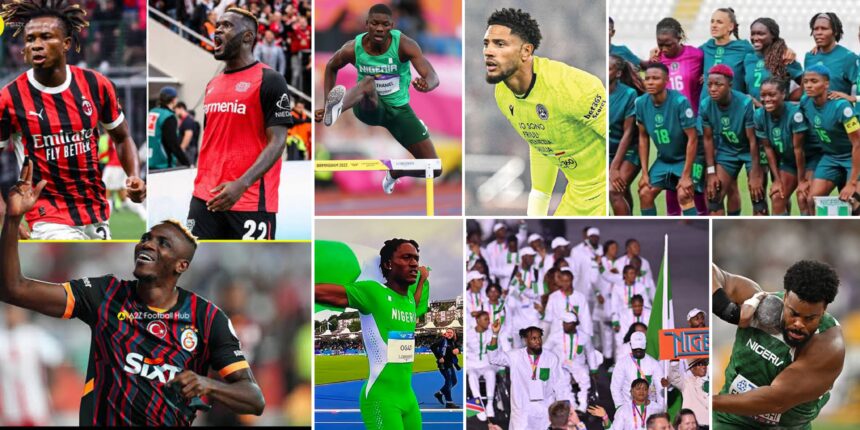
August 2026 has produced the kind of sporting month that refuses to fit neatly into a victory column or a disappointing results sheet, because across football, athletics, para sports and emerging disciplines, Nigerian athletes have given the country several different reasons to pay attention. Some arrived through goals scored on European pitches, some through gold medals won under intense pressure, some through records that changed the history books, while others came through defeats that exposed how quickly sporting dreams can disappear. The fascinating part is that these stories have unfolded almost side by side, creating a month in which individual brilliance has repeatedly stood apart from the fortunes of national teams. From Victor Osimhen and Samuel Chukwueze making headlines in Europe to Samuel Ogazi and Ezekiel Nathaniel creating Commonwealth history, August has placed Nigerian sporting talent back in conversations that stretch far beyond the country’s borders.
The month has also offered a reminder that Nigerian sport is rarely one simple story at any given moment, because success can arrive through an individual even when a team is struggling, while a medal can carry a much deeper meaning when it represents something Nigeria has never achieved before. Glasgow provided some of those unforgettable moments, with Nigeria finishing as Africa’s highest ranked nation at the 2026 Commonwealth Games after collecting 24 medals, made up of 10 gold, 7 silver and 7 bronze. The figures themselves are impressive, but the names behind them tell a more compelling story. Their stories gave August a historic dimension, yet the month also carried painful reminders through the Super Falcons’ WAFCON exit, the loss of their 2027 FIFA Women’s World Cup playoff, Nigeria’s Commonwealth medal decline from Birmingham and the withdrawal of the country’s flag football teams from a major world championship because of visa difficulties.
Osimhen Remains A Nigerian Football Reference Point
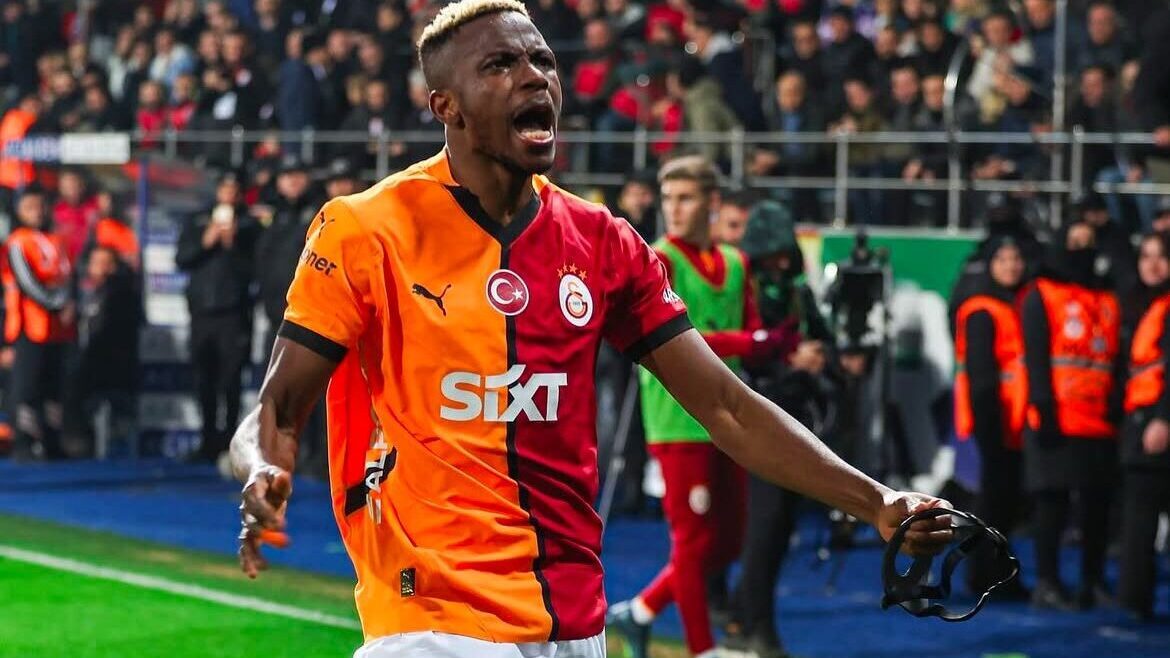
Victor Osimhen has continued to occupy a familiar place at the centre of Nigerian football conversations as European football moves into the 2026 and 2027 season cycle, with his goals and performances carrying significance beyond the club environment. The Nigerian striker remains one of the country’s most recognisable sporting figures, and every strong performance immediately feeds into a wider conversation about the strength of Nigeria’s attacking options. Recent European action has placed Osimhen alongside other Nigerian forwards and attacking players who are beginning their own important chapters, creating a picture of a generation that continues to command attention across some of the biggest football environments in Europe. His story therefore works as more than a player profile, because his performances remain closely connected to expectations surrounding the Super Eagles and the next stage of Nigerian football.
On Friday, August 14, 2026, Victor Osimhen scored both Galatasaray goals in their opening Turkish Süper Lig fixture against newly promoted Çorum FK at RAMS Park. The match finished 2–2.
The remarkable part is that Osimhen scored Galatasaray’s first goal of the new league season and then returned late to score the equaliser, effectively rescuing the champions from an embarrassing opening-day defeat. Reports place his first goal around the 53rd minute and his second around the 90th minute.
August has therefore placed him at the front of a wider European football story rather than presenting his performances as an isolated development. The season is still unfolding, yet the early signs have already created another reason to watch how Nigeria’s leading footballers perform when competitive football gathers pace.
Chukwueze Finds A Moment Worth Watching
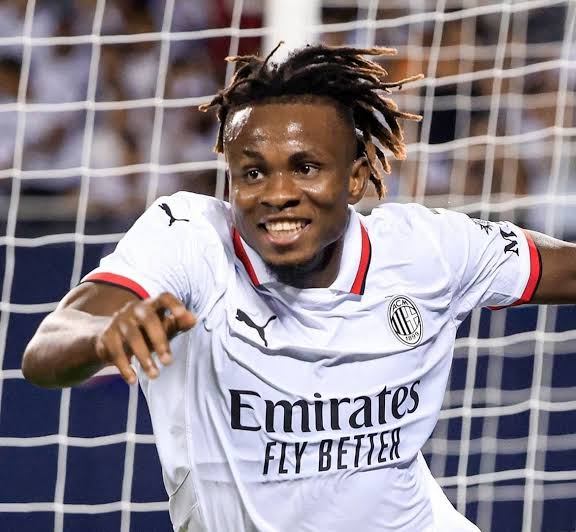
Samuel Chukwueze has produced one of the more intriguing football narratives of the month because his recent performance against Manchester United has reopened a conversation that has followed him for some time.
In AC Milan’s final pre-season match, Chukwueze scored once and provided two assists as Milan came from behind twice to beat Manchester United 4–2 at the Tarczyński Arena in Wrocław, Poland.
The match could be important for Chukwueze personally. Reports say he is trying to re-establish himself at AC Milan under Ruben Amorim, and his performance against United came in front of his new manager against Amorim’s former club.
It was therefore more than a routine pre-season outing: a goal, two assists and a major contribution to a 4–2 victory over Manchester United gave Chukwueze a strong argument for a bigger role.
His performance also fits neatly into the wider pattern emerging from Nigerian players in Europe, where several names have begun attracting attention at the same time.
Boniface Strengthens The Attacking Picture
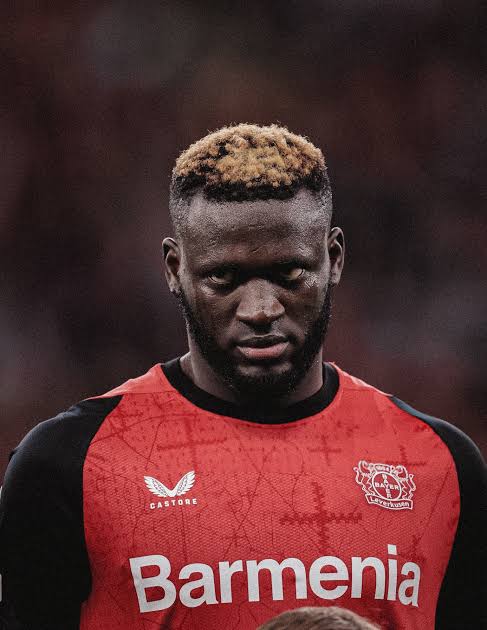
Victor Boniface has also remained part of the European football conversation, helping to reinforce the impression that Nigeria continues to possess an impressive collection of attacking talent operating outside the country. His recent form has placed him within the same broader discussion as Osimhen and Chukwueze, with Nigerian forwards once again attracting attention as the new European season takes shape.
On August 15, 2026, Boniface came off the bench and scored the winning goal as Bayer Leverkusen defeated Newcastle United 2–1 in a pre-season friendly at St James’ Park.
His goal came in the 82nd minute, with Boniface producing a strong individual move before finishing to put Leverkusen ahead. The strike proved decisive.
The result was particularly significant for Boniface because he is attempting to relaunch his career at Leverkusen after a difficult loan spell at Werder Bremen last season, during which he made 11 Bundesliga appearances without scoring.
Okoye Brings A Welcome Comeback
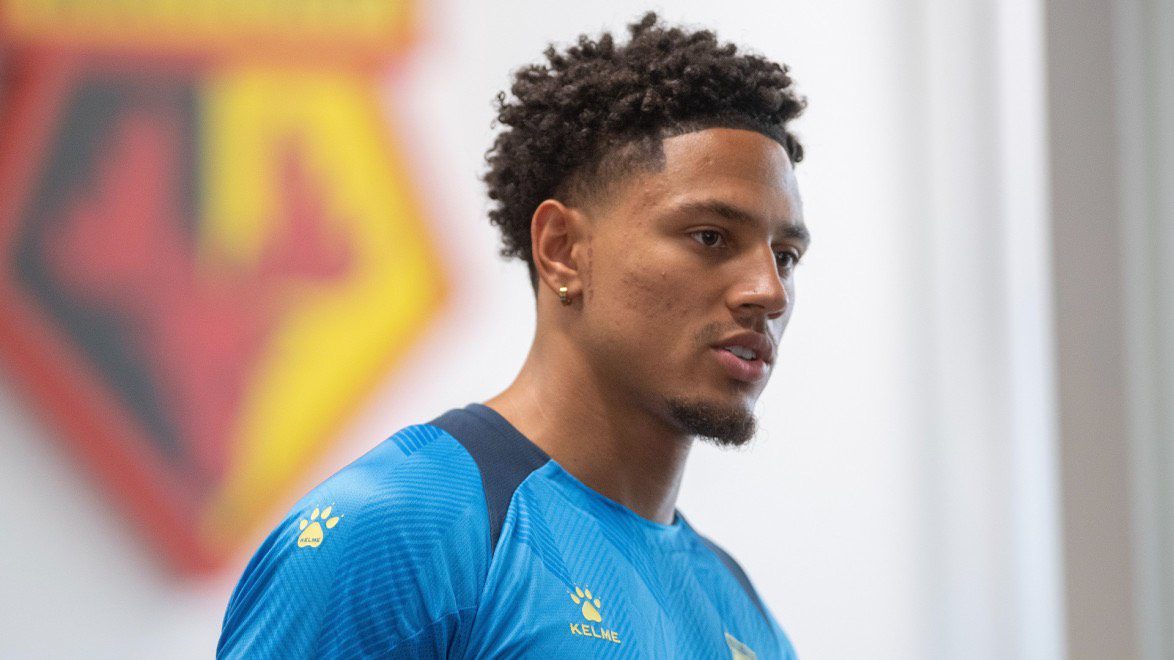
Maduka Okoye’s return from injury has supplied another important football storyline, particularly because goalkeepers are often judged through a different lens from attacking players. Udinese’s 1 0 victory gave Okoye an opportunity to return to competitive action and keep a clean sheet, while coach Kosta Runjaić praised his performance. A goalkeeper returning from injury does not always receive the same attention as a striker scoring goals, yet Okoye’s position gives his comeback a wider relevance for Nigeria. The Super Eagles need reliable options between the posts, and a fit Okoye gives the national team another experienced figure to monitor as the next international cycle develops.
His story also provides balance to the European football section because it shows that Nigerian success during August has not been restricted to goals. A clean sheet, a strong individual display and a successful return can carry their own importance, particularly for a player trying to rebuild momentum after an interruption. Okoye’s comeback therefore becomes another piece of the larger Nigerian football picture, where different players are arriving at important moments in their careers at roughly the same time.
Glasgow Turns The Spotlight Towards Medals
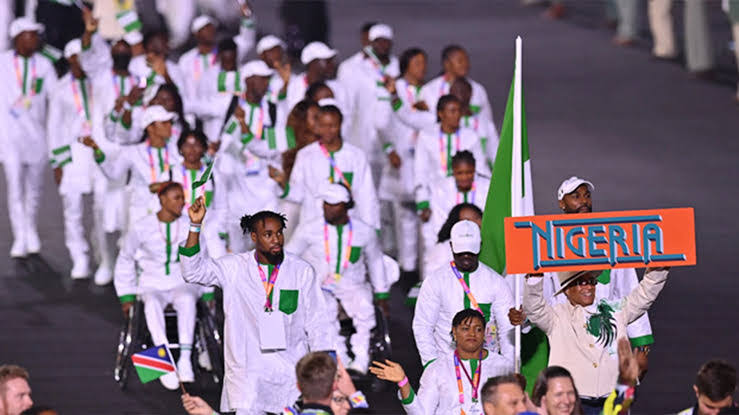
The 2026 Commonwealth Games in Glasgow changed the rhythm of the Nigerian sports story by moving attention away from European football and towards athletes who delivered some of the country’s most memorable achievements of the month. Nigeria finished the Games as Africa’s highest ranked nation, collecting 24 medals comprising 10 gold, 7 silver and 7 bronze to finish 7th overall. The final tally was impressive, although it was lower than Nigeria’s 2022 Birmingham total of 34 medals, a comparison that requires the context of a significantly smaller Glasgow programme. Several sports that have traditionally contributed to Nigeria’s Commonwealth medal count were not available in the same way, meaning the final table tells only part of the story.
The stronger story sits inside those 24 medals, because several Nigerian athletes achieved milestones that went beyond simply standing on the podium. Samuel Ogazi won men’s 400m gold, Ezekiel Nathaniel claimed men’s 400m hurdles gold, Chukwuebuka Enekwechi delivered another major shot put performance, while Goodness Nwachukwu and Folashade Oluwafemiayo produced record breaking para sport performances. Udodi Onwuzurike added silver in the men’s 200m, while several other Nigerian athletes contributed to a medal haul that confirmed the depth of the country’s sporting talent. Glasgow therefore became less about one superstar and more about a collection of athletes creating their own moments.
Ogazi Crosses A Historic Line
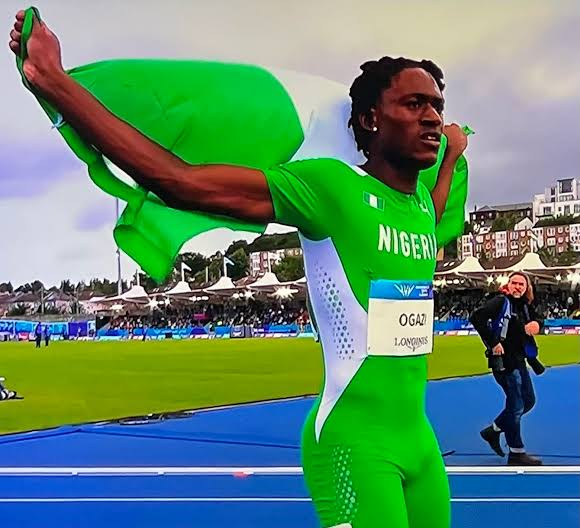
Samuel Ogazi’s men’s 400m gold stands among the defining Nigerian performances of Glasgow 2026.
On August 1, 2026, the 20-year-old Nigerian sprinter won the men’s 400m gold at the Commonwealth Games, becoming the first Nigerian ever to win Commonwealth Games gold in the men’s 400m.
Ogazi clocked 44.25 seconds at Scotstoun Stadium, finishing roughly six metres ahead of the field. Trinidad and Tobago’s Jereem Richards took silver in 44.82s, while South Africa’s Zakithi Nene won bronze in 45.21s.
That detail gives the medal an entirely different weight, turning a race victory into a piece of national sporting history. Ogazi did not simply add another gold medal to Nigeria’s collection, he became the athlete attached to a milestone that had remained beyond Nigerian reach in the event. His performance therefore belongs in the record section of any serious account of Nigeria’s August sporting story.
The achievement also fits into a larger resurgence of Nigerian athletics, where sprinting and field events have continued producing athletes capable of competing on major international stages. Ogazi’s gold gave that progress a very visible moment, particularly because the 400m requires a combination of speed, endurance, rhythm and tactical discipline that leaves little room for mistakes. His victory in Glasgow placed his name alongside the athletes who have expanded the boundaries of what Nigerian athletics has achieved at the Commonwealth level.
Nathaniel Creates Another First
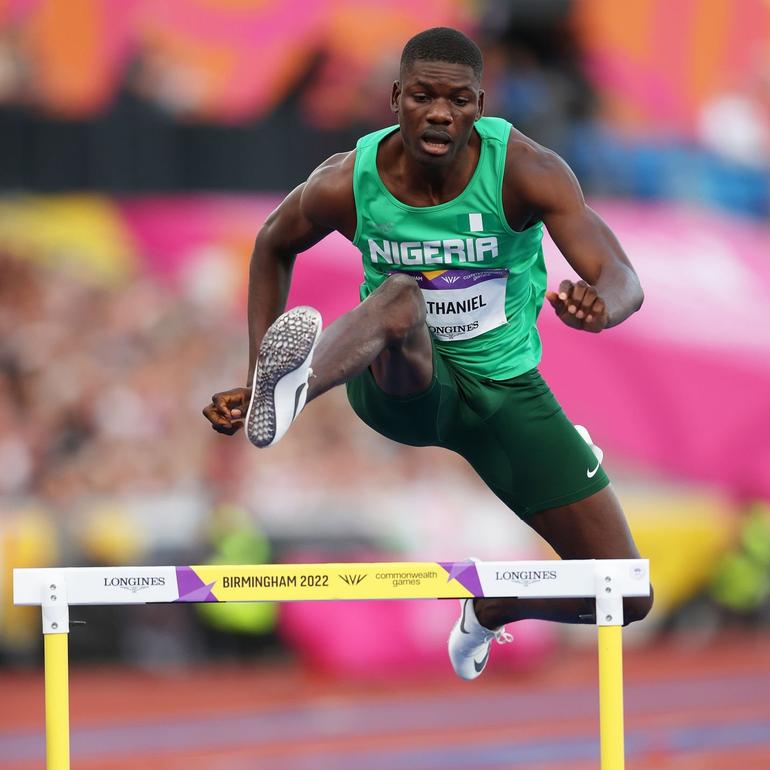
Ezekiel Nathaniel produced another historic Commonwealth moment by becoming the first Nigerian man to win gold in the men’s 400m hurdles at the Games.
On July 31, 2026, Nigerian hurdler Ezekiel Nathaniel won the men’s 400m hurdles gold medal at the Glasgow 2026 Commonwealth Games, clocking 48.47 seconds in the final at Scotstoun Stadium.
The victory was historic: Nathaniel became the first Nigerian to win Commonwealth Games gold in the men’s 400m hurdles. Nigeria had previously come closest in 1966, when Kingsley Agbabokha won silver in the event then known as the 440-yard hurdles.
His victory gave Nigeria another athletics milestone during a competition that was already becoming memorable for the country’s track athletes. The significance is straightforward, because Nigeria had never previously had a male Commonwealth champion in the event, making Nathaniel’s performance another addition to a growing list of firsts created during August 2026.
Nathaniel’s achievement also strengthened the impression that Nigeria’s athletics success in Glasgow was not dependent on one particular event. Ogazi had already provided the breakthrough in the 400m, and Nathaniel followed with another historic victory in the hurdles, showing the breadth of Nigerian talent across demanding sprint disciplines. Those results gave the Commonwealth campaign a momentum that extended beyond the medal table and into the history books.
Enekwechi Delivers Experience
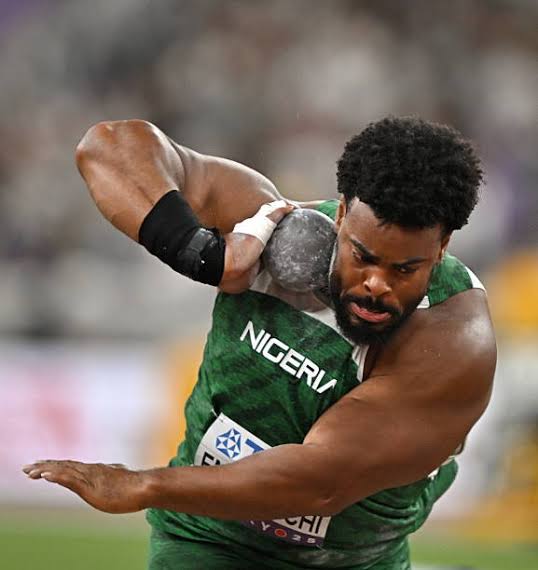
Chukwuebuka Eberechi added another gold medal to Nigeria’s Glasgow campaign through the men’s shot put, continuing his reputation as one of the country’s dependable performers on major international stages.
On July 30, 2026, Enekwechi won gold in the men’s shot put at the Glasgow 2026 Commonwealth Games, throwing 21.07m in the fifth round. He edged New Zealand’s Tom Walsh, who managed 21.03m, while England’s Scott Lincoln took bronze with 20.99m.
The significance is huge: Enekwechi became the first Nigerian to win Commonwealth Games gold in the men’s shot put.
His success carried a different kind of appeal from the first time winners, because Enekwechi represents experience, consistency and the ability to produce when a major competition demands it. His medal became part of a wider collection of Nigerian victories that showed how different generations of athletes could contribute to the same successful campaign.
The shot put victory also helped ensure that Nigeria’s medal success was not confined to track races. Field events remain an important part of the country’s international athletics identity, and Enekwechi’s gold reinforced that point during a Games where Nigeria collected historic victories across several disciplines. His contribution belongs alongside the younger athletes because the combined performance reveals the range of talent available to Nigeria.
Nwachukwu Turns Gold Into A Record
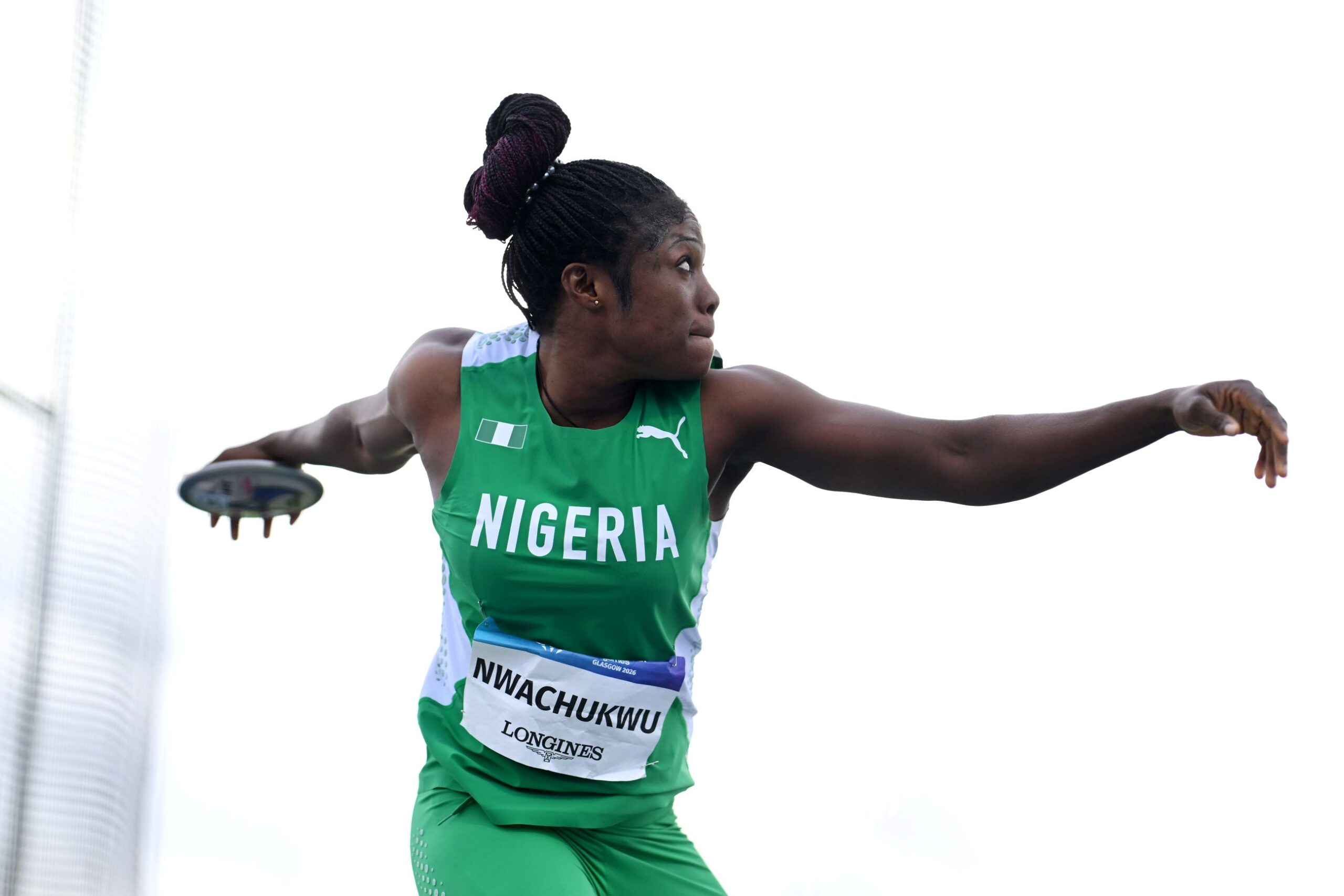
Goodness Nwachukwu produced one of the most powerful individual performances of the Glasgow Games when she won women’s para discus gold while also setting a new world record. A gold medal already represents the highest finishing position available, but adding a world record transforms the achievement into something considerably larger. Nwachukwu’s performance placed her name directly into the global record books while also giving Nigeria one of the standout moments of its Commonwealth campaign.
Her story carries particular importance because para athletes have repeatedly demonstrated that Nigeria’s sporting strength extends far beyond the most heavily publicised events. Nwachukwu’s record showed the level of excellence possible when preparation, confidence and competition come together at the right moment. The Glasgow stage gave her the platform, and she used it to produce a performance that will remain attached to Nigeria’s 2026 Commonwealth campaign for years to come.
Oluwafemiayo Adds Another Record
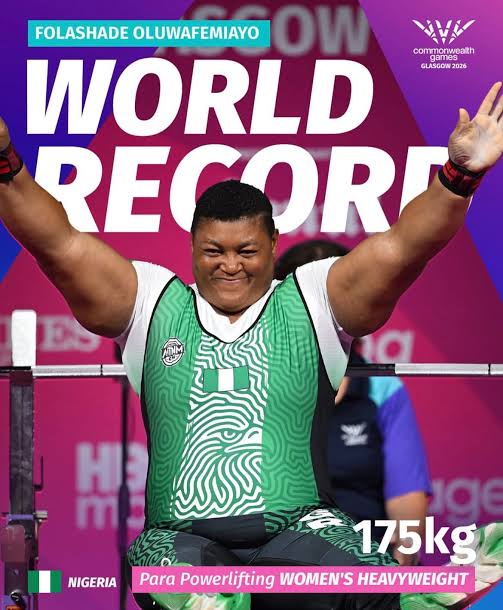
Folashade Oluwafemiayo provided another record breaking moment through her para powerlifting performance, breaking her own world record while winning gold.
On July 29, 2026, Nigeria’s para-athlete Goodness Nwachukwu won gold in the women’s discus F42-44/F61-64 at the Glasgow 2026 Commonwealth Games. Her final throw travelled 39.66 metres, earning 1,130 points and, more importantly, smashing her own F42 world record.
Her new mark was more than three metres better than her previous world record of 36.56m, which she had set at the 2022 Commonwealth Games in Birmingham.
The achievement created an especially strong combination of experience and excellence because she was not merely attempting to establish herself, she was returning to a level she already understood and then pushing the standard further. Breaking one’s own world record requires an athlete to surpass a mark that previously represented the best version of their own performance, making the achievement deeply personal as well as historically significant.
Her victory strengthened the record breaking theme that emerged from Glasgow and showed that Nigeria’s strongest performances were not confined to a single athlete or discipline. Nwachukwu and Oluwafemiayo produced separate record breaking achievements, each creating a moment that went beyond the medal ceremony. Together, their performances helped turn Nigeria’s Commonwealth campaign into a story about records as much as medals.
Oji Brings A New Chapter
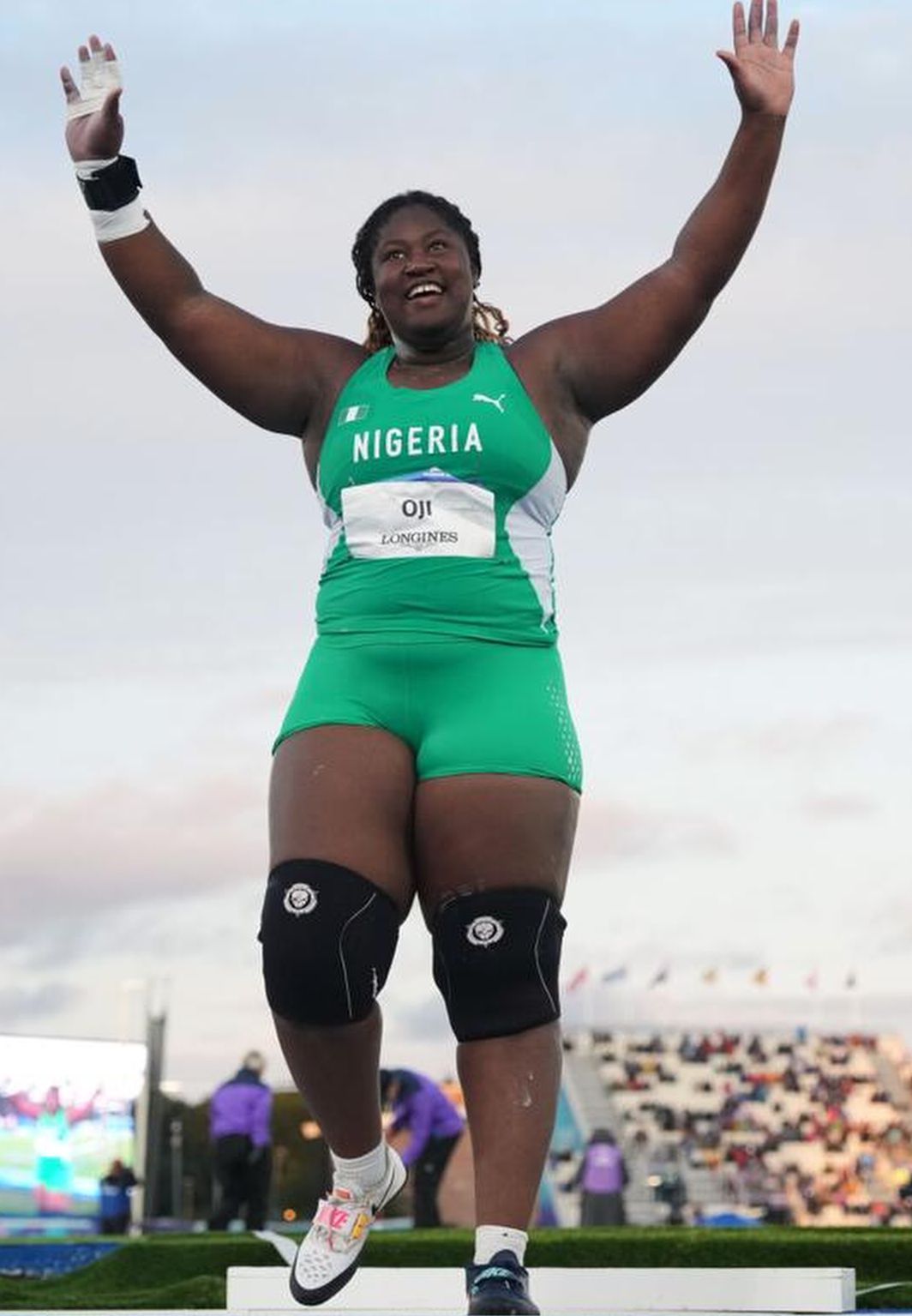
Jessica Oji may ultimately prove to be one of the most important emerging names from the month because her August journey connected a Commonwealth medal with a World Athletics U20 title. Oji won silver in the women’s shot put at the 2026 Commonwealth Games before going on to win gold at the World Athletics U20 Championships with an 18.08m throw. Her victory carried historic significance because she became the first Nigerian athlete to win a World Athletics title in a field event at any level.
That sequence gives Oji’s story a particularly compelling shape, because the Commonwealth silver was followed by a world title rather than standing as the final destination. The 18.08m performance moved her from promising young athlete to a name attached to a significant Nigerian athletics milestone. Her story also shows how quickly a major international competition can introduce a new athlete to a much wider audience, particularly when the result carries a historical first.
Onwuzurike Represents The Next Generation
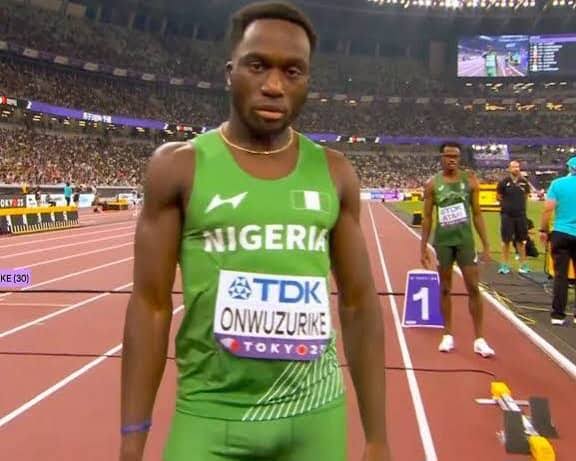
Udodi Onwuzurike’s silver medal in the men’s 200m added another important layer to Nigeria’s athletics story. On July 31, 2026, Onwuzurike won silver in the men’s 200m final at the Commonwealth Games in Glasgow, running 20.09 seconds. It was his fastest time of the 2026 season.
He finished behind South Africa’s Sinesipho Dambile, who took gold in 19.96s, while Jamaica’s Christopher Taylor claimed bronze in 20.11s.
His achievement placed him among the athletes contributing to the country’s sprinting future, with the medal offering evidence that Nigerian athletics continues to produce competitors capable of reaching the podium at major competitions. The silver may not carry the same historical wording as Ogazi’s gold or Nathaniel’s first Commonwealth victory, yet its importance sits within the broader development of Nigerian sprinting.
Onwuzurike’s performance also helps connect the present generation with the future of the sport, because Nigerian athletics needs athletes who can remain competitive across multiple international cycles. His Commonwealth result provides one of those early indicators, giving Nigeria another name to follow as major competitions continue to shape the next generation.
The Super Falcons Face A Painful August
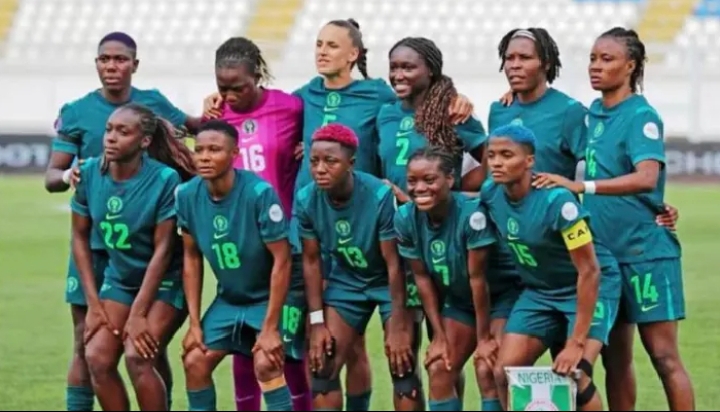
The celebratory side of August cannot be separated from the difficult story of the Super Falcons, whose campaign produced one of the month’s biggest setbacks for Nigerian sport. Nigeria were eliminated from the 2026 WAFCON at the quarter final stage after a 1-0 defeat to Cameroon, marking the first time the Super Falcons had failed to reach the semi finals of the competition. For a team with such a deep history in African women’s football, the result represented a major interruption to a familiar pattern of success.
The disappointment became even more significant when Nigeria subsequently lost 2-1 to South Africa in the continental playoff for the 2027 FIFA Women’s World Cup. That defeat ended Nigeria’s hopes of reaching the tournament and placed a painful conclusion on a campaign that had already gone away from expectations. The sequence matters because the WAFCON exit was not an isolated setback, it was followed by the loss of a World Cup pathway, turning August into one of the most difficult periods in recent Super Falcons history.
Ajibade Carries The Message Forward
Rasheedat Ajibade became an important voice after the disappointment, speaking about the lessons Nigeria needed to take from the experience. As captain, her comments offered a natural bridge between the immediate pain of the result and the work that follows a major sporting setback. Football gives players very little time to remain in one moment, because another competition, another qualification campaign or another generation of players eventually arrives.
Ajibade’s role therefore extends beyond the match itself, because the next phase will require the team to understand what happened and move forward without allowing the disappointment to define the future. The Super Falcons remain one of Nigeria’s most decorated national teams, and their August results have created a difficult chapter rather than an ending to their story.
Nigeria Misses A World Championship Opportunity
Another setback arrived outside mainstream football when Nigeria withdrew its men’s and women’s flag football teams from the 2026 World Championships in Düsseldorf because of visa problems. The teams had qualified after becoming African champions in 2025, which made their absence particularly disappointing because qualification had already represented a major achievement for the developing sport. The issue was not a defeat on the field, nor was it a failure to qualify, because Nigeria had already earned its place.
The missed tournament also matters because flag football has a developing pathway towards the Los Angeles 2028 Olympic cycle. Nigeria’s Olympic prospects have not completely disappeared, with the teams still able to pursue qualification through the 2027 continental championship, but the Düsseldorf opportunity was lost. That makes the episode one of the clearest examples of how sporting setbacks can happen before competition even begins, especially when logistical challenges interrupt the progress made by athletes.
Awoniyi Begins A Different Kind Of Chapter
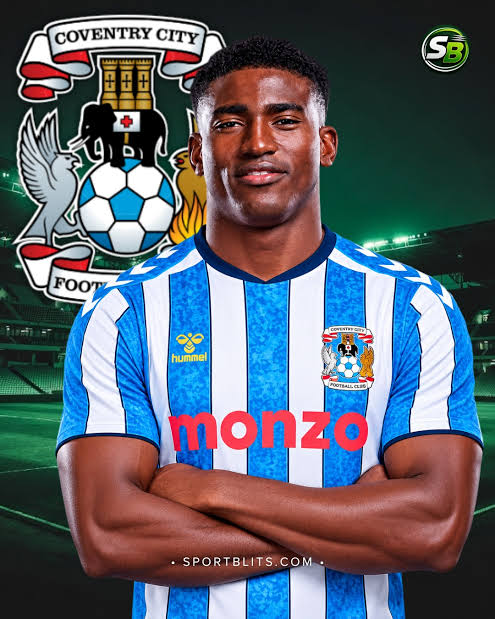
Taiwo Awoniyi’s August story has taken a different direction from the goals and medals that dominate the month’s headline. The Nigerian striker is set to move from Nottingham Forest to newly promoted Coventry City, with reporting placing the agreed transfer at around £17 million. The move represents a new stage for a player whose career has included major moments, injuries and difficult periods, making the transfer as much about rebuilding momentum as it is about changing clubs.
Awoniyi’s situation adds another dimension to the European football narrative because not every Nigerian sporting story during August has been about an athlete reaching the top of a competition. Some are about finding a new environment where an athlete can regain confidence and consistency. His move therefore sits naturally beside the stories of Osimhen, Boniface, Chukwueze and Okoye, because each player is approaching the new season from a different position while carrying expectations connected to Nigerian football.
Alebiosu Shows Promise Through A Difficult Result
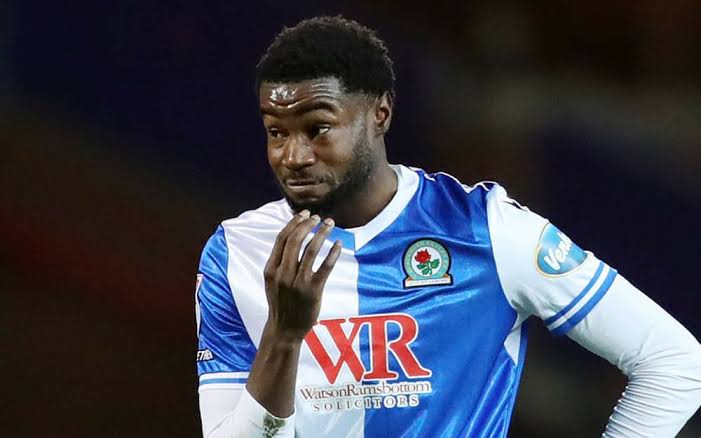
Ryan Alebiosu has also provided an emerging Nigerian football story after being named Player of the Match for Blackburn Rovers against Wolves. His individual performance stood out despite the controversy surrounding the result, with a penalty decision contributing to Blackburn’s disappointment. That combination of individual recognition and an unwanted team outcome captures one of football’s most familiar realities, a player can perform strongly even when the final result refuses to follow.
Alebiosu’s story is worth watching because young Nigerian defenders need opportunities to establish themselves within competitive European environments, particularly when the national team continues searching for dependable options across every position. His Player of the Match recognition does not automatically define his career, but it gives him a meaningful point from which to build. August has therefore provided another emerging Nigerian name whose progress deserves attention.
The Medal Table Tells Only Part Of The Story
Nigeria’s 24 medal haul at Glasgow deserves to be viewed carefully because the raw comparison with Birmingham 2022 can create an incomplete picture. Birmingham produced 34 medals for Nigeria, meaning the 2026 total was 10 medals lower, but Glasgow featured a significantly reduced programme and did not provide the same competitive opportunities across all the disciplines that had contributed to Nigeria’s earlier total. The final position of 7th overall and the status of Africa’s highest ranked nation remain important facts, while the individual achievements add another layer to the assessment.
An early report had placed Nigeria’s Glasgow tally at 23 medals before the final figure settled at 24, making the eventual breakdown 10 gold, 7 silver and 7 bronze. Those figures provide a useful snapshot, yet the deeper story sits within the names attached to them. Historic gold medals, world records and emerging athletes have given the campaign a significance that cannot be measured by comparing one total with another alone.
August Leaves Nigerian Sport With Two Faces
One side of August 2026 belongs to athletes who have pushed Nigerian sport into new territory, with Ogazi breaking a Commonwealth barrier, Nathaniel creating another first, Nwachukwu and Oluwafemiayo setting world records, while Oji became the first Nigerian athlete to win a World Athletics title in a field event. The other side belongs to teams and athletes facing difficult moments, from the Super Falcons’ failure to reach the WAFCON semi finals to the loss of their 2027 World Cup playoff, while Nigeria’s flag football teams watched a world championship opportunity disappear because of visa problems.
Football has supplied its own balance, with Osimhen, Boniface, Chukwueze and Okoye providing reasons for optimism while Awoniyi begins a career reset and Alebiosu emerges through an important individual performance. That mixture explains why the month feels larger than a collection of isolated results. Nigeria’s sporting story has moved between European pitches, Commonwealth arenas, world championship stages and qualification battles, with different athletes carrying the national conversation at different moments.
The Spotlight Has Found More Than One Name
August 2026 has ultimately produced a Nigerian sporting picture built around variety. Osimhen represents goals and expectations, Chukwueze represents a performance that can reopen a conversation, Boniface represents attacking depth, Okoye represents a return, Ogazi and Nathaniel represent historic Commonwealth victories, Enekwechi represents experience, Nwachukwu and Oluwafemiayo represent records, Oji represents the arrival of a potentially important new name, while Onwuzurike represents another step in the development of Nigerian sprinting.
The setbacks have made the story more human rather than less impressive, because sporting achievement has never been a straight line. The Super Falcons can lose a crucial qualification battle while individual Nigerian athletes are making history elsewhere, and Nigeria can finish 7th at the Commonwealth Games while collecting 24 medals and producing performances that had never happened before. The flag football teams can qualify for a world championship and still miss the event because of circumstances away from the field. Each episode adds another layer to the same national sporting picture.
A Month That Leaves The Story Open
The most interesting part of August is that many of these stories are not finished. Osimhen, Boniface, Chukwueze and Okoye still have a long European season ahead, Awoniyi is beginning another chapter at Coventry City, Alebiosu has another opportunity to build his reputation, while Ogazi, Nathaniel, Oji and the other athletes who created historic moments now carry new expectations into their next competitions. Their August performances have placed their names in the spotlight, but the real value of a breakthrough is what follows after the headlines begin to fade.
Nigeria’s sporting month has therefore offered goals without removing the pressure, medals without hiding the setbacks, records without pretending every national team succeeded and historic breakthroughs without suggesting the work is finished. The numbers tell one part of the story, with 24 Commonwealth medals, 10 gold, 7 silver and 7 bronze, while the individual achievements provide the details that make those numbers memorable. August 2026 has shown Nigerian sport through all of its familiar contradictions, moments of brilliance beside moments of disappointment, established stars beside emerging names and historic victories arriving at the same time as painful defeats.
That is precisely why the month deserves to be remembered as more than another collection of sporting results. The goals brought footballers back into focus, the medals gave Nigeria fresh reasons to celebrate, the records placed athletes into history and the setbacks reminded everyone how unforgiving elite sport can be. From European football pitches to Glasgow’s Commonwealth arena and the World Athletics U20 stage, Nigerian athletes have given August a collection of stories that reach well beyond one competition. The spotlight is back, but the next chapter is already waiting for the names that made this month matter.