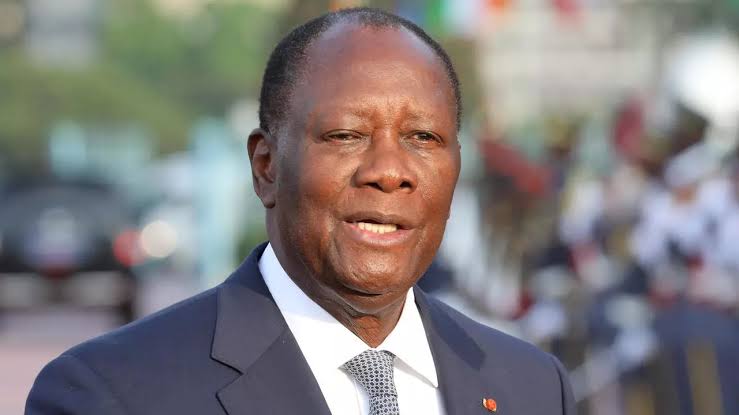
Ivory Coast president Alassane Ouattara was reelected to a contested third term, electoral authorities said Tuesday, after a vote marred by deadly unrest and a boycott by the opposition who promised to set up a rival “transitional” government.
The standoff pitches francophone West Africa’s top economy deeper into a crisis that erupted in August when Ouattara said he would run for a third term, angering the opposition who accused him of carrying out an “electoral coup”.
“The President Alassane Ouattara has been elected,” election commission president Ibrahime Coulibaly-Kuibiert said in an early morning broadcast.
He said Ouattara won 94 per cent of the vote and that turnout had been 53.9 per cent.
The landslide result had been widely expected after two leading opposition leaders called for a boycott of the ballot and a civil disobedience campaign.
Pre-election clashes killed at least 30 and anti-Ouattara protests have stoked fears of a repeat of a crisis a decade ago when 3,000 people died in fighting after then-president Laurent Gbagbo refused to accept defeat by Ouattara.
Hours before the results, the opposition said they would create a transitional government, insisting Ouattara’s mandate was over as he had broken the country’s two-term presidential limit.
Ouattara, a former IMF economist first elected in 2010, says a 2016 reform allowed him to run again.
“The opposition parties and groups announce the creation of a council of national transition,” Pascal Affi N’Guessan told reporters on Monday night. “This council’s mission will be to… create a transitional government within the next few hours.”
He said it would work to hold “a fair, transparent and inclusive presidential election”.
“Keeping Mr Ouattara as head of state could lead to civil war,” he added.
There was no immediate response from the government over the opposition announcement.
Streets in the economic capital Abidjan were mostly deserted late Monday night.
Activists and residents said shots or small detonations were fired outside the homes of two opposition leaders in the city, though no one was injured.
Opposition figures had already rejected Saturday’s ballot and called for a “civilian transition” from Ouattara, provoking a warning from his ruling party against trying to stir up unrest.
N’Guessan said the transitional council would be led by opposition veteran Henri Konan Bedie, 86, a former president and long-term adversary of Ouattara.
The tension over Ivory Coast’s election is another test for a region where Guinea is mired in a post-election dispute of its own, Nigeria is emerging from widespread unrest and Mali has faced a coup.
The Ivorian leader is praised by supporters for bringing infrastructure projects and economic growth after a decade of instability in the world’s top cocoa producer.
But the anger sparked by his third term has revived memories of past Ivorian feuds that were left mostly unreconciled after a 2002 civil war split the country in two.
Deadly clashes before the election mostly involved rallies degenerating into fighting between local ethnic groups allied to the opposition and Dioula communities seen as close to Ouattara, himself a Muslim from the north.
Pockets of unrest, vandalised voting material and closed polling stations were reported mostly in opposition strongholds during Saturday’s election.
But rival factions gave conflicting accounts of the extent of the boycott. The government called them isolated.
Residents said four more people had been killed on Sunday in central Toumodi when houses were set ablaze in clashes between neighbouring ethnic communities who back rival political factions.
At least five people died in clashes on Saturday.
An African Union observer mission said on Monday that the election was “generally satisfactory”.
In contrast,a mission from the US watchdog Carter Center said “the overall context and process did not allow for a genuinely competitive election”.
“The process excluded a number of Ivorian political forces and was hampered by an active boycott.”
Ouattara, 78, had said after his second term he planned to make way for a new generation, but the sudden death of his chosen successor prompted him to seek a third term.
He says a constitutional court ruling approved his move, allowing him to reset the country’s two-term presidential limit.
When Ivory Coast emerged from the civil war after 2002, the country was split in two, the north held by rebels and the south by forces of then-president Gbagbo.
Ouattara won a long-postponed election in 2010 although Gbagbo refused to accept defeat and Abidjan became a battleground. French forces eventually intervened to help Ouattara loyalists oust the former president.