
Around 5:00 a.m. on a Monday morning, I was traveling to a friend’s house since we needed to get to Ibadan, the capital of Oyo, for a strategic meeting. I chose to drive down the new dualized road in Ilesa to make deadlines when I noticed a crowd gathered around a young man in his late twenties. I parked near the road and observed the scenario from a distance before getting out of the car. While in the car, I noticed that the young man surrounded by five men was bound in ropes. His wrists and legs were tied. He was shouting in panic. The more he yelled, the more unsolicited slaps he received from men who surrounded him.
I took my ID cards and proceeded towards the situation. I realized that two of the five men were night guards and the other two were observers. I approached one of the night guards and presented my IDs as a journalist and criminologist. He grasped the term ‘journalist’ but struggled with the other. What happened?, I inquired. Segun, one of the night guards, informed me that they were in their hideouts when they heard repeated steps and when they looked up, they saw someone moving aimlessly with only trousers, no footwear, and no shirt about 1 a.m.
“We sprang out of our hiding places and chased him. He fought us, but we managed to apprehend him. We believed he was a robber who was fleeing after robbing several folks. We had hardly engaged him when we discovered his confused speech and rude behavior. He was hallucinating, acting strangely, and agitating in unusual ways, shouting N50m up and down. We subdued him and discovered that he had been beaten due to the marks on his body. We did not release him because we had seen cases where robbers act irrationally to avoid prosecution. “We will keep him and hand him over to the police after daybreak.” Segun narrated.
I contacted the young man named “Samson” (not his real name), who should be in his late twenties or early thirties. He was upset. I watched him for a bit and saw how he fought with his hands already tied with ropes. How did that happen? I inquired. “I’m seeking N50m. I am no thief. I did not steal anything. My client pledged to pay me N50million. Where is my N50M? Give me my N50 million. Owo mi da (Where is my money? I need to get my money. Ba mi gbe (give it to me).” He was agitated and struggled with the restraints. I persuaded him for fifteen minutes. I begged. I made numerous false promises regarding the recovery of his N50 million from his customer, a truck driver in the United States of America. I persuaded him for fifteen minutes. I begged. I made numerous false promises regarding the recovery of his N50 million from his customer, a truck driver in the United States of America.
I persisted in persuading him despite the growing crowd around us. “Awon yahoo yen, Alijaanu lo n da won laamu (those yahoo boys are troubled by evil spirits).” O ti gbe ebo kaanka (he has carried a tremendous sacrifice)”. These were the words spilling out from the mouths of people around us. As I listened to their comments, I turned on my phone’s torchlight and directed the light rays on his face, where I noticed his purple tongue. What did you take? I questioned him. I only took three sachets of a drug because I didn’t want to sleep, he explained.
How did you arrive here? I asked. I left my hotel room about 12:05 a.m. because I couldn’t sleep. Why did you sleep in a hotel? Don’t you have an apartment? I interrupted. “I don’t like sleeping in my house because I see scary things,” he replied. What kind of scary things? I asked. Evil spirits and ghosts. “I hear and see things,” he replied. So, how did you come to this location? I asked again.
“I left the hotel and roamed around since I couldn’t sleep and felt uncomfortable. Ara ni mi (I am frustrated and depressed). I walked from my hotel to the roundabout and was beaten up by some thugs because they demanded money, which I refused. They confiscated my phone and later returned it to me after another thug commanded otherwise.
I rushed away from the roundabout, terrified, towards Anaye, a neighborhood in Ilesa, when these individuals (pointing at the nightguards) chased me down and began beating me up. I informed them I’m not a thief. “They used ropes to tie me down,” Samson explained.
Where are your properties? I asked. He glanced around, but could not find them. I put it in my pocket. One of the nightguards informed me that they had recovered everything from him. What are they? I asked. “iPhone 14 – he used his picture as a wallpaper, a wifi, key to a hotel room and paper in his pocket” , the security staff member said. Can you unlock your phone? I asked the young man. He said, “I can’t remember my password.” Do you happen to know any offhead numbers? I asked again. Yes, Nomba Mummy Mi (my mother’s phone number). Her number is 070××××××××., he responded.
I dialed the number twice before an elderly woman answered it. I greeted her and inquired whether she knew anyone named Samson who claimed to be her son. The elderly woman exclaimed, “Olorun seun o.” We had been seeking for him for the past three weeks. He departed the house after selling his two ladies’ bikes and some electronics. I am currently in Port Harcourt, but will leave early to catch the next bus to Ilesa. Please hold him firmly and don’t let him run away, Samson’s mother begged.
Who will hold him until you arrive? I asked. She asked for help getting him to the police station. “He has not committed any crime and I really doubt if the police would detain him without committing any crime but I will call the DPO” , I informed Samson’s mother. I stopped the call and contacted DPO Ijamo’s number, CSP Gbenga Ajiboye, a senior police officer par excellence who is usually keen to respond quickly to any social crisis.
He picked up the phone, and I apologized for phoning him so early. He laughed and said he had been awake since 1:00 a.m., monitoring his troops on patrol and performing some police work. He stated that he does not turn off his phone since he can be called at any time and feels obligated to react.
I gave him an update on the issue, and we spoke for a few minutes. He protested furiously about the situation, calling it a new misnomer. “We dealt with two such cases last week, and one nearly wrecked our furniture, injured my officers, and scattered our literature. If the mother is unable to provide a relative to care for her child until she returns, he can be brought to the station and then given to Wesley if they have begun work, according to a concerned DPO.
I hung up with the DPO and dialed the mother’s number again. Where exactly do you dwell in Ilesa? She cited a family house in Bolorunduro. Could we take him there? I asked. I will greatly appreciate it. My sisters are at home. I tried calling their numbers, but they were not reachable, she said. I noticed Samson had calmed down a bit. He requested that the cords used to bind his hands and legs be released. I told the night guards to release the cords and returned all of his belongings to him. They did, and we were ready to take Samson to his family’s residence when four Ijamo police officers came.
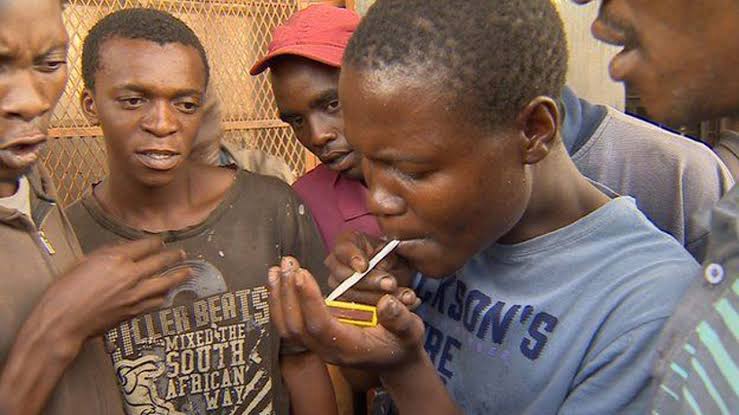
Samson’s story is no different. It is similar to the stories of many Nigerian adolescents who are trapped in the cycle of drug usage. They are found in a variety of locations, including parks, garages, bus stops, street pathways, and businesses. They are our friends, colleagues, and family. They fight with narcotics without any assistance. We see them losing the struggle for sanity and rationality. Drugs continue to flood our streets, the number of victims grows, crime rates rise, and our society remains shattered. Our story of destruction is only nicely crafted, but it is not pleasant to hear.
Our markets are saturated with harmful drugs. From tramadol to codeine to cannabis to Ropi, the list of addictive drugs grows. Youth today consume harsh drugs without apology. They consume syrup carelessly, without coughing. They blend everything. They prepare everything that gets them high. Eight out of ten Nigerian youngsters are currently addicted or suffering from mental illnesses. These medications do not fall from the heavens. Producers are not ghosts. Middlemen aren’t spirits. Our young generation that is meant to be energetic and productive are suddenly sluggish, frail and unproductive. They don’t produce. They consume irresponsibly.
There’s fire on the mountain. Nigeria is on gunpowder. Over 49% of Nigerian youngsters take drugs. 37% abuse codeine, tramadol, and cough syrups. Twelve percent use shisha and marijuana. Drug disorders affect two out of every six Nigerian youngsters. Six out of ten Nigerian youngsters utilize drugs. Go to the streets. You can’t go 200 meters without seeing young people whose lives have been ruined by drugs.
What is my fear? Drugs have spread to our primary and secondary schools. There are now more than just sachets of alcoholic drinks in students’ pockets. You see indian hemps, cough syrups, codeine and tramadol in their pockets and school bags. They get together as a group, joyous in ridiculousness. If you believe you have correctly taught and trained your child in God’s ways, he or she will encounter them at schools, churches, mosques, or other gatherings. Students are now beating teachers. This is drug-induced behavior. That is why we must be concerned about the well-being of all children.
Where is Noa? Our schools have been penetrated. Moral fabrics have been broken. Broken homes and schools. And a damaged society. I pity this generation. They did not inherit a positive society that will influence their lives. We have failed them. We all failed them. Public officials, religious leaders, teachers, parents, counselors, and others. We contributed to the degradation, and the cruel irony is that they will be the leaders of the future. There is no escape route for anyone. We’re in soup.
We are in a warzone. This time, the focus is not on explosives, firearms, or bullets. It’s about morality. We don’t have any active preventative efforts. We have a serious lack of management skills. I’ll utilize Osun as a case study. There are no active and functional rehabilitation centers in the state. The rehabilitation center in Osogbo, the state capital, is worse than a garage full of gangsters.
According to reliable reports, the majority of the children in the center jump fences to rob people because they are hungry. No quality meals, attention or care. They just packed youngsters and let them struggle for survival inside their camp. It’s much worse than what conventional eyes can see.
The good news is, it’s never too late. Things are worse, yet there is still room for fairness. We can raise the conscience of our young people. We need to get them young, but the ideal approach is to let elderly people who follow moral books live happily. We need to enhance the living conditions of our citizens. These children need to understand that you can drive a nice car, own a home, and live comfortably without engaging in fraud. You do not need to dupe a fellow human to survive.
Most undesirable behaviors may be traced back to an increase in the number of young people who have a nomadic idea of money and have agreed to live a specific lifestyle – dress shabbily, consume anything, do any drugs, and mislead anybody – in order to achieve their goals. We need to reorient our youthful population, and it starts with me and you.