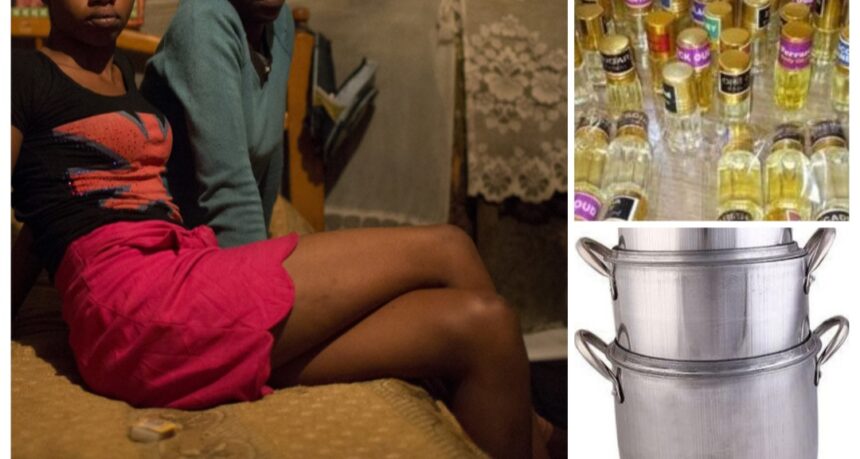
Couple of women who sell clothes, shoes, phones, beverages, perfumes, household items, and other goods through online platforms also offer sex to interested customers, according to a survey conducted by WITHIN NIGERIA.
WITHIN NIGERIA journalist, Sodiq Lawal Chocomilo, investigated Nigeria’s informal hook-up industry and observed that transactional relationships have evolved by harnessing the potential of technology.
This report not only shows how Nigerian youths engage in hook-ups as a means of survival, but also reveals how women who sell goods on social media take advantage of the demand for sexual pleasure to make extra profit.
It further reveals that these young online traders do not only make money from the goods they sell, but also receive payment for other services they render in order to meet their daily or weekly contributions or thrift obligations.
In my hunt for customers, I was scrolling through Facebook when I saw a graphic design featuring a young lady selling cooking utensils. I clicked on her page and saw a beautiful young woman with a scintillating smile. I messaged her to make a purchase. We exchanged phone numbers and moved our conversation from Facebook to WhatsApp. I also requested a physical meeting.
Omolade (not her real name), 21, was my first customer. She sells kitchen utensils, and her store is located in the Oke-Esho community, Ilesa. I visited her store. She is a beautiful young lady with a scintillating smile. Her teeth are white as snow, and she has a good body shape that easily attracts men to her. As I entered her store, I saw a sofa chair, a table, a freezer, and kitchen utensils carefully arranged on a wooden structure attached to the wall. I sat down, and we talked about life, dwindling market sales, and delays in meeting needs and commitments. I bought goods worth ₦7,000 and left.
I had forgotten about Omolade (not her real name) and continued my search for a new customer because I assumed that sellers who use their homes as stores mostly engage in that. Barely 48 hours later, I accidentally opened my WhatsApp status section, clicked on Omolade’s (not her real name) status, and saw several pictures of kitchen utensils she had posted with a note: home delivery is available for customers who can afford it.
“Dispatch rider or you? I don’t want broken ceramic plates,” I commented under a picture of an item I wanted.
“Lmao! I can deliver it myself, but can you afford it?” she asked.
“Don’t worry. I will cover your transport fare,” I replied.
“Just the transport fare? You will pay me, too,” she said.
“Pay you? For bringing pots and plates? Lol… How much?” I asked.
“₦15,000,” she responded.
“Just to bring pots and plates?” I asked again. She laughed and said she would keep me company and make me comfortable before she left.
Thirty minutes after I didn’t reply to her messages, she said I could pay ₦10,000 instead. She eventually asked me to pay only for a dispatch rider’s service. I didn’t reply to her messages.
Toyosi, 23 (not her real name), is a stunning beauty. She is tall and has a dark complexion. A male friend sent me a link to a WhatsApp group after I discussed my report with him. He asked me to join the group and follow the administrator’s directives.
Hours after I joined the group, the admin posted several household items, including electric fans, solar panels, and rechargeable lamps. Members were asked to download any item they were interested in and forward it to the admin via DM to discuss the details. I downloaded a picture of an electric and solar-powered fan and sent it to her via DM, asking about the cost.
“The fan is ₦130,000. Where do you live?” she asked.
“I live in Ilesa,” I answered.
“I live in Osogbo. I can send the fan via a motor park, but if you don’t trust bus drivers, I can deliver it in person,” she replied.
“Won’t that cost extra?” I asked.
“Definitely. You’ll pay for my transport fare and also take care of me,” she responded.
“Do you have anywhere you can stay in Ilesa?” I asked.
“Osogbo to Ilesa isn’t far. I can come to Ilesa and leave within two hours. Do you want me to spend the night in Ilesa?” she asked jokingly.
“Is that too much to ask?” I said.
“Are you here to buy a fan or for a hookup?” she asked, with a smiling emoji.
“I want to buy a fan, and I’m also looking for a friend with benefits,” I answered.
“Sir, just buy the fan and don’t worry about FWBs. If you pay well, then we can do hookups,” she said.
“I’m a nice person. I’ll really take care of you,” I responded.
“I have a boyfriend. I don’t need you to take care of me. Pay for the fan, and if you want me to bring it to you, I will, but you’ll have to pay,” she stressed.
I was scrolling through TikTok when I accidentally came across her videos. She was dancing to _‘Worship’_, the latest single by music star Ololade Asake, who featured DJ Snake. She filmed the video in front of her goods, which were neatly arranged on a wooden structure attached to the wall. She attached her phone number to each video she uploaded, asking fans or admirers to message the number on WhatsApp and request any item they wanted to buy. I copied the phone number from the video and messaged her on WhatsApp.
Damilola, 25, runs a grocery store but also sells men’s clothes such as boxers and jeans. Damilola, a fair-complexioned young lady, lives in the Ijoka community, but her store is located in Ilaje Quarters. When I messaged her, she requested a picture of me, which I sent as a ‘view once’ photo taken in a studio. I also requested her picture, and she sent one under the same condition. I bought some boxers and round-neck shirts from her, and they were delivered to me by an Okada rider who doubles as her dispatch rider.
Four days later, I messaged Damilola again to order more items. I also asked her to deliver the goods herself and sent her my house address. She laughed and asked why I made that request.
“Didn’t you say you can deliver goods in person?” I asked.
“You want me to leave my shop to deliver goods worth ₦12,000 when I can send a dispatch rider?” she replied.
“I actually want to see you, which is why I asked you to deliver them,” I answered.
“See me? For what?” she asked.
“I want us to be friends. If you permit me, I would like to date you,” I replied.
“You’re a very funny man. So I should just come to your apartment to discuss love because you patronize me?” she responded.
“Look, I’m not into this love thing. If you can pay me, I’ll come and see you. You’ll enjoy it,” she stressed.
“What would it take for me to see you?” I asked.
“₦20k for ST. ₦40k for NT,” she texted.
“What do ST and NT mean?” I asked, confused.
“ST means Short Time and NT means Night. I charge ₦20k for ST and ₦40k for Night,” she explained.
“I’m a salary earner. If I give you ₦20,000 or ₦40,000, how much will be left of my monthly earnings?” I told her.
“Don’t lecture me. It’s not my business. You wanted me, and I’ve told you the conditions. What do I care about your salary?” she replied.
I pleaded with her to let me pay ₦10,000 for ST (short-time), but she insisted that the price was fixed.
When I questioned her further, she said she had a lot of expenses to cover. “I have to buy my creams, nice clothes, and footwear. I also have daily and weekly contributions to make, and I need to restock my goods. If you date me, you won’t be able to provide all of that for me. No man will use a relationship to have sex with me again. No money, no s*x,” she said.
Women Driven to Sex Work by Poverty Need Economic Support, Not Stigma – Sulaiman Bimbo Ajibola
Osun-born lawyer, Sulaiman Bimbo Ajibola, while conversing with WITHIN NIGERIA, a Lagos-based digital newspaper, urged a shift in how society treats individuals who combine legitimate business with sex work, arguing that economic pressure, not criminality, is the driving force.
Bimbim noted that “strictly speaking, under the Criminal Code applicable to Southern Nigeria, prostitution in itself is not an unlawful act.”
He however cautioned that the trade carries “severe physical dangers—ranging from sexually transmitted infections to the very real threats of kidnapping, organ harvesting, and ritual killings.”
Ajibola said many women in this category are caught between survival and stigma.
“For the individual in question—who balances a legitimate business with sex work—it is evident that she is driven by an overwhelming pressure to meet financial obligations in a harsh economy,” he stated.
Drawing a parallel with past drug policy reforms, Bimbim argued for a public-health and economic approach.
“Historically, progressive societies shifted their perspective on drug abuse, realizing that consumers of cannabis should be treated as medical patients requiring rehabilitation rather than criminals deserving of jail,” he said.
“In the same vein, individuals who engage in sex work while trying to maintain a legitimate livelihood should be viewed through a lens of economic and social vulnerability. They require institutional empowerment and targeted financial support, rather than societal castigation.”
He called on government agencies, civil society groups, and financial institutions to design empowerment programs that address the underlying economic vulnerabilities, instead of relying solely on moral condemnation.
He also posited that while the Criminal Code does not criminalize the act of prostitution itself, related activities such as soliciting, brothel-keeping, and exploitation remain offences under Nigerian law.